
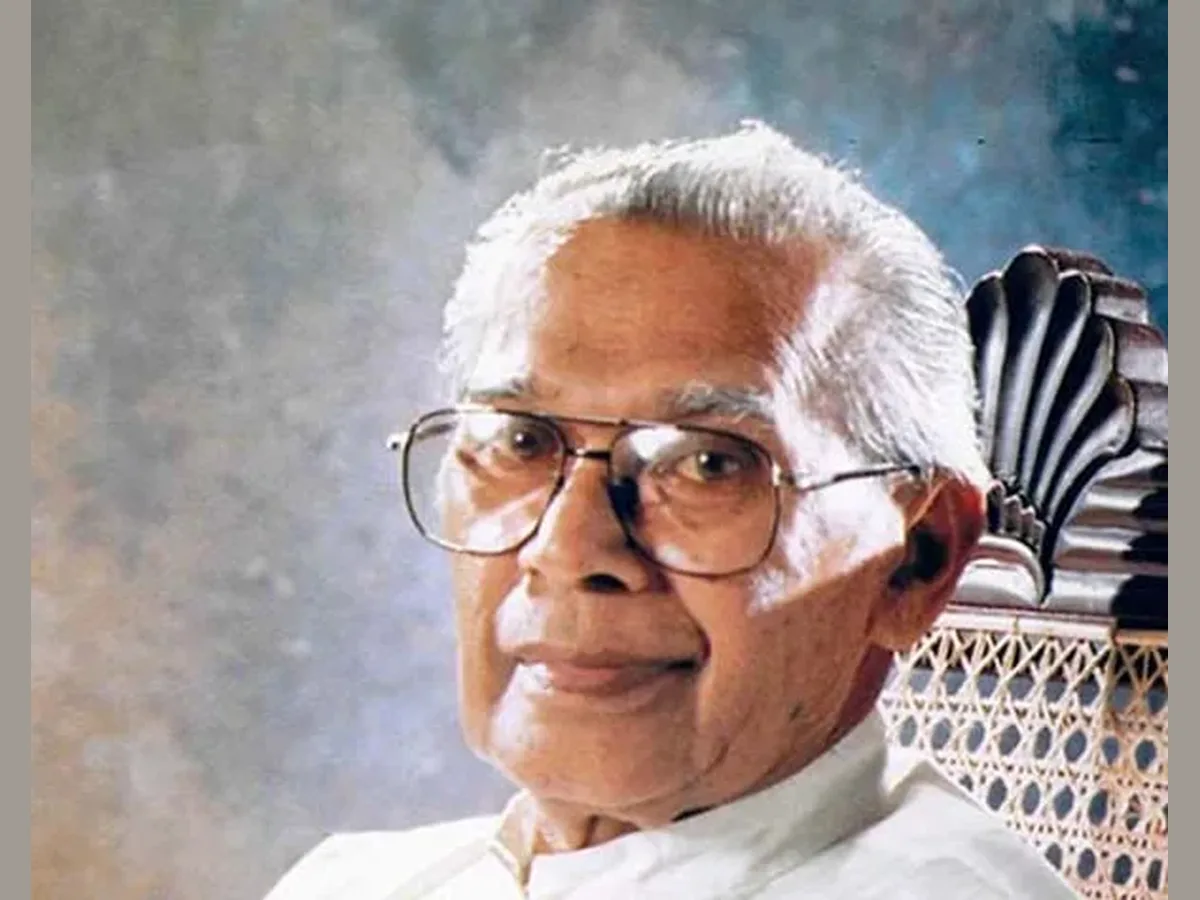
His parents named him Ariyasena Arsuboda. He changed it himself, to Arisen Ahubudu — the same name, stripped of every syllable that had come into Sinhala from Sanskrit, rebuilt out of the older, plainer stock of the language. A person who renames himself on a point of grammar is telling you something about what he intends to spend his life on, and Ahubudu spent his on exactly that: getting Sinhala to sound like Sinhala.
Koggala, and a teenager who impressed Kumaratunga
He was born on 18 March 1920 near Koggala on the southern coast — the sources give the place as Mudiyallagahawatta in Malalaga, or simply the village of Malalagama — the second of three children of Devundara Devamanimendra Heronis De Silva and Wathugedara Laisohami.
In 1937, at seventeen, he took his first teaching post at Piyadigama Saripuththa College in Ahangama. By then he was already writing poetry good enough to be noticed by the one man in Ceylon whose notice he would have wanted: Kumaratunga Munidasa, who conferred on him the title Subas Pathin Kiwithi.
What the Hela Havula was arguing about
To understand Ahubudu's lyrics you have to understand the movement he came out of, because his diction is not a stylistic quirk — it is a position.
Kumaratunga Munidasa was a grammarian and poet who held that written Sinhala had been buried under centuries of borrowed Sanskrit and Pali vocabulary, and that its real grammar and metre were to be found in the Sinhala literature written between the twelfth and seventeenth centuries — the register scholars call Elu. In 1941 he founded the Hela Havula, the Pure Sinhala Fraternity, to promote the language and reform its modern grammar along those lines. Its slogan was basa, jathiya, rata — language, nation, country. Kumaratunga died in 1944, but the argument outlived him.
The musical consequences were immediate and large. Elu prosody gave Sinhala songwriting a metre that was native rather than imported from Hindi film song. Sunil Santha's 1946 breakthrough Olu Pipila is unthinkable without it — he pronounced Sinhala words as Sinhala rather than as Hindi, and moved plainly from note to note instead of using the ornaments an India-trained singer would have used. Kumaratunga's closest colleague, Rapiyel Tennakoon, produced in Vavuluva a satire that also became a landmark poem-to-song crossover. Ahubudu was the movement's most prolific lyricist, and by the end of his life its last major surviving voice.
Forty-two years in a classroom
He was a schoolmaster first and a poet second, or perhaps both at once. He taught for forty-two years — beginning at Holy Trinity College in Nuwara Eliya, then Mahinda College in Galle, then Maha Bodhi College in Maradana, with short spells in the Katugastota area. His longest posting was at S. Thomas' College, Mount Lavinia, where he taught for twenty-nine years from 1952 until 1979, recruited by Warden R. S. de Saram as part of a deliberate post-independence effort to give Sinhala teaching in the elite schools the seriousness it had never had. He also wrote the school song for Royal College, Panadura.
In 1947, while teaching, he began publishing a children's magazine called Ediya — "power" — with the motto that it existed to improve the powers of children. From 1946 he wrote plays, among them Wanaraja Kumariya, Hela Hethiriya, Sakvithi Ravana and Lokanthaya saha Geta, and later a radio opera, Mangala Kinkini.
Gilem Obe Guna, and the rest
His best-known lyric is ගිලෙම් ඔබේ ගුණ මූදේ Gilem Obe Guna Mude — "let me sink in the ocean of your virtue" — set and sung by W. D. Amaradeva. It is a devotional text in which the language does most of the work: short, hard, native words, no Sanskrit cushioning, and a metre that lets the melody move rather than fight it.
The other titles a Sri Lankan is likely to know from childhood are කටේ කිරි සුවඳ Kate Kiri Suwanda ("the smell of milk still in the mouth") and ලංකා ලංකා පෙම්බර ලංකා Lanka Lanka Pembara Lanka ("Lanka, Lanka, beloved Lanka") — the second of which has been sung by generations of schoolchildren at morning assembly. Also his: පුන්සඳ එළියයි Punsanda Eliyayi ("the full moon is bright"), දකුණ නැගෙනහිර Dakuna Nagenahira ("south and east"), වළාකුලින් බැස Walakulin Basa ("descending from the clouds"), සෙංකඩගලපුර දළදා බුදුරැස් Senkadagalapura Dalada Budu Res on the Tooth Relic at Kandy, ලොව් තුරු පෙම් Lowu Thuru Pem, and අතු අගැ දිළි වන මල් Athu Aga Dili Wana Mal ("the wildflowers shining at the tips of the branches"), a title he used both for a song and for a poetry collection. Others frequently attributed to him include Rena Gira Rena Ambe, Pruthugeese Kaaraya, Sudata Sude Walakulai, Rejina Mamai Ape Rajje and Ko Hathuro.
Dictionaries, awards, and one belief best left flagged
After leaving S. Thomas' in 1979 he moved to the Sinhala Dictionary Office as an editor, where he served five years, and edited the Sinhala edition of the Mahavamsa. In 1985 he was appointed Presidential Language Consultant, and in 1989 he represented Sri Lanka at an Asian poets' conference in Bangladesh.
The awards came steadily: a State Literary Award in 1962 for Pareviya Sama Asna; a best-poetry award in 1969 for Rasa Dahara; a Sarasaviya award for the best film lyric, for a song from the film Hadaya; a second State Literary Award for the collection Athu Aga Dili Wana Mal; the state title of Kalasuri; the Kiwisuru title from Hela Urumaya in 1985; and the Hela Bas Mini award in 1990. Sources disagree on some of the dates — the Sarasaviya lyric award is given as both 1979 and 1980, and the second literary award as both 1984 and 1987 — so this article names the works rather than pinning years to them.
One further thing should be said plainly, because it is part of the record and because his admirers sometimes leave it out. Ahubudu held and argued publicly for the view that the Sinhalese descend from King Ravana rather than from Vijaya. It is not a fringe position within the Hela tradition, which was always as much a theory of national origins as a theory of grammar, but it is not supported by the genetic, linguistic or historical evidence, and it should be read as part of his politics rather than as a finding.
He died on 26 May 2011, aged ninety-one, the last of the Hela Havula's major figures. His centenary in 2021 was marked with a competition for schoolchildren, reprints of his research, a felicitation volume, and an animated production of Mangala Kinkini — which is, for a man who spent forty-two years in front of a class, about the right kind of memorial.