
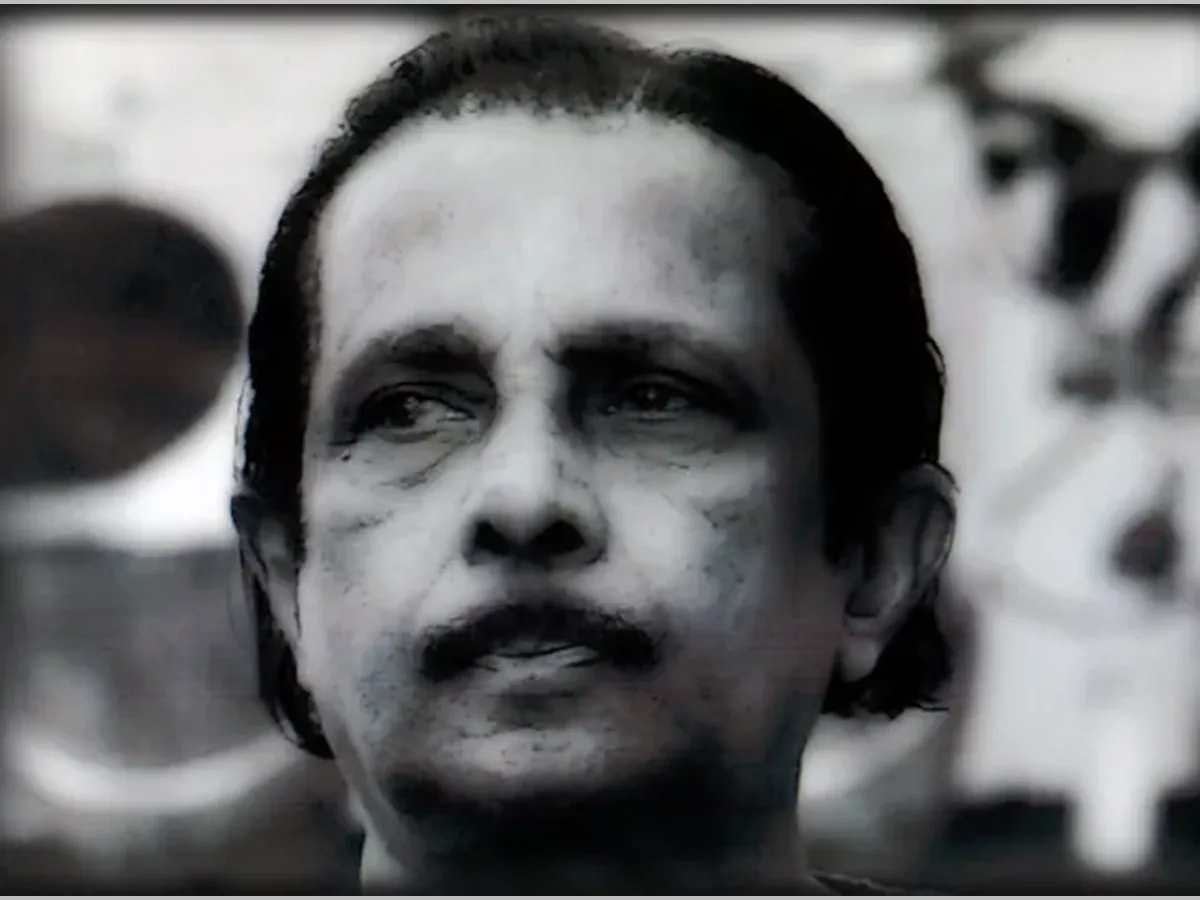
On a Thursday evening in March 2010, at the Elphinstone Hall in Maradana, an audience sat down to hear a bamboo flute play the raga Jog and then Mishra Khamaj. After that came something stranger: bhatiyali, the long, drifting boatmen's songs of the rivers of Bengal, more than a thousand miles from the hall they were being played in. The flautist was seventy-six years old. He had first heard those songs as a student in Bengal fifty-five years earlier, and he had spent most of his adult life persuading Sri Lankans that this music belonged to them too.
Siril who became Anil
He was born Siril Mihiripenna on 10 August 1933. The published accounts of his life are unusually detailed about his concerts and unusually silent about his childhood — they do not record the village he came from or the school he attended, and this article will not invent them.
What is documented begins in 1955, when he entered Visva-Bharati University at Santiniketan in West Bengal — the school Rabindranath Tagore had founded, and by then the single most important destination for Sinhalese musicians who wanted a formal training the island could not yet give them. Ananda Samarakoon had gone there in 1936. Amaradeva's generation went to Bhatkhande in Lucknow. Mihiripenna went to Bengal, and stayed four years.
Two degrees, and an instrument nobody else played
At Santiniketan he studied under three teachers: Ashish Chandra Banerjee for the esraj, Pandit Gour Goswami for the flute, and Pandit Jamini Kanta Chakravarty for voice. He graduated in 1959 as the first Sri Lankan to hold degrees in both the flute and the esraj.
The flute needs no introduction; the esraj does. It is a bowed instrument of eastern India, built with a long fretted neck like a sitar and a small skin-covered belly like a sarangi, and under the four playing strings run a dozen or more sympathetic strings that are never touched but hum along on their own. It has a thin, mournful, almost vocal tone, and in Bengal it is the instrument most closely bound to rabindrasangit, Tagore's own songs. Almost nobody in Sri Lanka played it. For the next half-century, if a Sri Lankan heard an esraj, it was very likely Mihiripenna playing it — on the radio, in a ballet pit, or in a school hall.
Building an audience from a classroom
He came home into the education system rather than the concert circuit. Sources place his first appointment as a music teacher in the Department of Education in 1959 or 1960 — his own published chronology gives both years, one line apart. In 1960 he passed the audition that graded him a super-grade artist on flute and esraj at the national broadcaster, the highest rung of a system that decided who could be heard on the air at all.
From 1961 he ran a concert series at the Lionel Wendt called Abhiranga, and from 1964 a programme aimed specifically at listeners who wanted to follow the ragas rather than simply enjoy them. He was appointed a lecturer at the Government College of Music in 1969, a visiting lecturer at the University of Kelaniya in 1972, and a lecturer at the Institute of Aesthetic Studies in 1974. In 1967 he assembled what he described as the first oriental hevisi band at Ananda College, Colombo — a school ensemble built on the drums and horns of temple processional music rather than on brass-band instrumentation — and formed a second at St. Lawrence's Convent in 1973.
Alongside all this he ran his own institution, the Sharadha Kala Nikethanaya, whose students provided the orchestral half of most of his later concerts, including that evening at the Elphinstone Hall.
Ballets, films and a peacock in Nebraska
Composition took him where solo recitals could not. From 1960 he wrote scores for ballet after ballet: Ranketiputha (1960), Chandalika (1962), Sebaliya (1970), Omarilatha (1975), Bilipuja (1976), Mother (1977) and, in 1983, both a piece for a visiting French ballet master and a setting of සැළලිහිණි සන්දේශය Selalihini Sandesaya — the fifteenth-century Sinhala message-poem in which a starling is sent flying across the kingdom carrying a plea. His score for the 1994 ballet Apeksha was judged the year's best.
He also wrote for documentary and feature film, including a 1984 Mahaweli film for the American Embassy and Paradise in Tears for the German Embassy in 1992, and between 1985 and 1987 he composed and directed a combined orchestra for the Sri Lanka Broadcasting Corporation, along with its opening and closing themes.
His most-travelled composition was a piece called Peacock Dance, performed by the Nebraska Symphony Orchestra and later by the Colombo Symphony Orchestra. The dates around his American tour do not line up cleanly: his published chronology places the invitation from four Nebraska-area universities in 1997, but cites a Lincoln, Nebraska newspaper page from February 1977 and dates the Nebraska Symphony's performance to 1978. The 1970s reading is the more likely one, and this is exactly the kind of small discrepancy a reader should know about rather than have smoothed over. He also performed at Indira Kala Sangeet University in Madhya Pradesh, at Banaras Hindu University, at Delhi University, at Bhatkhande's seventy-fifth anniversary festival in Lucknow, and at an international arts festival in Hong Kong and Taiwan in 1987.
What he wrote down
Performers rarely leave textbooks. Mihiripenna left several, and they are the most durable part of his work: a collection of gat — the fixed instrumental compositions around which a North Indian performance is improvised — as well as Diffusion of Indian Music in Sri Lanka (2009), Instruments of the East and the West, Elements of Hindustani Music and the Sinhala volume Vadya Sankalana. Two CDs, Sangeeth Bhavana and Saratha Sankalana, survive him.
Anil Mihiripenna died on 10 June 2017, aged eighty-three. He never had a hit song, and his name is missing from most popular histories of Sinhala music. But a great deal of what those histories describe — the raga-based melodies of the art-song tradition, the orchestral colour behind a film score, the sound of a bowed string floating under a Sinhala lyric — came into the island through people like him, one classroom and one recital at a time.