
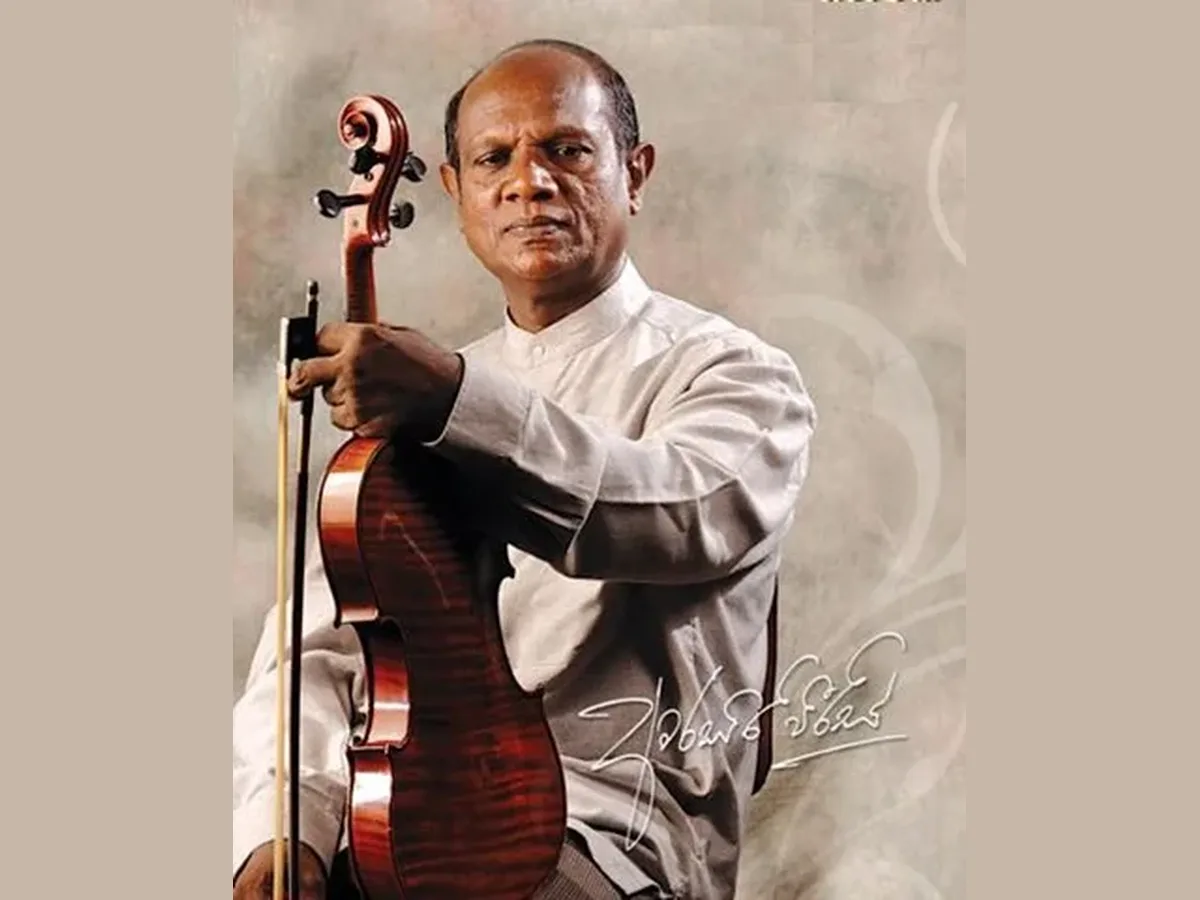
A cassette was being cut at Premasiri Khemadasa's Sangeetha Manjariya in Maradana, and the singer booked for one of the songs had not turned up. Khemadasa looked round the room. Sitting among the players was a young violinist from the Broadcasting Corporation who had been coming to the studio for years, carrying his instrument and saying very little. Khemadasa asked him to sing it.
The song was ලඳුනේ Landune, and it was approved on the first take. "It was special to me," Amarasiri Peiris said many years later, "because I was the violinist for the recording of it as well." That accident, somewhere in the 1970s, turned an orchestral musician into one of the most recognisable voices in Sinhala song.
A house full of instruments
He was born on 21 July 1946 in Boralesgamuwa, the eldest child of Albert Peiris and M. K. Asilin, and he grew up inside the sound world of early Sri Lankan radio. His father was a classical artiste at Radio Ceylon in the 1940s and, by family account, the first pupil of the master musician H. W. Rupasinghe. Albert Peiris played several instruments; the one that took hold of his son was the violin.
"I used to accompany him to Radio Ceylon at that time," Peiris recalled, "and watch recordings, violin solos and other musicals." Music was not a subject he studied so much as a household routine he absorbed. When he reached his Advanced Level year at Buwanekaba Vidyalaya in Maharagama he chose to sit music as a subject — despite, as he cheerfully pointed out, the school having no music teacher at all. He got through the subject on what his father had given him at home, and in 1962 entered the Heywood Institute of Art, the college that is now the University of the Visual and Performing Arts. He later studied violin under Douglas Ferdinands.
There is a smaller detail he liked to tell about himself. As a boy, under the influence of an uncle, Piyasoma Nanayakkara, what he actually wanted to be was a train driver.
Grade A, and then the whole department
Leaving Heywood, he was taken on by the Sri Lanka Broadcasting Corporation as an A-grade violinist. In the era he entered, that letter mattered enormously: a panel of music directors and lyricists graded every artist, auditions and re-auditions were held to police the standard, and a grading decided whether your playing reached the national airwaves at all. He was matter-of-fact about it — "Joining SLBC was considered a milestone in the life of any artiste of that era."
He stayed at the Corporation for the rest of his working life and rose through it: music conductor, then music controller, and finally Director of Music, the post he held at retirement. Very few Sinhala singers of his generation spent their careers on the institutional side of the microphone as well as in front of it, and it shows in how he talks about song — as something that is programmed, graded and broadcast, not simply performed.
The first song he ever sang into an SLBC microphone was not a love song at all but Budu Sihila Galala, a devotional bhakti gee composed by Sena Weerasekera.
Khemadasa's orchestra
The relationship that made him a singer began at Heywood and ran through Khemadasa's Sangeetha Manjariya. Peiris played violin on Khemadasa's sessions — including the Pahan Tharuwa cassette on which the Landune accident happened — and became a permanent member of the maestro's orchestras. Through them he met Douglas Ferdinands, Eardley Fonseka, Harvey Deutrom and the American musician Roscoe Williams during Williams's stay on the island.
Accounts, including Peiris's own, credit Landune to Ranbanda Seneviratne. After it became a hit, film directors began asking for him. He sang playback for Siri Medura, which brought him his first Sarasaviya award, for Minisa Marana Thunak Ethi, and went on to work on Guru Gedera, Awaragira, Kawuluwa and Samanala Sandhawaniya.
His concert repertoire, though, is built on radio and cassette songs rather than film. හන්තානට පායන සඳ Hanthanata Payana Sanda — the moon that rises over Hanthana — became the title of his stage show and the song most people name first. Alongside it sit ඔබ ඇපල් මලක් වාගේ Oba Apple Malak Wage, මගේ පුංචි රෝස මලේ Mage Punchi Rosa Male, සඳුද අවදියෙන් Sanduda Awadiyen, ස්නේහයේ නගරයයි Snehaye Nagarayai and නෙක උයන් වතු මැදින් Neka Uyan Wathu Madin. He also sang for Khemadasa directly on songs including මිනිසා Minisa, to words by Lucien Bulathsinghala, and වලා අතුල සිරි යහනේ Wala Athula Siri Yahane.
Look at who wrote for him and you get a map of Sinhala lyric writing across half a century: Lucien Bulathsinghala, Priyananda Wijesundara, Nilar N. Cassim, Kapila Kumara Kalinga, Sunil Sarath Perera, and later a generation of younger writers such as Kelum Srimal and Nisanga Mayadunne.
Still working
In 2011 he released a CD, Ganga Gala Yaa Den. In 2014 he announced a solo concert built round Hanthanata Payana Sanda at the Musaeus College auditorium in Colombo, with Rohana Weerasinghe leading the backing orchestra; sources differ slightly on the date, since the show was first advertised for 18 May and then rescheduled to 22 June, with the original tickets honoured. In February 2017 he took a concert called Unmada Sanda to Swarnapali Balika Vidyalaya in Anuradhapura. In 2024 he recorded අපේ පොඩි හාමුදුරුවෝ Ape Podi Hamuduruwo, written by Bandara Eheliyagoda and composed by Rohana Weerasinghe, after the death of the Venerable Galboda Gnanissara Thero of Gangaramaya.
Asked in 2014 what an artist actually is, he gave an answer that reads like a rebuke to the industry he had spent his life inside: "Just because you sing a few songs or play an instrument or appear in a film or two, you cannot become an artiste. The role of an artiste is a much more broad and hallowed one." Mastering an art, he added, will not by itself elevate anyone; it has to be complemented by "several other ingredients of humanity."
It is the sort of thing a man says when he has spent forty years watching people be graded.