
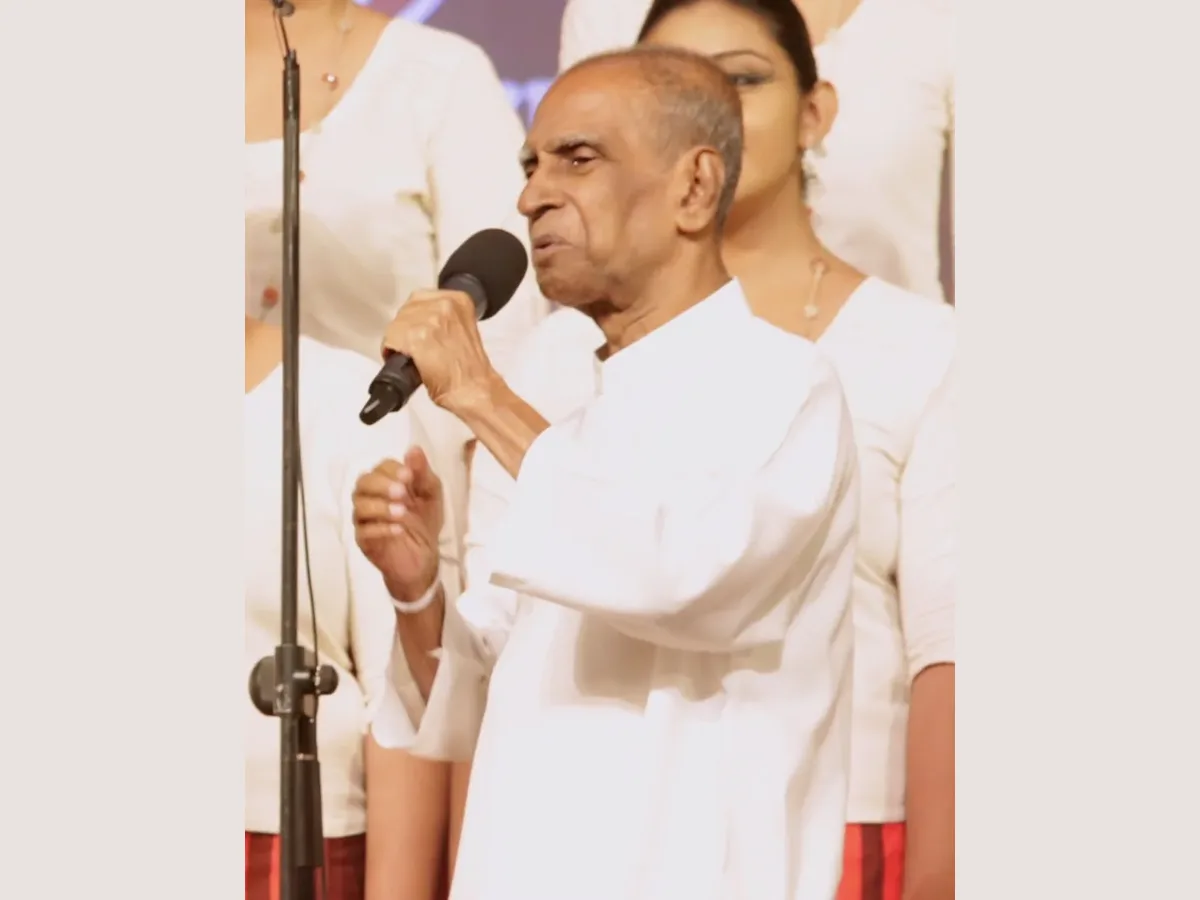
His father made violins. Not as an artist — as a carpenter at the Moratumulla carpentry school in Koralawella, where instruments came in broken and went out mended. The youngest boy of the house would pick one up and scrape at the strings while his mother sang hymns in the next room, and on his seventh birthday his father gave him a violin of his own: a tin one, made in Japan. That is where the music of Wannakuwatta Waduge Don Albert Perera begins — in a workshop, with a toy.
Eight decades later the same man would lie in state in the Independence Memorial Hall in Colombo, the first person in Sri Lanka's history to be given that honour. In between, he had done something no committee or ministry managed to do by decree: he had invented a sound that an entire country recognised as itself.
The boy from Koralawella
He was born on 5 December 1927 in Koralawella, Moratuwa, the youngest child of the carpenter Don Ginoris Perera and Maggie Weslina Mendis. The house was religiously mixed — a Buddhist father and a Christian mother — so both the temple chant and the church hymn were ordinary household sounds. He learned his first letters from a monk at the Koralawella temple, was asked to chant verse there, and ended up leading the village choir.
School noticed him next. A music teacher named W. J. Fernando, newly transferred from Kalutara, took him in hand; the boy won every school singing competition going, and in 1945 took a gold medal at a singing and violin contest run by the Jana Kala Mandalaya. Scholarships followed, and with them a move to Sri Sumangala College, Panadura, where the principal Danister Thomas Fernando — W. J. Fernando's elder brother — became a lifelong ally.
D. T. Fernando also gave him one of the best stories in Sinhala music. As Fernando told it, the two once met by chance on a bus running from Kalutara to Colombo. Amaradeva asked him for a lyric. Fernando began writing there and then, in the moving bus, and produced "Peenamuko Kaluganga" (පීනමුකෝ කළුගඟේ, "Let us swim, Kalu Ganga") — but could not finish reciting the last part, because his passenger had to get off at Bambalapitiya.
Ashokamala, Lucknow, and a new name
The film Ashokamala was shooting nearby when Gerard J. Pieris introduced the teenager to its music director, Mohamed Ghouse. Ghouse made him lead violinist of the orchestra and took him to India for the recording, where he also sang, danced and acted in the song "Ayi Yameku Kale Ale" (ඇයි යමෙකු කලේ ආලේ).
He was poor for years. Sunil Santha, then the most successful recording artist in the country, handed him two of his own music classes at Panadura so he could earn, and helped raise the money that sent him to India to study properly. At the Bhatkhande Music Institute in Lucknow he trained under the violinist Vishnu Govind Jog and came home with Visharad qualifications in both violin and voice.
He also came home with a different name. The playwright and scholar Ediriweera Sarachchandra gave it to him: Amaradeva, the deathless one.
The lecture that set the brief
In 1949, and again in April 1952, Radio Ceylon brought over S. N. Ratanjankar, principal of the Bhatkhande college in Lucknow, to audition and grade Sinhalese musicians. While he was in Colombo Ratanjankar gave a lecture at the Royal Asiatic Society titled "The Place of Folk Songs in the Development of Music", in which he told his hosts bluntly where their national music actually was: "The proper DESHI SANGEET of Lanka is in its villages. The Vannams, Astakas, the Sivupadas, the Stotras, the Pirits."
Two men took that as a work order. One was the lyricist and radio producer Madawala S. Ratnayake; the other was Amaradeva. Ratnayake had already tried a folk-based programme, Jana Gayana, and been beaten back by a hostile press; he restarted it with Amaradeva's help in 1957, and this time it was praised. Their song "Ran Van Karal Saleyi" ("The golden paddy sways") was built on the ten-beat tanama rhythm of the Turanga Vannama, an old Kandyan court song about Prince Siddhartha's horse — the rhythm kept, the meaning changed to a village at harvest. Amaradeva put an udakki folk drum in the orchestration and had it sung by a group of voices, so that listeners would hear villagers rather than soloists.
To find out what village music actually was, he had gone to the people who held it: the Kandyan dance masters Panibharatha, Kiriganitha, Gunamala, Ukkuva and Suramba. Their forms, he noticed, revolved around a single melodic line. He added verses leading into a returning central melody — a two-part shape that Sinhala traditional music had not used — and in doing so built the frame that the sarala gee ("light song") generation would work inside for the next fifty years.
Madhuvanti
In 1960 Amaradeva took up the post of conductor of Radio Ceylon's Sinhala Music Orchestra. That same year the poet Mahagama Sekera came to the station as a songwriter, and the two launched a radio programme called Madhuvanti, after a North Indian raga — a name that announced the ambition, which was art song.
Sekera rewrote his own poems into singable texts; Amaradeva set them, folding raga into folk melody, and sang them himself. The results are still the core of the Sinhala songbook: "Gi Potayi Mi Vitayi" (ගී පොතයි මී විතයි, "A book of verse, a flask of wine"), a Sri Lankan answer to the Rubaiyat; "Oba Ma Turule" ("You in my embrace"); "Ihala Vele" ("In the upper fields"), which reuses the metre of kamat kavi, the threshing-floor verses farmers sang over the grain. Their partnership ran on beyond the programme — "Sannaliyane" (සන්නාලියනේ), "Ratna Deepa Janma Bhoomi" (රත්න දීප ජන්ම භූමි), and the Lionel Algama settings of Sekera's lyrics that Amaradeva sang, including "Sandakath Pini Diya" (සඳකත් පිණිදිය) and "Etha Kandukara Himaw Arane".
He was never a purist about it. He experimented with Western harmony and counter-harmony, with South Indian and Tamil forms, and in "Ran Dahadiya Bindu Bindu" he reached for the baila of his own coastal home town. He built himself an instrument, the mando-harp, out of a mandolin and a harp. How many songs he recorded in all is a question no two sources answer the same way, and the honest reply is that nobody has counted them properly.
Film, honours, and the long afternoon
He made his debut as a film music director on Ran Muthu Duwa in 1962 and went on to score Gamperaliya, Ran Salu, Delovak Athara, Thun Man Handiya and others, as well as ballets including Chitrasena's Karadiya and Nala Damayanthi. In 1972 he composed the music for Gaumee Salaam, the national anthem of the Maldives, at that government's request.
The recognitions arrived steadily: Kala Keerthi in 1986, Deshamanya in 1998, the Philippines' Ramon Magsaysay Award in 2001, India's Padma Shri in 2002, France's Ordre des Arts et des Lettres in 2003, and — posthumously, in 2017 — Sri Lankabhimanya, the country's highest honour. Three universities gave him honorary doctorates, and he served as Chancellor of the University of the Visual and Performing Arts.
Amaradeva died on 3 November 2016 at the age of 88, of heart failure, at Sri Jayewardenepura Hospital. The government declared a week of national mourning and held a state funeral. Singers as different as Victor Ratnayake, Sunil Edirisinghe and T. M. Jayaratne have described his work as the ground they stand on; the film-maker Lester James Peries called his voice the greatest musical instrument. What he actually built, though, was smaller and harder than a voice: a way of putting a Sinhala sentence to a melody so that neither one had to give ground.