
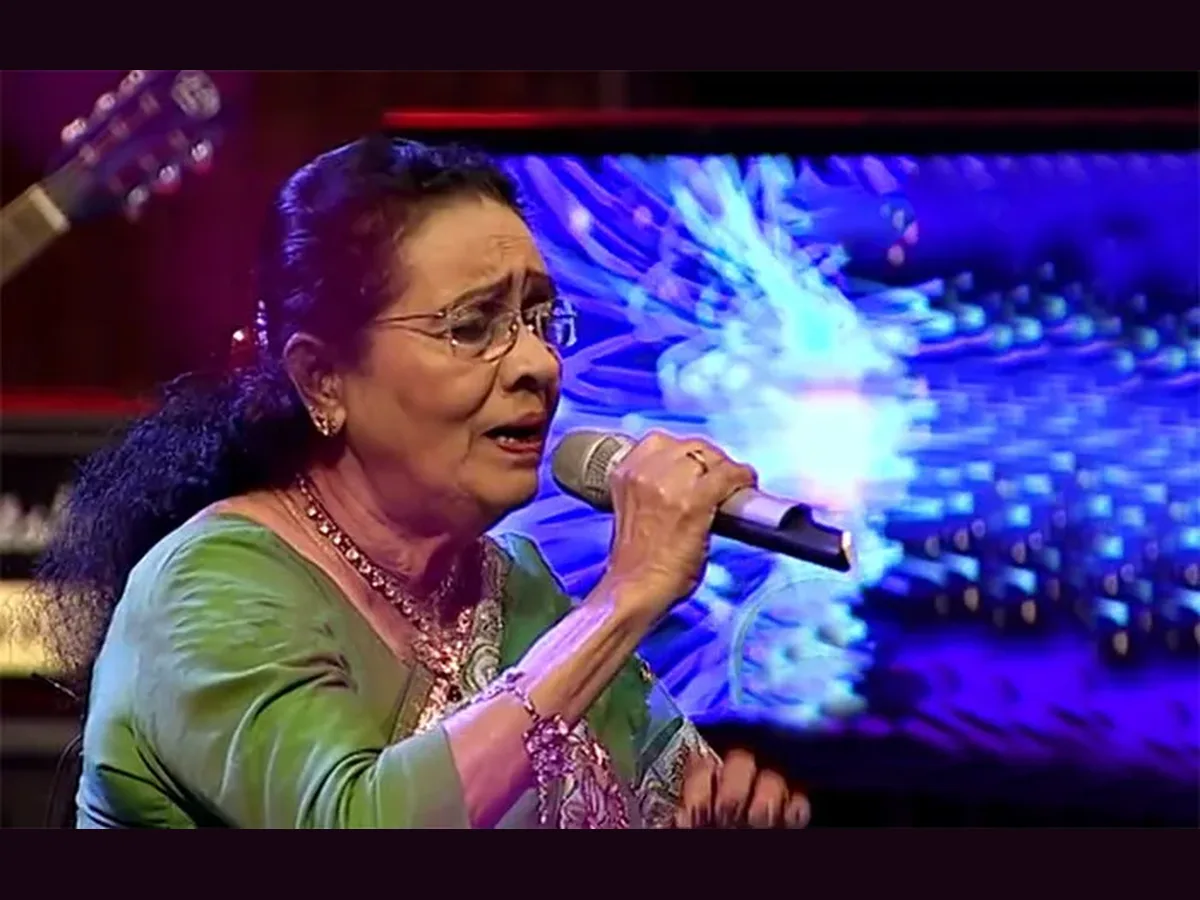
In 1952 the Heywood — the Government College of Fine Arts in Colombo, the institution that trained nearly everyone who mattered in twentieth-century Sinhala music — enrolled its first female student in classical music. She was twelve years old, she came from Batuwatta in Gampaha, and her name was Dona Amara Kasthuriarachchi. The first male student, enrolled at the same age, was a boy from Nawala named Dayarathna Ranatunga. They finished the six-year course together, were posted as teachers at eighteen — she to Meegoda Central College, he to Richmond College in Galle — married in 1964, and spent the next fifty-four years as the most consequential husband-and-wife partnership in Sri Lankan music.
She is remembered as Amara Ranatunga, and a Sinhala tribute after her death called her the unbroken bridge between the art song and classical music. It is an accurate description of an unusual career: almost nobody else in Sri Lanka was simultaneously a Hindustani-trained concert vocalist and a working academic music director.
A child on the radio
She was born on 22 August 1939, the fifth of eleven children. Her father, Don Wiyolis Kasthuriarachchi, was headmaster of the Hanwella Primary School; her mother, Dona Alpinona Meegahapola, was from Mathugama. She went to her father's school and then to Hanwella Rajasinghe Central College, played netball, and studied ballet under the dancer Wasantha Kumara.
Her first song is given as Yamuna Yamuna Sobana Yamuna, recorded at eight or ten depending on which account you read. What is better attested is that in 1948-49 she was a performer on the Radio Ceylon children's programme Lama Uyana, run by Ananda Sarath Wimalaweera; that she sang in a radio play called Keppetipola to music by Lionel Edirisinghe, the founding figure of the Heywood; that she sang a lullaby under the scholar B. S. Wijeratne, who would later be her teacher; and that in 1950 she acted in Wasantha Kumara's play Sanda Kinduru. She was on national radio before she was in secondary school.
Bhatkhande and Banaras
In 1961 she went to India, to the Bhatkhande Music Institute in Lucknow — the school built on Vishnu Narayan Bhatkhande's systematisation of Hindustani music, and the standard destination for serious Sri Lankan musicians of that generation. She returned in 1964 and, on 1 February, took up a lectureship at the Government College of Music. She later graduated from Banaras Hindu University as well, and studied two distinct North Indian vocal disciplines at a high level: dhrupad, the austere older form, under Professor Ritwik Sanyal, and khyal under Dr. Chitta Ranjan Jyothish.
This is the part of her life that separates her from almost every other woman singing in Sinhala at the time. Her contemporaries were making records; she was doing that, and also acquiring the technical apparatus to teach, examine and compose within a classical system.
Songs
Her first duet was with her husband: මහ රෑ යාමේ Maha Ra Yame ("in the deep watch of the night"), which remains the record most associated with the pair and which gave its name to a felicitation concert held for them at the BMICH in 2007. Under his musical direction she recorded සැලලිහිණියෝ Salalihiniyo ("the mynah birds"), to words by the lyricist Ajantha Ranasinghe — a good example of what her voice was for, a light classical melody sung with the diction of a trained recitalist. Others regularly named are Eye Ra Oba Sihinen, Radha Krishna and Amara Devi. Their son Pulasthi sang Senpathiyan Gena Nawpathiyan Gena with her when he was eight.
For her doctoral work she composed her own classical settings for thirty-four Hindi lyrics and ten Sinhala songs — which is to say that her research output was itself music. In 2008 the Vijitha Trade Centre released an album, Udumbara, that brought three generations of the family together.
Professor
Amara Ranatunga's academic career ran in parallel the whole way. She taught school for many years, lectured at the Government College of Music, headed the Department of Aesthetics at the University of Kelaniya, and served as Dean of the Faculty of Music at Kelaniya's Institute of Aesthetic Studies. When that institute became the University of the Visual and Performing Arts she continued there as professor and head of department. She was promoted to professor in 1995 and, from 1997 to 2001, she and her husband lectured on North Indian classical music in an ethnomusicology department at a university in California. The Indian government honoured them jointly with the title Bharatha Mithra; the year given for it in Sri Lankan sources does not square with the anniversary those sources attach to it, so it is left undated here. She also served as Director of the Sri Lanka Performing Rights Society.
She is very widely described as the first Professor of Music in Sri Lanka. That description comes from Sri Lankan press obituaries rather than from any university register, and Ada Derana's version of it is narrower — the first Sri Lankan professor of Hindustani classical music at the University of the Visual and Performing Arts. The narrower claim is the safer one to repeat.
She wrote books too, among them Amara Geetha, Sarasa Sambhava, Saundarya Avabodhaya and Sambhavya Sangeethaya.
A family and an institution
The Ranatunga household was in effect a small institution of its own. Dayarathna joined the Sri Lanka Broadcasting Corporation in 1969 as the first producer in its Music Unit and became Controller of Sinhala Music in 1978, which put him in charge of what the country heard. His sister Somalatha Ranatunga was a singer; his maternal uncle D. M. Kolambage was Radio Ceylon's first Sinhala announcer. Their eldest son married into another musical family, the Abeysekaras, granddaughters of the singer Wasantha Sandanayake. Three children — Nanditha Sarada, Pulasthi Indika and Kumudumathie Rupashika.
Amara Ranatunga died in a Colombo hospital on 16 October 2018, aged seventy-nine, after a heart attack. Her remains lay at the University of the Visual and Performing Arts before the funeral at Borella General Cemetery on 18 October.
Why she matters
The standard account of twentieth-century Sinhala music is a story about men: Ananda Samarakoon, Sunil Santha, Amaradeva, Khemadasa. Women appear in it as voices — as the singers of other people's compositions. Amara Ranatunga does not fit that shape. She sang, she composed, she took a doctorate whose deliverable was forty-four original classical settings, she ran academic departments that decided what the next generation of musicians would be taught, and she sat on the body that administered performing rights. The bridge metaphor in her obituary was about repertoire, art song on one side and classical music on the other. It works just as well for the two things Sri Lankan music usually keeps apart: the stage and the syllabus.