
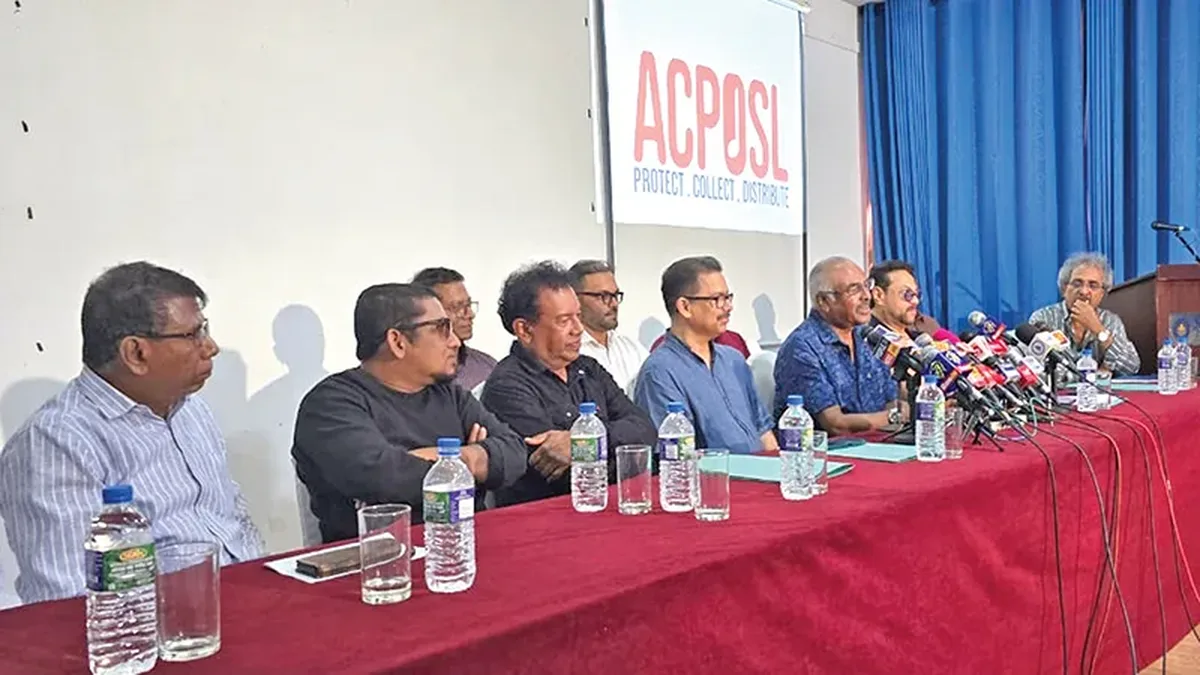
On a Thursday in August 2025, at the Sri Lanka Foundation Institute in Colombo, a group of elderly men sat down in front of the press to ask a question that ought to have been settled a century ago: when a song is played, who gets paid?
They were the Authors, Composers and Publishers Organization of Sri Lanka — ACPOSL — the country's only officially recognised collective management organisation for musical works, registered under the Intellectual Property Act No. 36 of 2003 and operating under the National Intellectual Property Office. Its chairman is the lyricist Nilar N. Cassim. Beside him sat the composer Ranga Dassanayaka, the lyricist Bandula Nanayakkarawasam, the composer Sarath De Alwis and the musician Darshana Ruwan Dissanayake.
The claim they put on the table, as reported by the Sunday Observer, was arithmetic. Some singers are paid over five hundred thousand rupees to perform a handful of songs at the Nelum Pokuna theatre. The people who wrote and composed those songs can walk away with ten thousand. For overseas shows a singer may charge between five and ten thousand US dollars, and the lyricist and composer receive no share of it at all.
"Most songwriters and composers today are elderly and living with financial difficulties," Cassim said. "They do not beg for anything. All they ask is that their work is given its due value."
Who owns a song
The legal position is not in doubt anywhere in the world, and it is not really in doubt in Sri Lanka either.
Under the Berne Convention of 1886, to which Sri Lanka is a party, copyright in a musical work belongs to its creators — the lyricist and the composer. Performers have a separate and narrower set of rights, usually called neighbouring rights: the right to perform, to charge a fee, and to control recordings of their performance. The distinction runs through the American Copyright Act of 1976, the European Union's 2001 Copyright Directive and India's Copyright Act of 1957, which keeps ownership with composers and lyricists even after a song is recorded.
Sri Lanka's Intellectual Property Act No. 36 of 2003 says the same thing, and gives it teeth. Performing or broadcasting a song without paying royalties is an infringement; offenders can face fines up to five hundred thousand rupees, up to six months' imprisonment, or both, particularly for a repeat offence.
What is disputed is not the law but the practice — and, increasingly, the temperature of the argument. The Sunday Observer article that reported the press conference was written squarely from the creators' side, and quotes composers recalling that "star singers" who once came to their doors with folded hands now claim ownership of what they never wrote. One singer, the paper says, publicly declared that once a songwriter and a composer are paid, "that business is over."
Sri Lanka now has a second recognised body. OSCA, the Outstanding Song Creators' Association, emerged in recent years to represent singers and performers; ACPOSL represents songwriters, composers and publishers. The two have disagreed, sometimes publicly. Both are recognised by the National Intellectual Property Office.
There is also a serious academic case on the other side of the ledger. Chamila Talagala's Performers' Rights in Sri Lanka: Singers' Melancholia (Springer, 2019) — the only book-length study of the subject — argues that the internationally derived performers' rights regime "does not seem to reflect the established practices and relationships within Sri Lanka's contemporary music industry", and finds that vocalists' own concerns cluster around two themes: belonging and remuneration. Singers, in other words, do not feel well served by the system either. Whether that justifies a claim on ownership is exactly the question the country has not resolved.
Twenty rupees a play
Underneath the argument about principle is a much duller problem: collection.
A 2020 Gazette Extraordinary empowered ACPOSL to collect from broadcasters at a set tariff — twenty rupees per song played on radio, one hundred rupees per song broadcast on television. Those numbers are the closest thing Sinhala song has to a market price for itself.
The trouble is that almost nothing is collected outside the capital. In practice, Dassanayaka told the press conference, collection is largely limited to music halls and theatres in Colombo, despite the fact that creators' work is used across the whole country every day. Royalties ought to apply to hotels, restaurants, hospitals and other public spaces too, but the legal machinery for that has not been built. ACPOSL has asked the Government to enforce a nationwide framework.
The international side works, at least in theory. "If our songs are played in Australia or England via local radio or TV channels," Dassanayaka said, "the authorised CMOs in those countries must collect royalties and forward them to the ACPOSL for distribution to our composers and lyricists."
Three million dollars that went somewhere else
The most expensive consequence of not having a functioning society is a number.
CISAC — the International Confederation of Societies of Authors and Composers, the umbrella body that links national collecting societies to one another — had at one point collected around three million US dollars in royalties owed to Sri Lankan songwriters for the use of their work abroad. It could not release the money, because Sri Lanka had no recognised society to receive it.
"We now have the ACPOSL," Dassanayaka said, "but because we had not secured CISAC membership at the time, they could not give the royalties to us. They held these funds for two years and distributed them among societies in other countries. Our creators lost that money."
Three million dollars, earned by Sri Lankan songs in other people's countries, paid out to other people's songwriters, because there was no address in Colombo to send it to.
The guitarist who helped write the law
The strangest thing about all of this is that Sri Lankan popular musicians saw it coming, and one of them did something about it.
Clarence Wijewardena — the man who effectively invented Sinhala pop with the Moonstones and the Super Golden Chimes, and who wrote සිහින ලොවක් Sihina Lowak ("a world of dreams") and dozens of songs still on the radio — gave an artist's evidence to the framing of the Code of Intellectual Property Act No. 52 of 1979. It was unglamorous work for a hit songwriter to take on.
It did not save his own catalogue. After his death in 1996 his widow Sheela spent years in unsuccessful litigation trying to establish rights over his songs. The man who helped write the copyright law could not, in the end, get his family paid under it — which is as compact an illustration as this subject offers of the gap between having a statute and having a system.
The statute is being reworked again. Sri Lanka has convened a committee of legal and cultural experts to resolve long-standing ownership and royalty disputes, and Dassanayaka noted that the 2003 Act is being updated to cover issues it never anticipated, artificial intelligence among them.
What we know, and how we know it
The figures, quotations and institutional detail here come from Chamikara Weerasinghe's report of the ACPOSL press conference in the Sunday Observer of 24 August 2025, which is the fullest published account of the dispute; the reform process is from Asia IP Law's summary; the counter-argument is from Chamila Talagala's Performers' Rights in Sri Lanka (Springer, 2019); Clarence Wijewardena's part in the 1979 Act is from his Wikipedia entry and a 2018 Sunday Observer profile.
Two cautions. The Sunday Observer piece is advocacy as much as reporting — it argues the creators' case in strong language, and no singer or representative of OSCA is quoted in it, so the five-hundred-thousand-to-ten-thousand comparison is ACPOSL's characterisation and not an audited finding. And the CISAC episode, though quoted directly from a named ACPOSL director, has not been confirmed against CISAC's own records; the three-million-dollar figure and the two-year holding period rest on that one account. Anyone writing about this further should go to CISAC and to OSCA, both of which have a case to put that this article could not obtain.