
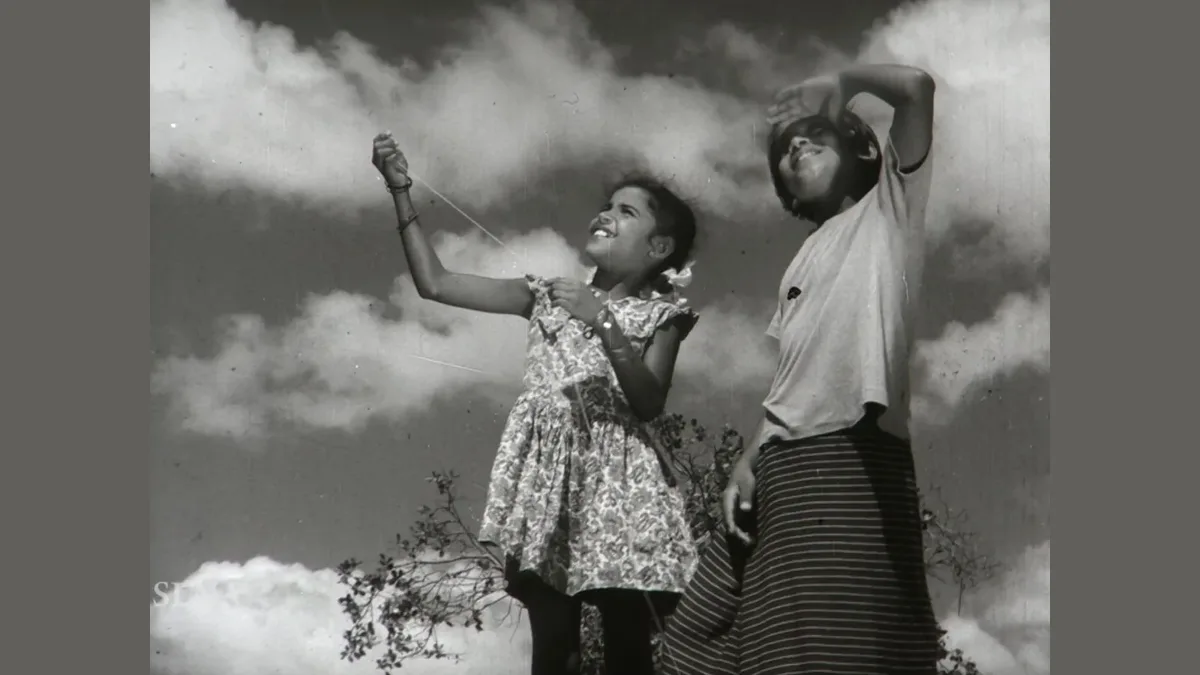
Three men walked out of the Government Film Unit in the mid-1950s to make a feature film outdoors. Everybody they knew thought they had lost their minds. "The whole industry thought three mad men were going to do something impossible," Lester James Peries recalled fifty years later, "by trying to film the whole movie entirely out of doors."
Outdoors was the least of it. It was not just the pictures they meant to record in the open air, but the dialogue — in 1956, with equipment that had to be carried. And they intended to do it in a country whose entire film industry to that point had been conducted in studios in Madurai, Coimbatore and Madras.
රේඛාව Rekava — "line of destiny" — premiered at the Regal Cinema in Colombo on 28 December 1956. It was the first Sinhala film shot entirely in Ceylon. It went to the main competition at Cannes the following year, and it is still the only Sri Lankan film ever nominated for the Palme d’Or. At home it lost money.
What it left out
The film's failure was not incidental to its ambitions. It was caused by them.
By 1956, a Sinhala film had a shape, and audiences knew it as well as the producers did. B. A. W. Jayamanne had specified it a decade earlier: two and a half hours, an hour of dialogue, half an hour of songs, half an hour of silent background, a fifteen-minute interval. Around that skeleton grew the rest of the expected furniture — the boy-meets-girl plot, a fight, a comic interlude, and musical numbers built on Hindi models.
Rekava has none of that. It runs eighty-nine minutes. Its story is about a village boy, Sena, who is told by a travelling stilt-walker and palm reader that he will grow up to be a great healer, and about what happens when the village — and Sena's moneylender father — decide to believe it. A rich landowner brings his sick son. The boy dies. The village turns on Sena and drought follows.
There is no romance to speak of and no comic relief. The songs are few, and they are not Hindi-style numbers. This was not carelessness. Peries had spent his apprenticeship at the Government Film Unit making documentaries, and what he wanted from a Sinhala village was the village, not a set of it.
Audiences, in 1956, wanted the set.
Sunil Santha, four years into exile
For the songs, Peries went to a man the state broadcaster had just finished with.
Sunil Santha's services as a Radio Ceylon recording artist had been terminated in 1952 after he refused to sit the auditions the station required, on the grounds that Hindustani standards were being imposed on Sinhala singers. Between 1952 and 1967 he was largely absent from Sri Lankan musical life — at home, cooking, doing odd jobs, tinkering with engines and radios, which he had loved since boyhood.
Peries, who had a particular affection for him, asked him to compose the music for Rekava. Santha agreed. The lyrics were written by Fr. Marcelline Jayakody, the Catholic priest and poet whose Sinhala verse had already crossed into song. B. S. Perera handled music direction and the background score; the vocals were shared among Latha Walpola, Indrani Wijebandara, Ivor Dennis and Sisira Senaratne.
The song that outlived the film is Senaratne's ඕළු නෙළුම් නෙරිය රඟාලා Olu Nelum Neriya Rangala, still sung, still known, still able to summon a village in a line. It is a strange fate for a song from a picture that emptied cinemas.
Two men, in other words: a director who had walked out of a government film unit, and a composer whom the government radio station had put out. Both were making the case that a Sinhala art form could be built from Sinhala materials, and both were doing it from outside the institutions of Sinhala culture.
Two versions of the same film
There is a detail about Rekava that most accounts skip, and it goes directly to the music.
The film that succeeded abroad was not the film Colombo saw. Speaking in 2006, before a fiftieth-anniversary re-screening at the Regal, Peries distinguished between "the long version of the film, with its songs and sub-plots" and "the short export version, which was an international success first at the Cannes International Film Festival and then England and many European countries." The re-screening used the long one.
So the version that carried Sri Lankan cinema onto the world stage was the version with less music in it, cut for foreign eyes — while the version made for Sri Lankan audiences, with the songs restored, was the one that failed at home for having too few of them. That is a fair emblem of the whole predicament of the 1950s: the local formula was too heavy for export and the export cut too thin for local taste, and nobody had yet worked out how to write a Sinhala film song that was neither.
By 2006 even preserving the long version was difficult. "A few scenes are missing," Peries said, "as a result of the ravages of time. We just had no money to print a new copy and anyway the original negative may not be all in one place, due to the appalling state in which our films are stored in this country."
Sandeshaya, and a joke in 6/8
Peries called Santha back for his second feature, Sandeshaya, released in 1960 — a much more conventionally entertaining film, a historical adventure with Gamini Fonseka in it.
One of Santha's songs for it was "පුරුතුගීසි කාරයා" Puruthugisi Karaya — "the Portuguese fellow." It is cited by writers on kaffrinha as a clear example of that rhythm entering the respectable Sinhala film song, alongside Amaradeva's and Khemadasa's borrowings from the same source. The point is quietly funny: the composer who lost his radio career for refusing North Indian standards went on to write, for a film about the Portuguese, a song in the Afro-Portuguese dance rhythm the same cultural establishment despised.
Santha returned to Radio Ceylon in 1967, after a change of government brought a new Minister of Broadcasting and a new chairman, Neville Jayaweera. He recorded again for fourteen more years and died in April 1981. Peries went on to Gamperaliya (1963) and Nidhanaya (1970), and to a career long enough that by its end nobody remembered Rekava as a flop.
That is the usual arc for this kind of film, and it is worth resisting the temptation to make it tidy. Rekava did not fail because audiences were unsophisticated. It failed because it broke a working commercial contract between a film and the people who paid to see it, and it took another decade for a Sinhala cinema to emerge that could keep both halves of that bargain.
What we know, and how we know it
The production history, the Cannes selection, the 89-minute running time, the cast and the music credits are from Wikipedia's Rekava article, which cites the Cannes festival archive directly. Peries's own words about the Government Film Unit walkout, the long and short versions, and the state of the negative come from Susitha R. Fernando's Sunday Times report on the fiftieth-anniversary screening in December 2006. Sunil Santha's 1952 termination, his years out of public life and Peries's approach to him are documented in Tony Donaldson's centenary profile in the Sunday Times of 12 April 2015.
Two small uncertainties: the title of the film's best-known song is transliterated both as Olu Nelum Neliya Rangala and Olu Nelum Neriya Rangala, and English sources differ on whether the editor was Titus de Silva or Titus Totawatte. Neither affects the story. What is not documented anywhere we could find is the film's actual box-office loss — that it lost money is agreed by every account; how much is not on record.