
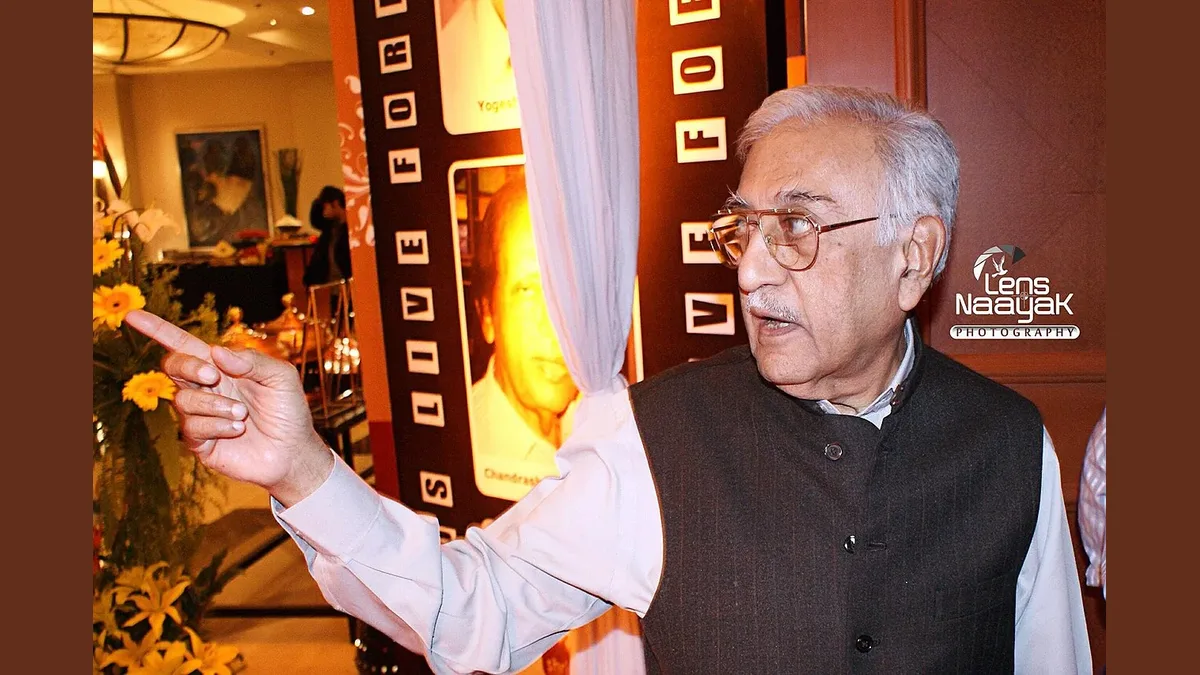
On 13 May 1952 a Sanskrit scholar and dhrupad singer named Balakrishna Vishwanath Keskar became India's Minister of Information and Broadcasting. He had a view about the film songs then pouring out of Bombay: they were vulgar, cheap and Westernised, and a national broadcaster had no business carrying them. He began by capping film music at ten per cent of airtime. Then he banned it from All India Radio outright.
Nothing about this was aimed at Ceylon. But the effect of it, within a few years, was that a station on a small island a thousand miles south of Delhi became the most listened-to broadcaster in the subcontinent — and the reason two generations of Indians knew the words Behno aur bhaiyo.
The minister who threw out the hit parade
Keskar was in the job for a decade, longer than anyone before or since, and he used it. He believed Indian music had been degraded — by centuries of Muslim rule, in his account, and then by the British — and he set about restoring what he took to be its classical, spiritual core. Much of what he did was constructive and is still defended: he launched the National Programme of Music in 1952, started the Akashvani Sangeet Sammelan in 1954, and gave classical musicians a national platform and a salary at exactly the moment the abolition of the princely states destroyed their old patronage.
He also banned cricket commentary, on the argument that the game's appeal in India rested on an atmosphere of British culture and language and would not outlive the Raj. And he banned the harmonium from All India Radio, as a European intruder into Indian music. The cricket ban he was eventually forced to repeal. The film-song ban he kept.
What he had not reckoned with was that a listener denied a song does not become a listener of something else. A listener denied a song turns the dial.
Colombo picks up an audience of millions
Radio Ceylon was ready for them, more or less by accident. It had launched a Hindi service in the early 1950s, and it had, thanks to the wartime shortwave plant built on the island for the South East Asia Command, transmitters powerful enough to put a clear signal across India.
The programme that did it was Binaca Geetmala — "Binaca's necklace of songs" — first broadcast in 1952 and sponsored, as the name says, by a toothpaste. It was the first radio countdown show of Indian film songs, and it has been described as the most popular radio programme in India for the whole of its run. It was hosted throughout by Ameen Sayani, a young Bombay broadcaster who had come up through All India Radio's English programmes, and whose greeting — Behno aur bhaiyo, "sisters and brothers", reversing the customary order — became one of the most imitated sounds in South Asia.
The show was produced in Radio Ceylon's studios and broadcast from Colombo. Its rankings were built from record sales, from the verdicts of record-shop owners, and from the weekly lists sent in by shrota-sanghs, the listeners' clubs that formed around the programme — a crowd-sourced chart three decades before anyone used the phrase. It ran on Radio Ceylon until 1988, then moved to All India Radio's Vividh Bharati until 1994.
Where there are listeners there are advertisers. Radio Ceylon set up Radio Advertising Services in Bombay to collect Indian advertising revenue, run by Dan Molina, Frank Courtney and S. Hariharan, and millions of rupees flowed south into a station belonging to a country of eight million people. The station's Indian announcers became stars in their own right — the Ganjwar sisters Vimla and Kamini, Gopal Sharma, Manohar Mahajan, Hamid Sayani, and a young man called Sunil Dutt who left broadcasting for Hindi cinema.
Odd Man Dodd
The commercial machine behind all this was built by a broadcaster who had never seen Ceylon before he arrived there.
Clifford R. Dodd was born in Wellington in 1905 and had twenty years in Australian radio behind him when the Australian government sent him to Colombo under the Colombo Plan in the early 1950s. He was made Director of Radio Ceylon's newly formed Commercial Service, and he ran it from Torrington Square as a business. He upgraded the Hindi service, courted the advertisers aiming at the Indian market, and — the part that outlasted him — hand-picked young Ceylonese and trained them into broadcasters. Vernon Corea, Livy Wijemanne, Tim Horshington, Greg Roskowski, Jimmy Bharucha and Christopher Greet all came through that training. Corea would later become the BBC's Ethnic Minorities Adviser, the first Asian appointed to senior management there, in 1978.
His management style produced the island's first great broadcasting row. Announcer Mervyn Jayasuriya summed up Dodd's approach in three words: "His credo, as I have said before, was Hire and Fire." Dodd argued to the Director General and to the Permanent Secretary of the Ministry of Broadcasting that announcers should not be entitled to permanency or a pension, because an announcer who loses his voice cannot do the job and the station must be able to let him go.
Jayasuriya, presenting the announcers' case, answered: "Gentlemen, just as an announcer might lose his voice and so become a liability, so can a surgeon lose his eyesight, and a Director or Administrator lose his sanity and become useless to the service of the State. Is there a little bias here, or am I just being silly?"
The announcers won. Dodd stayed, and the cartoonist Aubrey Collette gave him the nickname that stuck: Odd Man Dodd. When his Colombo Plan assignment ended he returned to Australia, and was succeeded by Livy Wijemanne, the first Ceylonese Director of the Commercial Service.
What Delhi lost, and what Colombo kept
All India Radio watched its audience and its revenue leave, and in 1957 it launched Vividh Bharati, a light-entertainment service designed to win them back. It took years, and Keskar himself lost his parliamentary seat in 1962.
There is a neat irony buried in this, and it matters for Sinhala music. The same B. V. Keskar who drove India's film-song audience to Colombo also invented, at All India Radio, an English-language category called "light music" — a commissioned, respectable genre meant to counterbalance film song, produced from 1953 by light-music units at AIR stations that hired classical musicians and poets to write two radio songs a week. Radio Ceylon's own commissioned genre of Sinhala radio song took its name from the same idea: සරල ගී (sarala gi), "light song". Keskar's ban made Radio Ceylon the king of the Indian airwaves, and Keskar's category gave Ceylon's own new music its name.
What we know, and how we know it
The mechanism is well documented: Keskar's ten-per-cent quota and subsequent ban, the bans on cricket commentary and the harmonium, and the resulting rise of Radio Ceylon are covered in his Wikipedia biography with citations to Asha Kasbekar's Pop Culture India!, The Caravan and Ramachandra Guha, and are the subject of a 2022 feature in ThePrint. Binaca Geetmala's 1952 start, its ranking method and Sayani's role come from the programme's and Sayani's Wikipedia entries; Clifford Dodd's tenure, the "hire and fire" dispute and the Collette cartoon from his, which cites Sri Lankan press features now readable only in web archives. One thing we deliberately do not give is an audience figure. The numbers in circulation vary by two orders of magnitude and none of them is sourced to a survey; that Radio Ceylon was the most listened-to station in the subcontinent is well attested, but how many people that was, nobody actually counted.