
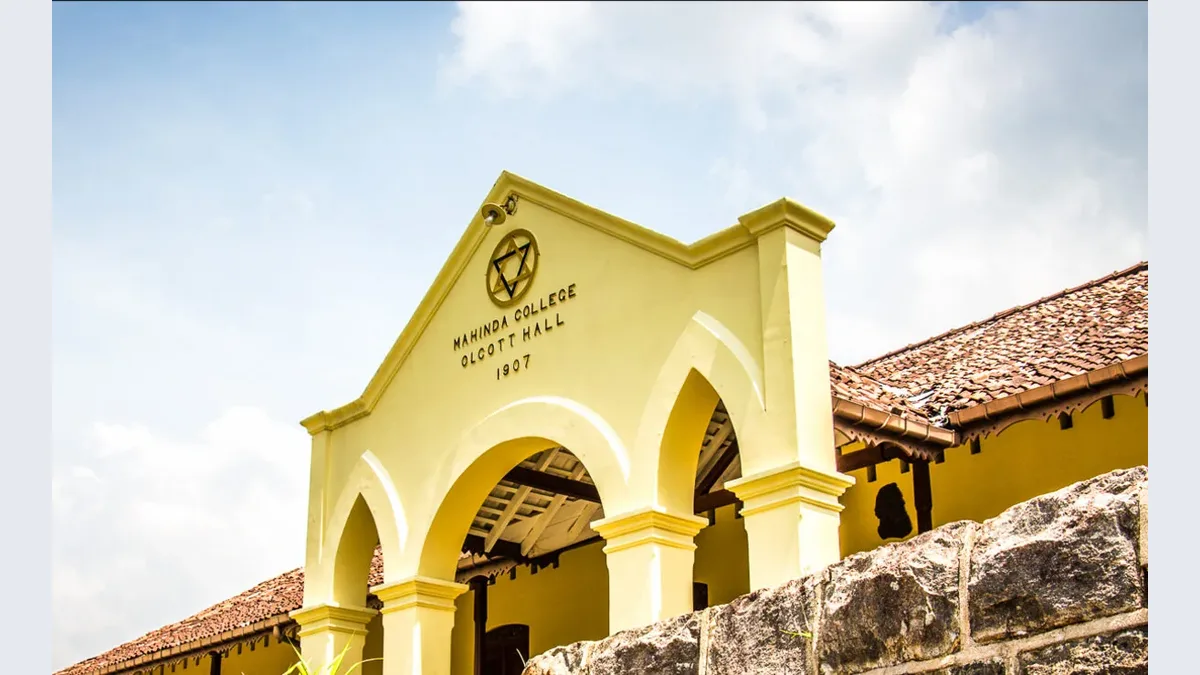
In October 1940 the music master at Mahinda College, Galle, noted in one of his own books that he had written a song that month. He was twenty-nine, and two years on the staff. The commission had come in the mildest way imaginable: T. D. Jayasuriya, Chief Inspector of Schools for the Southern Province, had asked him for something that would put a feeling for the country into schoolboys. Ananda Samarakoon called what he produced a jatika geeya — a national song. He appears to have meant it the way a school means it.
Eleven years later it was the national anthem of Ceylon. Twenty-one years later its opening line had been cut off and another put in its place, and he was dead.
The song is නමෝ නමෝ මාතා Namo Namo Matha — "Salute, salute, Motherland." Almost every Sri Lankan can sing it without knowing it is a revision.
Two accounts of where it came from
The version on record is the schoolroom one. Sumana Saparamadu, writing in the Sunday Observer in 2011 and drawing on a 1984 article in the tabloid Nava Yugaya, traced it to Jayasuriya's request and to Samarakoon's own dated note. It was first sung in public before W. Dahanayake, then Mayor of Galle, with Samarakoon accompanied by Elain de Silva, his partner in the duet එන්නද මැණිකේ Endada Menike. In 1942 he sang it on a Radio Ceylon programme with his pupil Swarna de Silva. It first appeared in print in 1943, in a songbook called Kumudini with a foreword by Jayasuriya — the Sunday Times gives the title as Geetha Kumudini — and he and Swarna de Silva recorded it for HMV. Other accounts say Mahinda College boys sang it first, in the school's Olcott Hall.
His nephew Sunil Samarakoon told the Sunday Times in 2001 a flatly different story. In that account the song was never conceived as a national song at all. It was the last item in the songbook, composed on a plane home from India as Samarakoon looked down at his own country, and by the time it mattered he no longer owned it: short of money to publish, he had sold the manuscript outright to his printer, R. K. W. Siriwardena. So when the song won and a prize of Rs 2,500 was paid, the money went to the printer. Samarakoon was in India holding art exhibitions and knew nothing of the contest; his wife and his brother Berty had entered it for him.
The two accounts are not fully reconcilable, and both come from people close to the material. What survives in both is the same odd fact: the most official song in the country began as an unofficial one, and its composer was elsewhere when it was chosen.
The competition nobody talks about
Ceylon became independent on 4 February 1948 without an anthem of its own. It kept "God Save the King." That was not for want of trying. Before independence the Lanka Gandharva Sabha had run a competition to find one. Among the entries were Samarakoon's Namo Namo Matha and "Sri Lanka Matha Pala Yasa Mahima", words by P. B. Illangasinghe, music by Lionel Edirisinghe. The second won — and both Illangasinghe and Edirisinghe sat on the judging panel. Radio Ceylon broadcast the winner on the morning of 4 February 1948, but it was not sung at the Freedom Day ceremony.
At the first Independence Day ceremony a year later, on 4 February 1949 at the Independence Memorial Hall in Torrington Square, both songs were performed, in Sinhala and Tamil, as "national songs" rather than as the anthem. Saparamadu describes a further competition at the end of 1948, in which Swarna de Silva — by then an undergraduate — assembled a group of girls, had them trained, and entered Namo Namo Matha without its composer's knowledge. Whether these were two competitions or one remembered differently, the sources do not resolve.
The decision came later and by committee. In 1950 the Minister of Finance, J. R. Jayewardene, asked the government to recognise Namo Namo Matha officially. A committee under Edwin Wijeyeratne heard several songs and picked it, altering the tenth line with Samarakoon's approval. The government endorsed the choice on 22 November 1951, and it was first sung as the official anthem at the 1952 independence day parade. M. Nallathamby's Tamil version, ஸ்ரீ லங்கா தாயே Sri Lanka Thaaye, dates from the same period.
What the gana did
Then the metre became a matter of state. In Sinhala prosody a gana is the pattern of long and short syllables in a group of three. From the late 1950s, poets, pundits and Buddhist monks argued that the gana of na-mo-na — short, long, short — was inauspicious, and that the country's misfortunes followed from it. Two prime ministers had died in office; none had completed a term. Floods and other disasters were entered on the same account. Samarakoon, who had studied ghana shastra in India, replied that he was the only person qualified to judge whether there was an error in the words.
The government changed them anyway, and here the sources part company. Kumudini Hettiarachchi's Sunday Times report says the decision was taken in August 1960 under Sirimavo Bandaranaike's government, and the anthem sung as Sri Lanka Matha for the first time on Independence Day in February 1961. Wikipedia dates the change itself to February 1961. Saparamadu, writing in 2011, says simply "in 1962." Every account agrees that nobody asked the composer.
"The anthem has been beheaded"
Sunil Samarakoon was eleven when his uncle drove up to the gate in his baby Austin. The boy ran out to greet him. His uncle put a hand on his shoulder and said: puthe, mage oluwa galawala, when ekak hi karala — son, my head has been removed and another fixed on. The child had no idea what he meant. "He was never the same again," his nephew said. "He became morose."
A few days before his death Samarakoon wrote to "Timesman," a newspaper columnist. Saparamadu quotes the letter:
The anthem has been beheaded. It has not only destroyed the song, but also destroyed the life of the composer. I am frustrated and broken-hearted. It is a misfortune to live in a country where such things happen to a humble composer. Death would be preferable.
He also wrote to Dudley Senanayake, then Leader of the Opposition, saying he no longer wished to live in such a society. He died of an overdose of sleeping tablets, aged fifty-one. The dates differ: Wikipedia gives both 2 April and 5 April 1962 in different places, Saparamadu's 2006 piece says he was found dead on the morning of 5 April, and her 2011 piece reconciles them — tablets on the night of 2 April, death on 5 April.
It is universally said that the alteration killed him. That is an inference, not a record. What is on record is the change to the anthem, the words to his nephew, the letter, and the death that followed — in that order. The sources do not close the gap between those facts and the sentence "the change caused his suicide," and it is worth leaving open, because a man's despair is not a mechanism.
The other anthem
Sri Lanka Thaaye has had its own long argument. Sung at the 1949 ceremony and afterwards mostly in the north and east, it was the subject of a cabinet decision in December 2010 to drop the Tamil translation — never formally enacted, denied by the Presidential Secretariat, but followed in practice by an unofficial ban. In March 2015 President Maithripala Sirisena announced there was no such ban, and on 4 February 2016 the Tamil version was sung at an official Independence Day ceremony for the first time since 1949. It was dropped again from the main ceremony in 2020, kept in regional ones, and reinstated at the 76th Independence Day in 2024.
Sri Lanka is not unusual in having a multilingual anthem — Belgium, Canada, Finland, New Zealand, South Africa and Switzerland all do. It is unusual in having spent seventy-five years arguing about it.
What we know, and how we know it
The composition date, the Jayasuriya commission, the 1942 broadcast, the 1943 songbook and the "beheaded" letter all come from Sumana Saparamadu's two Sunday Observer articles, which cite Samarakoon's own note and a 1984 Nava Yugaya piece; the sold manuscript, the Rs 2,500 and the words to the nephew come from Kumudini Hettiarachchi's 2001 Sunday Times interview with Sunil Samarakoon; the competition and the constitutional history are documented on Wikipedia's Sri Lanka Matha article, there being no standalone article on Sri Lanka Thaaye.
Genuinely unsettled: whether the song was written for schoolboys or salvaged from a songbook, who sang it first, when the first line was changed — August 1960, February 1961 or 1962 — and on which day in April 1962 Samarakoon died. The largest uncertainty is the one everybody states as fact: nobody can show that the alteration caused his death. He said what it did to him; that is not the same as what killed him.