
In 1957 a Ceylonese delegation went abroad to an international music conference — Ceylon Today's account places it in Russia — carrying a Sinhala song to perform. They sang it. Then the hosts asked for something that was not set to an Indian tune.
It is a small, embarrassing moment, and it is the hinge of this story. What the delegation fell back on was a vannama — the Turanga Vannama, the Vannama of the Horse — and Tikiri Tikiri Liya. The audience liked them. The lesson the folk-music researcher W. B. Makuloluwa took home was that the country possessed a body of native melody it had never learned to use, and that somebody would have to build the machinery to teach it.
Over the next twenty years, that is what happened — not through a manifesto but through syllabuses, conferences, committees and a research unit with a tape recorder.
The programme that got shouted down
The radio side of it started earlier, and badly.
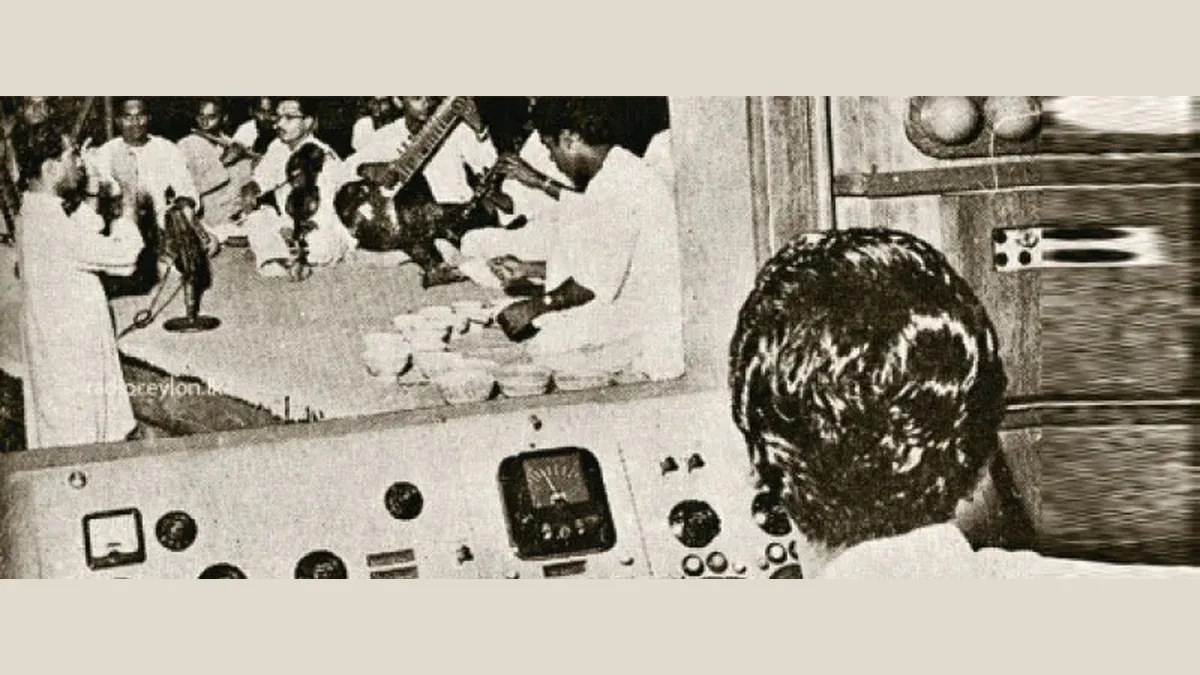
In 1955 Madawala Ratnayake, hired the previous year as a scriptwriter at Radio Ceylon, launched his first programme. He called it ජන ගායන Jana Gayana, "folk singing," and it did something urban listeners at the time found faintly ridiculous: it treated jana gi, village song, as material worth an evening slot on the national station. "Jana Gayana consisted of five radio programmes based on Sinhala folk songs," Ratnayake recalled. "Some were limited to a half hour like our first show, 'Tikiri Liya' (Village Damsel)… We experimented with the tunes of folk songs and wove a storyline in between songs… This was part of my attempt to preserve the values of the village and rural life."
The Sinhala press attacked it for "destroying" folk music. Ratnayake stopped the programme.
Then in 1957 he restarted it with the composer W. D. Amaradeva, who had just come back from training in North India — and this time it was acclaimed. Nothing about the music had changed much. What had changed was 1956: S. W. R. D. Bandaranaike's election, the Official Language Act, and a new Ministry of Cultural Affairs with money to spend on reviving Sinhalese art. A programme that venerated village life had become politically legible.
Two things about that sequence deserve saying out loud. The first is that "authentic national music" was, at least in part, a matter of timing. The second is that the same political turn that funded it marginalised the island's Tamil-speaking minority — a fact Garrett Field is careful not to leave out of his account, and neither should this one.
Ten beats from a horse
The first song aired on the revived Jana Gayana was රන් වන් කරල් සැලේයි Ran Van Karal Saleyi, "the golden paddy sways." Ratnayake built it out of the Turanga Vannama.
The vannama are court songs, commissioned under a Kandyan king who reigned from 1707 to 1737: he had a Buddhist monk compose the verse and hired a Tamil musician to set it to South Indian raga-based melodies. The Turanga Vannama's text tells how Prince Siddhartha mounted his horse Kanthaka, left the palace, leapt the Anoma River and renounced the world.
Ratnayake did not take the words. He took the rhythm. Every vannama carries a tanama, a spoken drum-syllable pattern; the Turanga Vannama's runs tat tat ta nat ta ne na / tat tat ta nat ta ne na / tat tat ta nat ta ne na / ta na — ten beats. Ratnayake wrote his lyric so that its syllables fell into that exact pattern:
tat tat ta nat - ta ne na …ran van ka ral - sa le …
Anyone who knew the vannama would hear the old song moving underneath the new one. What the new one described was not renunciation but a paddy harvest: ripened grain that hardly sways in the wind, like the steady mind of a woman observing the Buddhist precepts; overflowing tanks; a village blossoming in happiness. Tank, temple and paddy field — vava, dagaba, yaya — were precisely the three images Sinhalese cultural nationalists had spent the century establishing as the markers of authentic Sinhalese life. Amaradeva scored it for a group of voices rather than a soloist, and put an udekki folk drum in the orchestra so the association could not be missed.
One small inconsistency is worth flagging: Field states that Ran Van Karal Saleyi was the first song aired on Jana Gayana, while quoting Ratnayake himself saying he created it "for the radio programme 'Tikiri Liya'" — which was one of the segments within Jana Gayana. The two statements are compatible but not identical, and no other source resolves them.
Getting folk song into the syllabus
The durable part of the movement was bureaucratic, and it is traceable decision by decision.
The intellectual licence came from an unexpected direction. When Radio Ceylon brought the Lucknow principal S. N. Ratanjankar to Colombo to audition musicians, he also gave a lecture at the Royal Asiatic Society, "The Place of Folk Songs in the Development of Music," in which he told his Sinhalese audience that their real music was in their villages: "The Vannams, Astakas, the Sivupadas, the Stotras, the Pirits are the proper DESHI SANGEET of Lanka. They are still retained in their traditional forms. But much refined music can be built upon the basis of these." An Indian musicologist telling Ceylonese musicians to stop looking at India is one of the odder turns in this history, and both Ratnayake and Amaradeva credited it directly.
In 1959 the government held the first national conference on Sinhala music. Makuloluwa delivered a lecture there on the methodical singing of hela virith, Sinhala prosody, and — after what he described as much discussion and debate — the conference accepted it. His own summary of what he wanted is unambiguous: "All schools and all music schools should teach folk songs as a compulsory subject… Radios should broadcast folk songs, folk poems, and wannam sung by talented singers." Through the 1960s that is largely what happened; music and dance entered the school curriculum, teacher-training colleges opened, and competitions and workshops followed. In 1962 Makuloluwa published Hela Mihira, a collection of folk songs, and his research is gathered in Hela Gee Maga.
Folk song was written into the syllabus of the State Fine Arts Institute, the Lalitha Kalayathana, for the academic years 1968 and 1969, taught by artists including Sumanadasa Kendasinghe, Nanda Perera, Ivo Dennis, Weerasena Gunathilake and Rohana Beddage.
And in 1972 C. de S. Kulathilake took charge of the newly established research unit of the Sri Lanka Broadcasting Corporation. Kulathilake had already been travelling to villages under the Department of Cultural Affairs, recording folk songs and studying the ritual repertoires — yaga, bali, thovil, kankari — and he now had a national broadcaster's resources behind him. He published Lankawe Sangeetha Sambhawaya in 1974. Makuloluwa, writing later, called the unit's service "unmatchable."
What it left behind
The score is mixed, and honest accounting matters more here than celebration.
On the credit side: an entire generation of Sinhala song after 1960 draws on folk melody as a matter of course rather than as an experiment, and the reason is a syllabus and a broadcasting research unit rather than a spontaneous revival. Sarachchandra's Maname and Sinhabahu, Dayananda Gunawardena's Nari Bana, Makuloluwa's own Depano of 1966 and Henry Jayasena's Thawath Udasanak all belong to the same current. Lionel Ranwala, who performed in Depano, went on to become the country's best-known keeper of folk song, and the archive of scholars' papers on hela gee was eventually entrusted to him.
On the debit side, Makuloluwa himself named the risk in the same essay in which he demanded compulsory teaching: "Some people change and distort Sinhala folk songs and tunes and present them on the radio to the public… Distorting Hela Gee is a national crime. Hela Gee should be sung and presented preserving their authenticity and rawness." He wanted both things at once — untouched preservation and creative reuse — and the movement mostly delivered the second.
What we know, and how we know it
The Jana Gayana broadcasts, the 1955 press attack and 1957 relaunch, the Turanga Vannama tanama, the lyrics of Ran Van Karal Saleyi and the Ratanjankar lecture all come from Garrett Field's open-access Modernizing Composition (2017), which footnotes them to Sinhala sources. The institutional chain — the 1957 delegation, the 1959 conference, the Lalitha Kalayathana syllabus of 1968–69 and Kulathilake's 1972 appointment — comes from Ama H. Vanniarachchy's three-part "History of our melody" in Ceylon Today, itself drawn from a Sinhala essay by Harsha Wickramatunga.
Some details are softer than others. Ceylon Today places the 1957 conference in Russia but names neither the city nor the event, and gives no source for the exchange about singing something not set to an Indian tune — it is the kind of story that circulates in the Sinhala literature on Makuloluwa and has not, as far as we can find, been traced to a contemporaneous document. Treat the anecdote as the movement's founding story rather than as an established fact; the syllabus decisions and the appointments that followed it are firmly documented.