
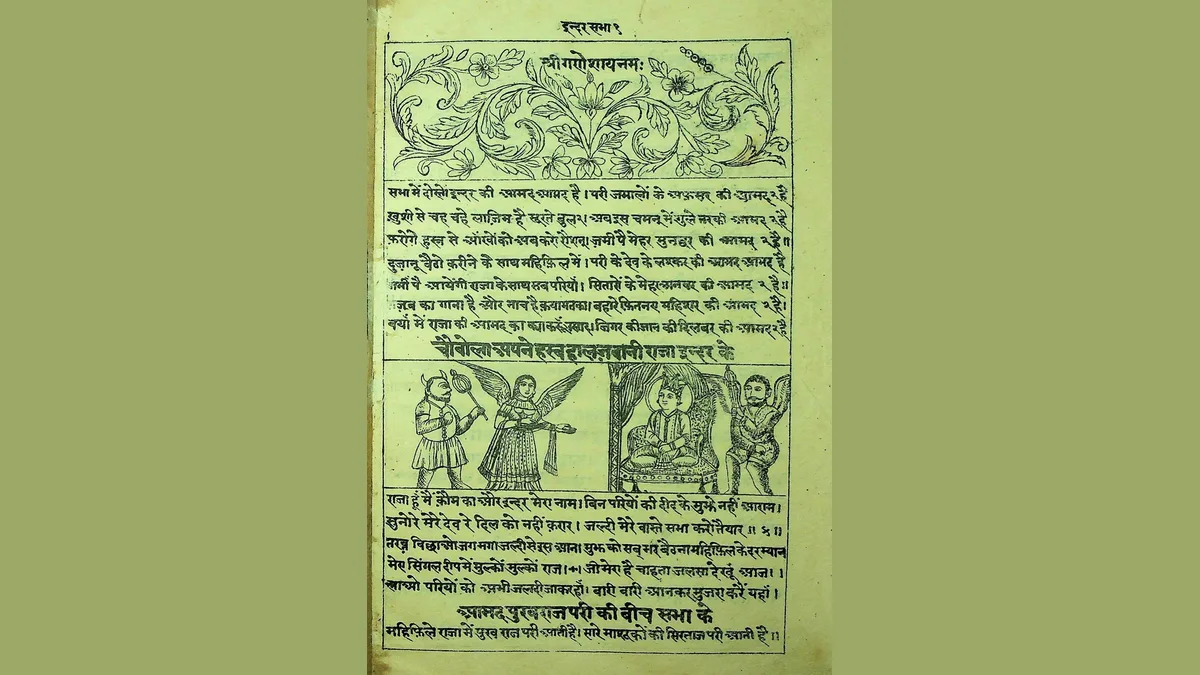
The play they brought was about a fairy who falls in love with a mortal prince and is thrown out of the court of Indra for it. Inder Sabha had been written in Lucknow in 1853 by the court poet Agha Hasan Amanat, it is generally called the first complete Urdu stage play, and it is not really a play at all: it is thirty-one ghazals, nine thumris, four holis, fifteen songs, two chaubolas and five chhands, strung on a story, with fireworks. In Bombay the Parsi theatre companies had turned it into the most reliable ticket in South Asia.
On 26 May 1877 it was performed in Colombo. Almost nobody in the hall spoke Urdu. It did not matter in the slightest.
Which company, and when
Here the record splits, and it is worth being exact about how.
The peer-reviewed account — Nishadi Meddegoda's 2026 study in the Journal of Research in Music, citing the Sinhala scholar Sunil Ariyaratne — names the company that staged Indra Sabha on 26 May 1877 as the Hindustan Dramatic Company. Garrett Field, working from the same Sinhala scholarship, agrees: a Parsi troupe from Bombay called the Hindustan Dramatic Company arrived in 1877 with two Urdu dramas, one of them Indar Sabha, and it was a different troupe — K. M. Baliwala's Elphinstone Dramatic Company — that presented Indar Sabha in 1882, along with at least seven new musicals.
Popular accounts routinely merge the two, and give 1877 to the Elphinstone company. They also disagree with each other about when Elphinstone actually came. Sumana Saparamadu, writing about the Tower Hall, dates the Elphinstone visit to 1883. Meddegoda, following Sarachchandra, says the company "returned repeatedly between 1889 and 1931". Field says the Bombay troupes came back six more times between 1889 and 1913.
So: three dates for Elphinstone's first visit — 1882, 1883, 1889 — and two for when the Parsi visits stopped. The one thing several independent chains agree on is 26 May 1877, and the name attached to it in the peer-reviewed literature is the Hindustan Dramatic Company. This article follows that, and flags the rest as unsettled.
What actually came off the boat
The novelty was not the tunes. It was the whole apparatus. Parsi theatre fused Persian dramatic convention, Urdu literature, North Indian classical music and European stagecraft: acts and scenes, painted scenery, mechanical effects, a curtain that could be flown, an orchestra in front, and professional actresses in the female roles. Sinhala audiences had nadagam — an all-night sung drama performed on a semicircle of piled earth under coconut thatch, with the musicians sitting on stage. Beside that, the Bombay companies looked like the future.
The reply came the same year. Field records that after seeing the Hindustan Dramatic Company, C. Don Bastian of Dehiwala wrote and staged the first නූර්ති nurthi musical, Rolina, in 1877 — the story of a princess who saves her husband's life. The word nurthi comes from the Sanskrit nritya, drama. Sinhala playwrights began writing librettos and simply hanging them on Parsi theatre melodies.
How direct that borrowing was can be measured. Ariyaratne, cited by Field, found that nine songs across six different nurthi musicals of the 1880s were imitations of a single tune — the most popular song in Indar Sabha. One musical used it for five different sets of lyrics.
Why North India, and not South
Here is the part that is usually skipped. Sinhala music had been in conversation with South India for centuries. The court vannam were set to raga-based melodies by a Tamil musician; prasasti, the sung praise of kings and of the Tooth Relic, came out of the same tradition; nadagam, the island's only fully operatic form, descends from Tamil terukkuttu and is built on sindu ragas. Carnatic music was not a stranger. It was the substrate.
And yet almost none of the sophisticated Carnatic apparatus — the kritis, the varnams, the codified raga system — was absorbed into Sinhala music. Hindustani was, comprehensively, within about two generations.
Meddegoda's argument, and it is the strong one, is that this had nothing to do with which system was better music. It was ideology. Three things happened at once.
First, nadagam was demoted. Colonial modernity brought a new hierarchy of artistic value in which refinement, professionalism and classical authority were the measures, and a form performed by villagers and transmitted orally was reclassified as "folk" — a category that had just acquired a low price. Meddegoda points out that the usual explanation, that nadagam declined because its tunes were repetitive, cannot be sufficient: plenty of Asian traditions survive repetition. What changed was the value system, not the melodies.
Second, Carnatic music was reclassified as Dravidian — which is to say, as Tamil, and therefore as somebody else's. In 1883 there were clashes in Colombo between Buddhists and Catholics, and the broader hostility of the period fell on Tamils. Music followed the politics.
Third, the Buddhist revival gave North India a genealogy. Anagarika Dharmapala and his colleagues promoted an "Arya-Sinhala" identity: Prince Vijaya, the putative founder of the Sinhala people, was held to have come from a region of North India, and the Pali word arya carried a heavy freight of nobility from the Buddha's own teaching. Within that framework, North Indian music was not an import at all. It was heritage, recovered.
You can watch the argument being made. In the preface to a musical printed in 1903, John de Silva reasoned that Sinhala poetic metres had originally belonged to the raga and tala system of North Indian classical music — the eighteen syllabic instants of the samudraghosa metre, he thought, came from an eighteen-beat North Indian cycle — and concluded that the ancient Sinhalese had known Indian classical music well. Around the same time Ananda and Ethel Coomaraswamy were pressing, in "A Plea for the Teaching of Indian Music in Ceylon" (1906) and "Music in Ceylon" (1907), for Indian music in the island's schools. Prestige arrived first; the justification was written afterwards.
Meddegoda reads this through Hobsbawm: an invented tradition, in which a genuinely recent borrowing is presented as the authentic ancestral inheritance. The Sri Lankan Tamil community, whose Carnatic practice ran on through temple worship and formal teaching in Jaffna, simply carried on. Two communities on one island took two different Indias.
Everything after it
The line from 1877 runs unbroken. Nurthi became the dominant urban entertainment, and when John de Silva wanted better music for it he paid a musician from western India, Visvanath Lawjee, to come and write it; de Silva would explain a scene to him in English, Lawjee would build a melody out of North Indian ragas, and de Silva would then write Sinhala words to fit the tune. That is how දන්නෝ බුදුන්ගේ Danno Budunge was made, in 1903.
When the gramophone companies arrived, they recorded what was selling: nearly every song released in Ceylon between 1906 and 1930 was a nurthi song. When nurthi faded, the labels tried alut sindu, "new music" — revivalist themes over melodies lifted from Hindi and Tamil film songs. When Sinhala musicians went abroad to train, they went to Santiniketan and to the Marris College of Music in Lucknow, and came home with Hindustani voice, sitar and sangeet visharada diplomas. When Radio Ceylon needed someone to audition and grade its musicians in 1949 and again in 1952, it hired S. N. Ratanjankar, principal of the Marris College. The genre that emerged from that station, sarala gee, was played on sitars, tablas, sarods, flutes and violins.
Sunil Santha, who had trained in Lucknow himself, described what it had done to him: "When singing Sinhala songs, I would pronounce the words as though they were Hindi words. I considered the Hindi accenting of Sinhala words to be a great thing." In 1952 he boycotted Ratanjankar's auditions and gave up his A grade over precisely this question.
Every argument Sinhala music had with itself in the twentieth century — the ban on imitation, the search for a village source, the fight over what counted as national — is downstream of a boat that docked in 1877.
What we know, and how we know it
The date, the company and the ideological reading come from Nishadi Meddegoda's peer-reviewed article in the Journal of Research in Music, which cites Sunil Ariyaratne's Sinhala scholarship for the 1877 performance; the Parsi arrival, the 1882 Elphinstone visit, Bastian's Rolina, the nine borrowed songs and de Silva's 1903 preface are from Garrett Field's Modernizing Composition, footnoted to the same Sinhala material. The description of Inder Sabha itself is from the English Wikipedia article on the play.
What is genuinely unsettled is the company. Accounts differ on whether the 1877 troupe was the Hindustan Dramatic Company or Baliwala's Elphinstone Dramatic Company, and on when Elphinstone first came — 1882, 1883 or 1889 — and how long the Parsi visits continued, to 1913 or to 1931. Nobody consulted here works from a Ceylon newspaper notice of the performance itself, which is where the answer would be. Until someone reads the Colombo press of late May 1877, the name on the playbill remains an open question.