
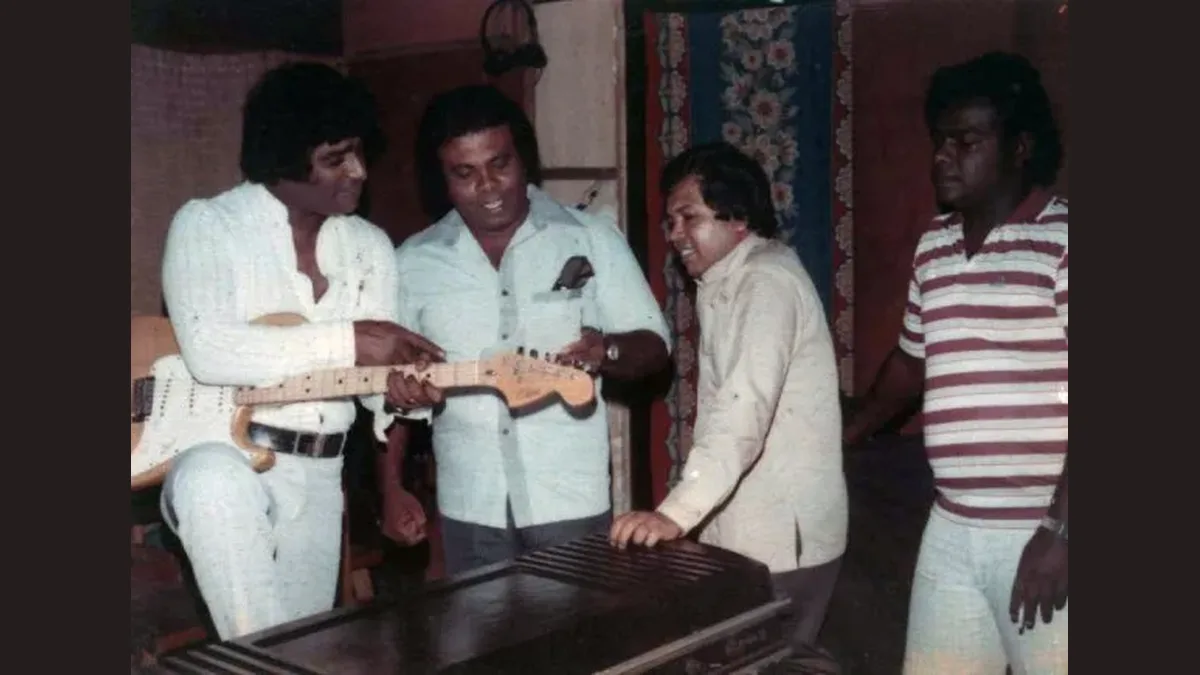
In 1968 a small record went on sale in Colombo: four songs, an extended-play disc on the Philips label, catalogue number JVPC007. The first track was මන්ගෝ කළු නැන්දේ (Mango Kalu Nande, "Mango, dark auntie"), a comic song about a woman slipping out of the house at dusk, and it is usually called simply "Mango Nanda." The record sold five thousand copies, which for a Sinhala record by an unknown band was a great deal.
The man who wrote it had trained for none of this. Clarence Wijewardena was born on 3 August 1943 at Brampton Estate, Haputale, the son of an estate medical practitioner. The family moved to Batugedara, near Ratnapura. He had a career waiting for him as a planter and he abandoned it, taught himself the guitar, and at twenty-one formed a band with a young singer named Annesley Malewana.
Two men and a name
Accounts differ on the year. Wikipedia's article on Wijewardena says he formed the Moonstones at the age of twenty-one, which would put it in 1964 or 1965; the article on Malewana says the two met when Malewana left school and formed the group in 1966. What is agreed is the division of labour that followed, and it lasted three decades: Wijewardena wrote the melodies, wrote most of the lyrics, arranged the songs around his own guitar, and let Malewana sing them.
The instrument was the point. Sinhala song in the 1960s was radio song — sitar, violin, tabla, flute, a poet's text approved before broadcast. What the Moonstones offered instead was a guitar-shaped arrangement, simple enough to be reproduced by five friends in a garage. Any Sri Lankan who has since stood in front of an audience holding a guitar, the Sunday Observer wrote in 2018, is in this man's debt.
The band's second release, More Hits by The Moonstones, came out in November 1968 as the first record on the new Sooriya label, catalogue CHB001; it carried "Kalu Mama," "Rosa Male," "Ramani" and ගොයම් කපනවා (Goyam Kapanawa, "reaping the paddy"). In 1969 the singer Indrani Perera joined and sang lead on දිල්හානී දුවනී (Dilhani Duwani), a lullaby to a small daughter that became the band's biggest seller. Wijewardena himself sang lead only once in this period, on දිලීප පොඩි පුතූ (Dileepa Podi Puthu) — a poem the Radio Ceylon announcer Karunaratne Abeysekera had written for his own son, set to music and given back to him.
The list of firsts
What makes Wijewardena a technology story rather than only a pop story is how methodically he brought new equipment and new techniques into Sinhala recording, one song at a time. The firsts credited to him are specific enough to be checked against the records themselves:
- The first use in Sri Lanka of a guitar wah-wah pedal, on the song "Pemkathawa."
- The first bossa nova beat in Sri Lankan music, on "Sigiriya" — after which he reused it on "Piyaneni," "Mage Palpathe," මුහුදු රැල්ල (Muhudu Rella, "the sea wave"), "Renin Piyabanna," "Maliniye," "Ramya," "Ran Monarun" and "Lalitha Kala."
- The sitar, imported from the classical side of the house into pop arrangements for the Moonstones.
- Two lead guitarists playing a line and a counter-line at once, on "Sumudu Mal Pipinu" and "Dileepa Podi Puthu"; a blocked guitar tone on "Kusumalatha"; single-guitar harmony in an introduction; arpeggio figures on "Sihina Lowak" and "Malata Bambareku Se"; a muted introduction on "Dineka Me Nadee Theere."
- The country's first non-stop music cassette, a format that would define Sri Lankan road trips for a generation.
- Sing Lanka, the first recording studio in Sri Lanka with multi-track facilities. He joined it as general manager and brought the technology in.
Read together, that is a man working through the toolkit of international pop and testing each item on Sinhala material. Nothing about it was inevitable. A wah-wah pedal is a cheap effect anywhere in the world; getting one into a Sinhala hit in the late 1960s meant a person deciding it belonged there.
Three bands, and a set of dates that do not agree
The band history is genuinely tangled, and the sources conflict.
Wijewardena left the Moonstones — most accounts say in 1970 — and staged a show in Moratuwa with Chanaka Perera and Wijith Peiris billed, cheerfully, as "Breakaways from the Moonstones." Mike Goonesekera took over the Moonstones. Wijewardena's new group, the Golden Chimes, is dated to January 1971 by his Wikipedia article; but when the band marked an anniversary in April 2000 the Sunday Times reported it as their thirtieth year, which points to 1970. Their first release included "Kimade Nawe," "Mage Pelpathe," "Sihin Sinawai" and "Samanalayo," and the group later brought in the vocalist Anil Bharathi, for whom Wijewardena wrote "Ada Wei Iru Dina," the Christmas song "Bethlehempure" and "Tikirimalee."
Then in 1972 — or 1973, depending on which account you read — Wijewardena and the lead guitarist Dixon Gunaratne left to form the Super Golden Chimes, reuniting with Malewana. That band held the number one slot on both the Sinhala and the English services of the national broadcaster, which is to say it conquered the institution that had once given its predecessor a quarter of an hour a week. It ran until Malewana married in 1978 and announced his retirement.
The jingles, the teledramas and the law
The last two decades of his career were spent making music for everything. He wrote advertising jingles that a whole country could hum — Bata, Elasto, Astra margarine, Arpico, Singer, Dot toffee, Atlas pens — and was good enough at the words to be a copywriter as well as a composer. He scored the films Sikuruliya (1975) and Apeksha (1978) for H. D. Premaratne, and wrote all six songs for the teledrama Susima. For Nidikumba Mal he composed "Sasara Gewa Yana" and asked W. D. Amaradeva — the presiding figure of the radio-song tradition his own guitar had disrupted — to sing it. When Sri Lanka reached Test status in 1982 he produced an album to mark it.
He also worked on the rules. Wijewardena contributed an artist's view to the drafting of the Code of Intellectual Property Act No. 52 of 1979, arguing for musicians' rights in a country where royalties were mostly theoretical.
The irony is bitter and well documented. After his death in December 1996, at fifty-three, his widow Sheela went to court repeatedly over recordings and renditions of his songs, and lost — in one case against Malewana himself, who had signed the original contracts alongside him. The man who helped write the copyright law left an estate that could not enforce it.
What we know, and how we know it
The birthplace and date, the abandoned planting career, the 1968 EP and its five thousand copies, the wah-wah pedal on "Pemkathawa," the bossa nova beat on "Sigiriya," Sing Lanka and the contribution to the 1979 intellectual property act are set out in his Wikipedia article, which cites Sinhala-language features in Dinamina, Silumina, Deshaya and Sarasaviya alongside the Daily Mirror. The claim that he made Sri Lanka's first non-stop music cassette comes from the Sunday Observer's 2018 tribute, written by a founder member of the Clarence Wijewardena Memorial Foundation.
Two things remain unsettled. The band dates conflict: the Moonstones' formation is given as both 1964–65 and 1966, the Golden Chimes as both 1970 and January 1971, and the Super Golden Chimes as both 1972 and 1973, and no source reconciles them. And two songs — "Gopalu Handa" and "Kandulella" — are frequently attributed to him or to the Moonstones online; neither title appears in any article, feature or discography checked for this piece, and the attribution should not be repeated until one does.