
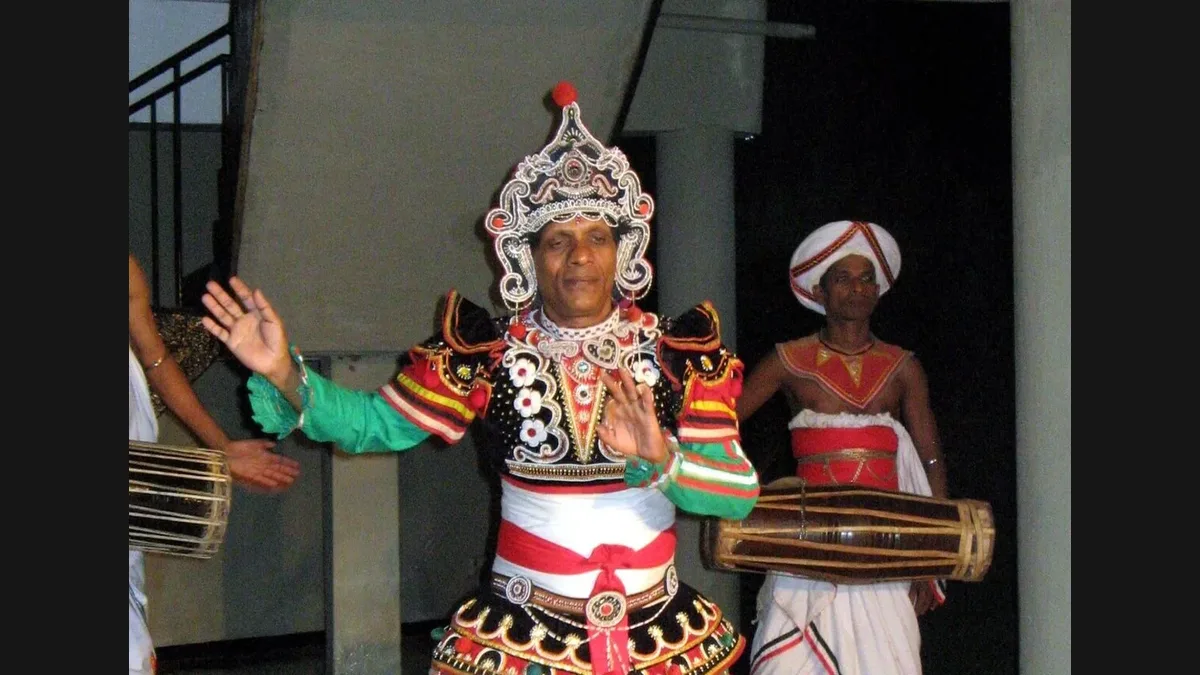
The first of the eighteen is about a noise. ගාහක වන්නම Gahaka Vannama describes the sound of the right-turning ceremonial conch blown at a consecration — not the shell, not the ceremony, but the way the note goes up and spreads out over everyone standing there. Its assigned mood is adbhuta, wonder. The second, ගජගා වන්නම Gajaga Vannama, is a royal elephant in full regalia: the walk, and the ears flicking at the sound of its own bells. Wonder again. The fifth, තුරඟා වන්නම Turanga Vannama, is Prince Siddhartha going out of the palace gate on the back of the horse Kanthaka — and its rhythm, everyone agrees, is the horse.
That is what a vannama is. The word comes from varnana, descriptive praise. Each one takes a single subject, praises it at length, and carries one fixed emotional colour from beginning to end.
The hall where songs were judged
They were made in an institution. Under the Kandyan kings the court maintained separate guilds for separate arts — a dance academy, a drama establishment, an ensemble of indigenous drums and wind instruments required to play eight times a day, and a corps for royal processions — and among them the කවිකාර මඩුව kavikara maduwa, the poets' hall, which sat inside the palace and held song and poetry contests. Nishadi Meddegoda's 2026 survey of Indian influence on Sinhala music describes its main product as prasasti, elaborate sung praise of kings and later of the Tooth Relic, and notes that the singers were paid in land and in honorific titles: kavindra, kavishwara. This was a salaried, competitive, courtly art.
The vannam belong to that hall. Sri Vira Parakrama Narendrasinghe, who reigned from 1707 to 1737 and was the last Sinhalese king of Kandy before the Nayakkar succession, is the ruler nearly every account attaches them to.
Who actually wrote them is where the accounts part company. The Sinhala Wikipedia entry and the OpenLearn 18 Vannam Kavi course both name a learned man called Ganithalankara as the author of the verses, working with the help of a monk of the Malwatte chapter; the Sinhala version specifies that he was a brahmin with Indian training. Garrett Field, drawing on Sinhala scholarship, describes a different division of labour: the king asked a Buddhist monk for the poetry and separately hired a Tamil musician to set it to South Indian raga-based melodies. Meddegoda, meanwhile, records the names of distinguished Carnatic musicians at the Kandyan court — Ganitalankara, Narasinghe, Alaganaidu — with almost none of their work surviving. The same name appears in one telling as the poet and in another as the musician, which is a fair warning about how thin the evidence is. What all the versions share is the shape: Sinhala Buddhist words, South Indian music, a king paying for both.
Eighteen of how many?
Not eighteen. The OpenLearn course notes that an old text refers to thirty-six of them. The Sinhala Wikipedia article lists, alongside the famous eighteen, a separate set of twenty-one called the Anuradhapura vannam, a set of twenty Tamil vannam said to have been composed in the seventeenth century by a South Indian poet in praise of a king, and thirty-two sindu vannam named after their rhythmic modes.
The number hardened late, and Sudesh Mantillake's dissertation shows how. In 1908 Mahawalatenne Bandar, a descendant of Kandyan aristocrats, published vannam lyrics in the journal of the Ceylon branch of the Royal Asiatic Society — the first time the texts had ever been printed. His collection ran to at least thirty pieces, and their subjects were what you would expect from a court repertoire: kings, royal victories over Europeans, love between kings and queens. Only afterwards did the canon settle at eighteen, and when it did, the surviving eighteen were mostly about animals. By the time S. L. B. Kapukotuwa published his texts in 1934, thirteen of the eighteen described an animal or an animal's character. හනුමා වන්නම Hanuma Vannama, which in Bandar's 1908 text praised a Kandyan king's victory over the Portuguese, had become a monkey.
The eighteen as they now stand run: the conch, the elephant, the incomparable qualities of the Buddha, the majesty of the king, the horse, the monkey, the peacock, the hare, the reptile, the hawk, the rooster, the lapwing, the lion, the cobra, the emerald, the arrow, the goddess Surapathi and the god Ganapathi. Each has its mood fixed to it — the hawk in flight and the soldier of ඊරඩි වන්නම Eeradi Vannama are heroic; the lapwing and the cobra are tender; the lion who is tricked by a tortoise into jumping down a well is comic. අසදෘශ වන්නම Asadrusa Vannama, on the incomparable virtues of the Triple Gem, is held to be the finest of them and the last one composed in the Kandyan period, and its mood is shanta, peace.
Sung first, danced later
The most useful correction the scholarship offers is that these were songs. Mantillake, citing the musicologist C. de S. Kulatillake and the dance researcher Donaldson, is blunt: the repertoire was composed only for singing, sung for entertainment in the kavikara maduwa, and became a dance after the British intervened. Ritual ves dancers, who before that performed only in rituals, took up vannam in the colonial period, and then went further — they began not just dancing to the recitation but physically impersonating the animals in it, an elephant-step with trunk movements, a monkey's antics. Mantillake links that innovation to the colonial exhibitions of the Hagenbeck brothers, where Sri Lankan performers were displayed alongside live animals.
Against this, Field's own footnote takes the opposite view, citing Almut Jayaweera: that the king's court musicians used the songs' rhythms as the basis of a new Kandyan dance style whose roots were in the Kohomba Kankariya. The OpenLearn course says the same, that the step patterns come from the Kankariya. Accounts differ, in other words, on whether the dance is as old as the song or a century and a half younger, and the disagreement matters, because one version makes the vannam an unbroken court tradition and the other makes them a colonial reinvention wearing court clothes.
What is not disputed is the anatomy of a vannama in performance. The Sinhala Wikipedia entry lists seven parts a dancer must master: thitha, bera matraya, tanama, kaviya, kastirama, seerumaruwa and adavva — a rhythmic ground, a drum measure, a syllabic pattern, the verse itself, and the closing and linking figures.
Radio takes the horse
Two centuries later that anatomy became raw material. In 1952 the Indian musicologist S. N. Ratanjankar, in Colombo to audition musicians for Radio Ceylon, gave a lecture at the Royal Asiatic Society arguing that "the proper DESHI SANGEET of Lanka is in its villages" and naming, first in his list, the vannam. The lyricist Madawala Ratnayake and the young W. D. Amaradeva took him at his word.
The first song broadcast on Radio Ceylon's Jana Gayana was රන් වන් කරල් සැලෙයි Ran Van Karal Saleyi ("the golden paddy sways"), and Ratnayake built it out of the Turanga Vannama. Not its story — the vannama is Siddhartha's renunciation; the song is a village at harvest — but its tanama, the spoken rhythmic pattern tat tat ta nat ta ne na, repeated three times and closed with ta na, which comes out as ten beats. Field prints the two rhythms one above the other and they are identical. Ratnayake kept the horse's gait and put a paddy field on top of it.
He was not the only one. Chandrarathna Manawasinghe and Amaradeva simply wrote a new one, මහබෝ වන්නම Mahabo Vannama, the vannama of the great Bodhi tree, in 1957 — and it now sits in the Sinhala list of vannam alongside two other modern additions, the butterfly and the swan. A repertoire that had been closed for two hundred years reopened as soon as there was a microphone.
What we know, and how we know it
The attribution to Narendrasinghe's court and the pairing of a Buddhist monk's verse with South Indian melody are given in Garrett Field's Modernizing Composition, which footnotes them to Sinhala sources; the Ganithalankara version comes from the OpenLearn 18 Vannam Kavi course and the Sinhala Wikipedia entry on vannam, which also supplies the subjects, moods and the seven components of performance. The 1908 Mahawalatenne Bandar publication, the shift from kings to animals by 1934, and the argument that vannam were sung before they were ever danced are from Sudesh Mantillake's University of Maryland dissertation.
The soft ground is the composition itself. No manuscript, no date, no contract survives; the composer's name, his profession and even how many vannam there originally were all change depending on which account you read. The hard ground begins in 1908, when somebody finally wrote the words down.