
The room was small enough that everyone who described it afterwards used the same word for it: tiny. It was inside the Central Telegraph Office in Colombo, and what came out of it was not speech but a gramophone record, played into a microphone by engineers of the Ceylon Telegraph Department who wanted to find out whether anyone could hear it.
That was 1923 — three or four years after the first broadcasting stations opened in Europe, and at a moment when a wireless receiver in Ceylon was a homemade thing owned by a few dozen enthusiasts. From those experiments came Colombo Radio, later Radio Ceylon, later the Sri Lanka Broadcasting Corporation, which marked its hundredth anniversary in December 2025 and is generally called the oldest radio station in Asia.
It is a good story. It is also, in almost every detail that a historian would want nailed down, disputed.
The engineer and his club
The one figure everybody agrees on is Edward Harper, a British engineer born in 1873 who sailed to Colombo in 1921 to work for the Ceylon Telegraph Department and was appointed its chief engineer. Broadcasting was his enthusiasm rather than his job, and he pursued it the way enthusiasts did in the 1920s: by finding other enthusiasts. Together with Ceylonese and English amateurs he founded the Ceylon Wireless Club, and it was through the club and the Telegraph Department together that the experimental transmissions were made. He is remembered in Sri Lanka as the father of broadcasting in Ceylon.
The department had two advantages that made the experiment possible at all. It had engineers who could build a transmitter, and it had the telegraph office — a building already full of aerials, batteries and men who understood radio frequency. Broadcasting in Ceylon did not begin in a studio. It began in a workshop that happened to have a gramophone.
The submarine
And now the part of the story everybody repeats.
The transmitter used in those first experiments is very widely said to have been salvaged from a captured German submarine, and rebuilt by Ceylon Telegraph engineers. It is a marvellous image — the wireless set of a beaten U-boat playing dance records over the Indian Ocean — and it appears in Sri Lankan newspapers, in encyclopedia entries and in centenary features.
It should be treated as a story that is told rather than a fact that is established. We could find no primary citation for it: no salvage record, no departmental report, no contemporary newspaper item naming the vessel or the date the equipment reached Colombo. The claim circulates on the authority of other repetitions of the claim. That does not make it false — surplus and captured Great War radio equipment genuinely did travel around the Empire, and a chief engineer scrounging parts is entirely plausible — but until somebody produces the paperwork it is folklore in the strict sense: a thing everyone knows and nobody can source.
Two dates, two governors
The larger problem is the founding date, and here the disagreement is not between a legend and a record but between two accounts that both look serious.
The version usually printed runs like this: experimental broadcasts from the Central Telegraph Office in 1923, followed by a regular service inaugurated on 16 December 1925, using a one-kilowatt mediumwave transmitter at Welikada, with the station taking the call sign "Colombo Calling" — and the opening broadcast made by the Governor, Sir Hugh Clifford.
A rival account, argued by the retired broadcaster Asoka Tillekeratne, dates the first experimental transmission to 22 February 1924, at the Colombo YMCA rather than the telegraph office, and the inauguration of the service to 27 June 1924, under the Governor Sir William Henry Manning.
Neither version can be dismissed on the grounds of the governors, which is the first thing one checks. Manning held office from September 1918 until 1 April 1925; Clifford took office on 30 November 1925 and served until June 1927. A governor named Manning could have opened a station in June 1924, and a governor named Clifford could have opened one on 16 December 1925 — sixteen days into his term. Both stories are internally consistent. They simply cannot both be true.
Nor is the confusion confined to old sources. The Sunday Observer's own centenary feature of 14 December 2025 states that the first official broadcast on 16 December 1925 was made by Sir Edward B. Denham, "the British Governor of Ceylon". Denham did begin his career as a cadet in the Ceylon Civil Service, but in 1925 he was in East Africa, and he was never Governor of Ceylon at all; his governorships were the Gambia, British Guiana and Jamaica, from 1928 onwards.
We are not in a position to adjudicate between 1923 and 1924, and this article does not try to. What can be said is that the institution itself has settled on the later of the two anniversaries — the SLBC celebrated its centenary on 16 December 2025, exactly a hundred years after the Colombo Radio date.
What a hundred years of it did
Whichever year the first record was played, the consequences were the same and they were large.
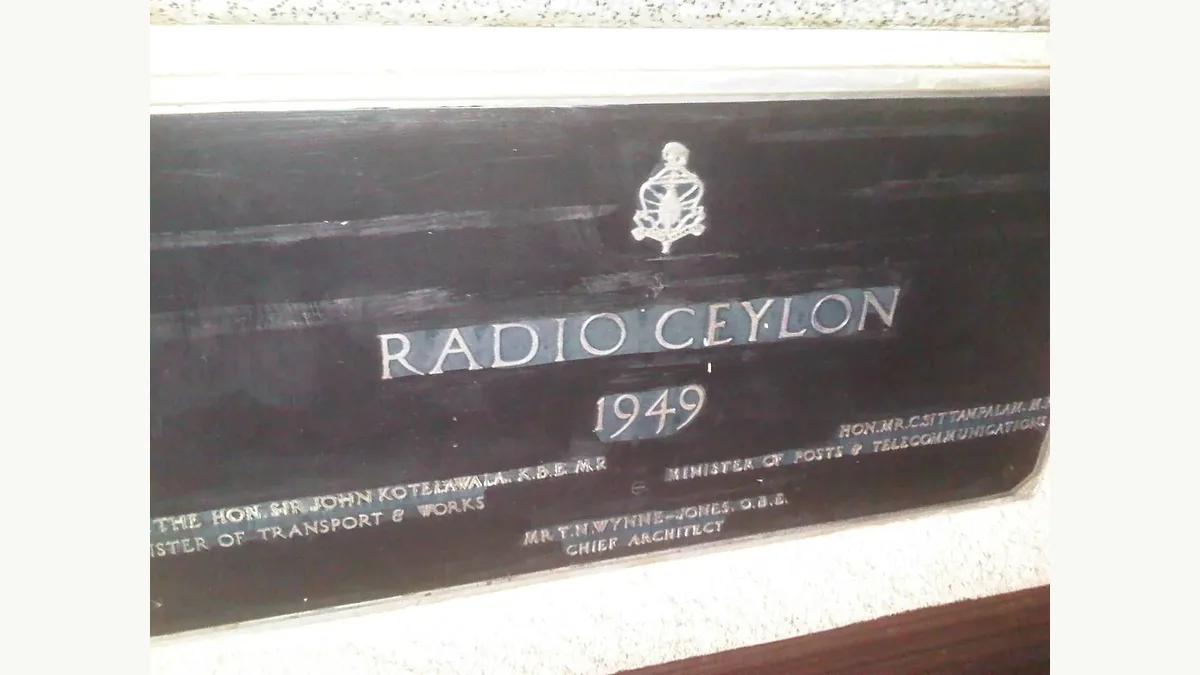
Colombo Radio grew into a three-language service through the 1930s, carrying news, talks and music in Sinhala, Tamil and English. The Second World War brought a far more powerful transmitting plant to the island for Radio SEAC, the South East Asia Command forces station, and that inheritance is the reason a small island broadcaster could later be heard clearly across the subcontinent. The broadcasting service was reorganised as a separate government department in 1949, incorporated under the Ceylon Broadcasting Corporation Act No. 37 of 1966 with effect from 1967, and renamed the Sri Lanka Broadcasting Corporation on 22 May 1972.
For Sinhala music the consequence was more specific still. A station needs programming every day, and after 1949 the state that owned it began paying lyricists, composers and singers to make it. Almost every argument in twentieth-century Sinhala song — over auditions, over grades, over what a national music should sound like — happened because there was a transmitter, and it happened in buildings that trace back to a small room and a gramophone.
What we know, and how we know it
Edward Harper's role, the Ceylon Wireless Club and the 1925 Colombo Radio launch are documented in Wikipedia's articles on Harper and Radio Ceylon, which rest in turn on Sri Lankan newspaper features, most of them now reachable only through web archives; the centenary details come from the Sunday Observer of 14 December 2025; the governors' dates from the official list of terms of office. Two things remain genuinely open. Sources disagree on whether the first experimental broadcast was in 1923 from the Central Telegraph Office or in 1924 from the Colombo YMCA, and on whether the service was inaugurated in June 1924 or December 1925 — we present both and settle neither. The 1924 account is associated with the retired broadcaster Asoka Tillekeratne; we were not able to reach a published copy of it online, and it is set out here as it was reported to us rather than from the original. And the captured German submarine transmitter, endlessly repeated, has no primary citation we have been able to find.