
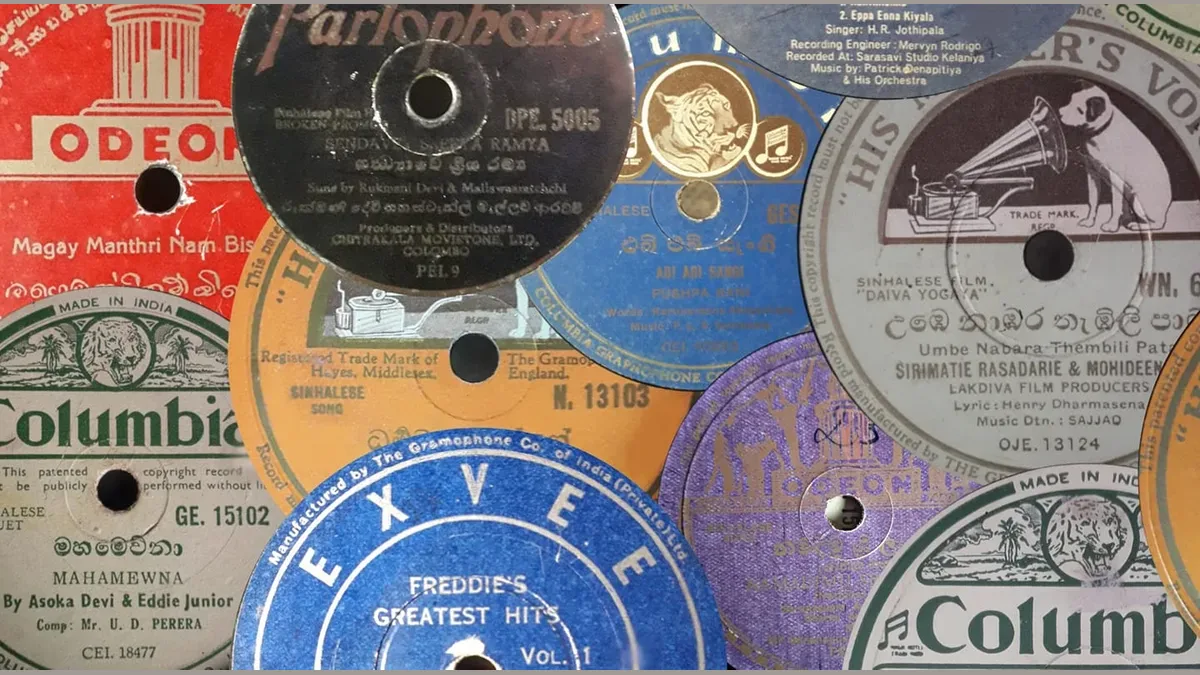
In 1930 the Parlophone record label put out six double-sided discs in Ceylon that were not theatre songs. That is a small thing to have done — twelve sides — but for the Sinhala record trade it was a genuine departure, and the labels needed a word for it. They called it අලුත් සිංදු (alut sindu), "new music", which tells you mainly that nobody had a better name.
Within a few years Odeon, Broadcast, His Master's Voice and Columbia were all issuing it. It became the dominant form of Sinhala commercial song for the next fifteen years, and it worked on a principle so simple it is almost a business model rather than a genre: take a melody that is already a hit in an Indian film, and put Sinhala Buddhist words on it.
Twenty-four years of the same thing
To see why the change came, you have to see what came before it.
When the gramophone companies first went looking for Sinhala repertoire, they went to the theatre. Talent scouts from His Master's Voice, Odeon and Parlophone turned up at the door of the playwright John de Silva, whose nurthi musicals had been playing in Colombo since 1903. Garrett Field states the outcome plainly: nearly every song that labels released in Sri Lanka between 1906 and 1930 was a song from the nurthi stage. දන්නෝ බුදුන්ගේ (Danno Budunge, "those who know the Buddha"), from de Silva's Sirisangabo Charitaya, is the type specimen.
That was a sound commercial strategy for as long as nurthi filled halls. When the theatre's popularity faded in the late 1920s, so did sales of theatre songs on shellac, and the labels were left holding a distribution network with nothing new to put through it. Parlophone's six discs of 1930 were the first attempt at an answer.
The word for tune was "echo"
The answer they arrived at was not composition. It was substitution.
Sinhala cinema did not yet exist, but Hindi and Tamil films did, and they played in Colombo theatres within weeks of their Indian release. The moment a film opened, producers at Columbia or HMV noted which of its songs the audience was humming. A composer was hired to arrange that melody. A lyricist was paid five to ten rupees to write Sinhala words that fitted the original text's pattern of long and short syllables. The disc went on sale.
The vocabulary of the trade admits what was going on. Field notes that the Sinhala word used for a song's tune in this period was අනුනාද (anunada) — "echo".
The lyricists were not credited. Labels did not print their names on the discs, which is why most gramophone-era Sinhala song texts have no known author. A man could write a hit that half the island sang and be worth ten rupees and no byline.
One melody, three records
The mechanics are easiest to see in a single case.
In 1940 the Hindi film Bandhan was the second highest-grossing Hindi picture of the year, and its patriotic song "Chal Chal Re Naujawan" was the hit of the film. After Bandhan opened in Ceylon, Columbia commissioned an arrangement of that melody and a new Sinhala lyric for it, and released දුල් සල් වනේ ලකල් (Dul Sal Vane Lakal, "the shining sal tree in the forest") — a song about the tree under which Queen Maya gave birth to the Buddha. The new words imitated the Hindi text's syllabic rhythm closely enough to sit on the tune without alteration.
It sold. So Columbia released a second Sinhala song to the same melody, දුල් මල්ලිකා කුසුම් (Dul Mallika Kusum, "the shining jasmine flowers"). And HMV released its own, තෙල් මල් පුද වඳිම් (Tel Mal Puda Vandim, "we shall worship, offering flowers and oil"). One Bombay film tune, three Colombo records.
The labels copied each other's subjects as readily as their tunes. In 1939 Columbia issued මුනි නන්දන ශ්රී පාද වඳිම් (Muni Nandana Sri Pada Vandim, "we worship the Buddha's Sri Pada"), about the pilgrimage to Adam's Peak; HMV promptly answered with ශ්රී ගෞතම ශ්රී පාද වඳිම් (Sri Gautama Sri Pada Vandim, "we shall worship Gautama at Sri Pada").
None of this was hidden. Advertising the source was a selling point: when HMV released පිට දීප දෙස ජය ගත්ත ආදි සිංහලුන් (Pita Dipa Desa Jaya Gatta Adi Sinhalun, "our Sinhalese ancestors were victorious over other lands") in 1939, built on the tune of "Divya Darisanam" from the Tamil film Cintamani, it was advertised as a "Raga from Cintamani".
Selling the revival back to itself
Read the words of that last song and the whole arrangement turns slightly absurd. It attacks the kalu suddā — literally "black white man", the Sinhalese who had taken up Western manners — for eating imported rice instead of jackfruit and sweet potato, and for feeding their children imported milk powder. It is a hymn to buying local, set to an imported melody, sold by a British company, on a disc pressed abroad, over a shop counter that also sold Australian butter.
That contradiction is the honest description of the genre, and Field puts the distinction between alut sindu and what came before it in one line: if nurthi songwriters like John de Silva used song to strengthen the Buddhist revival, alut sindu songwriters drew on the sentiments of the revival to sell records.
It would be easy to sneer, and easy to be wrong in doing so. The borrowing was not concealed, the borrowed melodies were often superb, and the practice was not unique to Ceylon — it was standard across South Asian light music. What it did do was fix an assumption in place: that a Sinhala song was an arrangement of someone else's tune, and that composing an original melody suitable for a three-minute record was a specialist skill nobody local was expected to have. When Ananda Samarakoon began writing his own words, his own melodies and singing them himself at the end of the decade, that was remarked on precisely because it was three jobs done by one man who had gone to Bengal to learn how.
The name for the borrowing practice survived into the radio era, and it was not a compliment. Songwriters called it වචන දානවා (vacana danava), "putting words" — the image being, Field explains, of an unskilled mason clumsily setting one brick on top of another. The lyricist Chandrarathna Manawasinghe, who worked through the 1950s when the practice was at its height, defined it as taking the words of a Hindi song and replacing them with Sinhala words that sounded roughly the same.
What we know, and how we know it
Almost everything specific here — the six Parlophone discs of 1930, the Bandhan case, the Sri Pada exchange, the "Raga from Cintamani" advertisement, the five-to-ten-rupee fee and the word anunada — comes from Garrett Field's Modernizing Composition, which is open access and footnoted to Sinhala scholarship, chiefly Sunil Ariyaratne's work on Hindustani imitation in Sinhala song. The Roman spellings of song titles follow Field; the Sinhala spellings given here are the standard forms of those titles. What cannot be reconstructed is authorship: the labels did not print lyricists' names, and the collectors who have gone looking report that the register books which held them have mostly been lost to damp and neglect.