
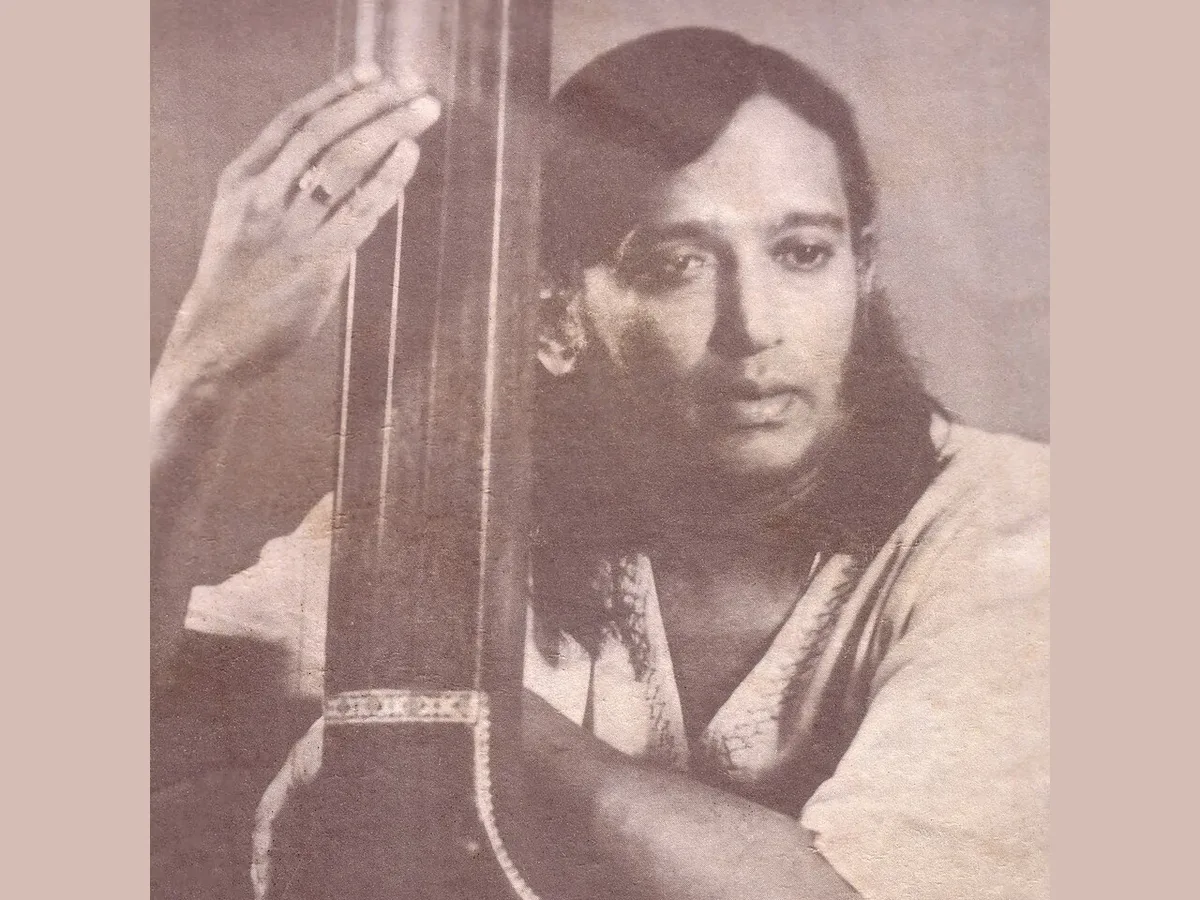
The name of the concert was one syllable long: ස — Sa, the tonic note, the first degree of the scale, the sound a singer makes before there is any music at all. It was suggested by his friend Chintana Jayasena, who pointed out that no Sri Lankan play, film or work of art then bore a name of a single syllable, and thought it would bring luck. It opened at the Lumbini Theatre in Havelock Town on 20 July 1973. It closed at the Lumbini Theatre on 20 July 2012, thirty-nine years later to the day, on its 1,450th performance.
Before Sa, no Sri Lankan musician had stood alone on a stage for a whole evening and made a career of it. After Sa, that became the ordinary shape of a Sinhala singer's life.
A harmonium at nine
Victor Rathnayake was born on 18 February 1942 in a small village near Kadugannawa, the third child in a family of ten. His father, Rathnayake Arachchilage Don James — known in the district as Rathnayake Veda Mahaththaya — was an apothecary who sang noorthi gee, the theatre songs of an older Sinhala stage. It was he who gave his nine-year-old son a harmonium for his birthday, the boy's first instrument. One of Victor's brothers, Somapala Rathnayake, also became a musician, working largely in film and television background scores.
He was taught first by D. A. D. Dharmadasa, then at school by K. M. Sugathapala, and under that guidance he came first in the solo singing category of the All Island Inter-School Musical Competition in both 1958 and 1959. In his teens he studied voice and instruments under Cyril Perera at the M.G.P. Institute in Mulgampola, and in 1963 entered the State Music College in Colombo, the institution that became the Institute of Aesthetic Studies. In 1964 he wrote his first song, an ode to the Buddha, and it was broadcast.
The teacher on the Bandarawela train
He then did what a great many Sri Lankan musicians of his generation did: he took a government job. As a music instructor for the Ministry of Education he was posted to Eththalapitiya Maha Vidyalaya near Bandarawela, and travelled to it by train. Years later he turned those journeys into සිහිල් සුළං රැල්ලේ Sihil Sulang Ralle ("on the cool breeze"), with words by Sena Weerasekera written from Rathnayake's own recollections of the hill country going past the window.
His first recording as a singer was Devangana Paradana Komala Katha, for a radio play, Manichora, by Piyasena Costa. The first radio disc issued in his own name was Hade Susuman Pathitha Weemen, composed by D. R. Peiris to words by Dalton Alwis, for the programme Pancha Madhura. Arisen Ahubudu then wrote two songs for him, and Mahagama Sekara brought him into playback singing; his first film duet, Sara Sonduru Mal Patali for Hanthane Kathawa, was sung with Nanda Malini.
Sa
By 1973 he was a trained musician looking at a country whose concert culture had no room for him. The nearest thing to a solo show was Shrawana Aradhana, which Amaradeva and Nanda Malini performed together. A group of friends — the lyricists Premakeerthi de Alwis, Sunil Ariyaratne, K. D. K. Dharmawardena and Bandara K. Wijetunga, along with R. R. Samarakoon and Chintana Jayasena — pushed him to try it alone.
Rathnayake has described his method as a fitting blend of Western music with ragadhari classical music, and named Sunil Santha, Ananda Samarakoon and C. T. Fernando as the pioneers he was building on. What Sa actually did was put a trained classical voice, a modern arrangement and a plain proscenium stage together and let an audience sit with it for two hours.
The response was not polite. Critics reaching for a phrase settled on things like "exquisite insanity" and "melodic lunacy", because audiences locked out of full houses would sometimes lay siege to the building; one fan wrote to tell him she had collected forty-nine of his hairs, one for each time she had seen the show. The songs that came out of it are among the most widely known in the language: අපි ඔක්කොම රජවරු Api Okkoma Rajawaru ("we are all kings"), Api Marenne Nae, කුරුල්ලන්ට ගී ගයන්න Kurullanta Gee Gayanna ("sing songs for the birds"), පොඩි කුමාරිහාමි Podi Kumarihamiye and තොටුපොල අයිනේ Thotupola Aine ("beside the ferry landing").
Films, and a friendship
Rathnayake became a film music director in 1973 with Matara Achchi, and used it to introduce a new voice: Sunil Edirisinghe, the director's brother, who sang Sandakada Pahana. Rathnayake sang the brisk Andura Bindinnata in the same film. He went on to score Rajagedara Paraviyo, Hulavali, Sri Madara, Sarungale, Podi Malli, Siribo Aiya, Athuru Mithuru and others. From Sri Madara came ගහ කොළ මල් Gaha Kola Mal ("trees, leaves, flowers"), sung with Latha Walpola; from Podi Malli came කොහේ සිට ඔබ Kohe Sita Oba ("from where did you come"), which appears in the film as taped footage of Rathnayake performing it in Sa.
Running through all of it is his friendship with the lyricist Premakeerthi de Alwis, who called him Rathney and whom he called Prem. It began with the devotional දෙව්රම් වෙහෙරේ Dewram Wehere and produced, among much else, තනි තරුවේ Thani Tharuwe ("lone star") — which, according to a report in the Silumina, de Alwis named on the spot one evening while lying on a beach and staring up at a single bright star — and ආදරයේ උල්පත වූ අම්මා Adaraye Ulpatha Wu Amma ("mother, the wellspring of love"), written when de Alwis's own mother was gravely ill, and set by Rathnayake to a melody drawn from a traditional Sinhala nursery rhyme. De Alwis was murdered in 1989. The songs remained.
The long close
Sa kept touring, at home and abroad, for four decades. Rathnayake released the album Thani Tharuwe in 1984 and Nil Kandu Yaaya in February 2012, and brought Sa to its final performance five months later, in the hall where it had started. In December 2014 he staged Victor Adasiyawasa — "Victor: half a century" — at the BMICH. He continues to perform.
He is remembered for one structural invention and a few dozen indispensable songs; but the invention is the larger thing. Every solo Sinhala concert since 1973 is, in a sense, a descendant of a show named after a single note.