
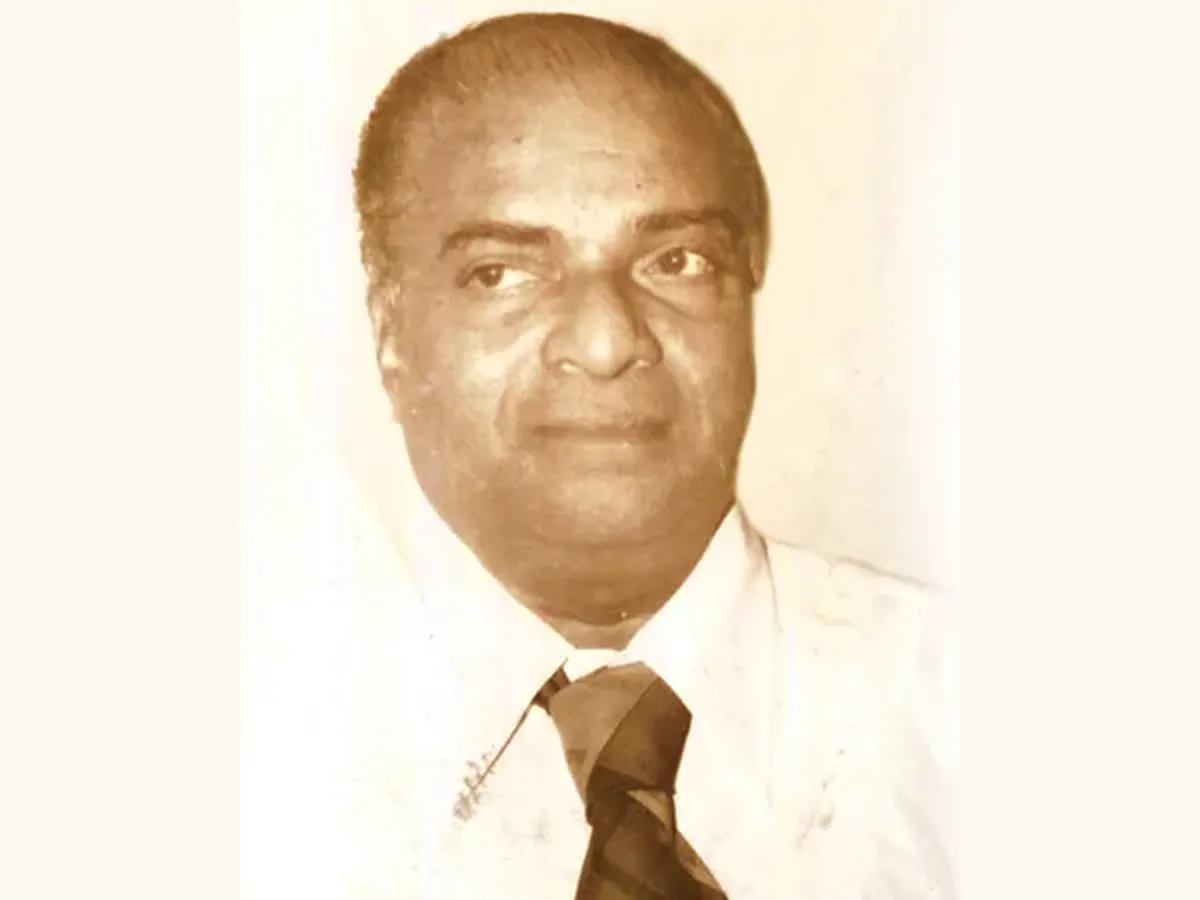
On the morning of Sunday 23 July 1989 a man of sixty-five walked out of his house in Narahenpita to buy hoppers for his breakfast. He was alone. On the bridge on Polhengoda Road, gunmen shot him five times with a T-56 assault rifle and left him there.
Forty years earlier the same man had sat down in a Colombo studio and become the first person to read a shift in Sinhala on the oldest radio station in South Asia. Between those two mornings lies almost the entire history of broadcasting in Sri Lanka — and, because for most of that period radio was the only way a song could reach a village, a good deal of the history of Sinhala song as well.
The second announcer
Thevis Guruge joined the station in 1949. Both the English and Sinhala Wikipedia articles, and the Sinhala-press account they rest on, describe him the same way: he was the station's second announcer overall and its first Sinhala-language announcer.
It was a good year to arrive. In 1949 the Radio Service was reorganised as a government department in its own right, the last step before it became Radio Ceylon and then, in 1972, the Sri Lanka Broadcasting Corporation. The same year the station brought S. N. Ratanjankar, principal of the Marris College of Music at Lucknow, to Colombo to audition Sinhalese musicians and sort them into grades. He heard 716 applicants and awarded the A grade to five. Nobody who was not graded got near a microphone.
That is the machine Guruge walked into as a young announcer, and it is why a broadcaster belongs in a history of music at all. There were no Sri Lankan record companies to speak of, no cassettes, no television. A song existed nationally if the radio played it, and it did not exist nationally if the radio did not. When Ratanjankar was brought back in April 1952 to grade musicians again, Sunil Santha — one of the five A-graders of 1949, and the composer of ඕලු පිපිලා Olu Pipila, still one of the best-loved Sinhala songs ever written — boycotted the auditions and resigned his grade, writing in Lankadipa that he did not believe the island needed a foreigner to advise it on how to make a national music. He was off national radio until 1967. That was the power of the building Guruge worked in.
The golden voices
He is remembered, when he is remembered in English at all, as one of a roll-call. Writers on Radio Ceylon's great years list him alongside Livy Wijemanne, Vernon Corea, Mervyn Jayasuriya, Eardley Peiris, Greg Roszkowski, Pearl Ondaatje, Chris Greet and Prosper Fernando — the announcers whose voices carried, on medium wave and short wave, from Jaffna to Matara and far past that. Radio Ceylon was heard across the subcontinent; when Edmund Hillary and Tenzing Norgay switched on a transistor after coming down from Everest in May 1953, what they picked up was Colombo.
Almost all of those names belonged to the English service, which is why they are the ones written about in English. Guruge belonged to the Sinhala service, which had the far larger domestic audience and has had far less written about it. The Divaina account of his life says simply that he was a teacher to many of the well-known Sinhala radio journalists who came after him. No recordings of his shifts appear to survive under his own name, and no biography of him exists.
The chair
He retired from announcing in 1983. By then, and afterwards, he had become an administrator rather than a voice. The fullest Sinhala-language account of him — Dharman Wickremaratne's Divaina series on journalists killed during the second JVP insurrection — records that he held the chairmanship of the Sri Lanka Broadcasting Corporation and the post of Director-General, and that in the 1980s, after the government took over the Independent Television Network, he was appointed its Competent Authority. The sources do not give dates for the individual appointments, and it would be inventing history to supply them.
What the three posts add up to is plain enough. Having begun as the man who told the country which song was coming next, he ended as one of the small number of officials who decided which songs the country was allowed to hear at all.
Censorship, and July 1989
By late 1988 the insurgency had almost shut the state broadcasters down. The JVP's armed wing, the Deshapremi Janatha Viyaparaya, ordered staff not to report for work and threatened those who did; some resigned. It then issued an order that people who listened to radio news or watched television news would be killed, and the Divaina account records 219 people murdered across the country for disobeying it. Households nailed up boards at their gates announcing that they no longer used a radio or a television. The government put the two stations under military protection and, for a period, air force personnel read the television news.
On 5 July 1989 Thevis Guruge was appointed the competent authority for the censorship of news under the emergency regulations. Eighteen days later he was dead.
Four other broadcasting figures were on the same list: the SLBC's additional director-general Hudson Samarasinghe, its news chief Palitha Perera, the training institute's Wasantha Lankathilaka, and the programme producer and lyricist Premakeerthi de Alwis. The first three moved out of their homes. Premakeerthi did not, and was taken from his house at Homagama and shot on 31 July, eight days after Guruge.
Guruge's funeral was held at the Borella cemetery on 25 July 1989. The eulogies were given by the Minister of Education and Cultural Affairs W. J. M. Lokubandara, by the Venerable Kotikawatte Saddhatissa Thero, by Al-Haj M. H. Shawl Hameed for the island's Muslims, by Felix Premawardhana for the Christian council, and by Hudson Samarasinghe, who was himself in hiding at the time.
What is documented, and what is not
Nobody has been convicted of killing him. English Wikipedia attributes the shooting to the JVP and states that its youth squad had threatened him the week before; the Sinhala-language source that article rests on says only that he was killed by the insurgents, and Wikipedia's own categories file the case under unsolved murders. What is documented beyond argument is the pattern: an armed movement that had publicly ordered the killing of broadcasters, listeners and viewers, and a man who had just been made the state's censor.
His birth year is not recorded anywhere reachable. The Divaina report gives his age at death as sixty-five, which would place his birth around 1924, but no source states it outright, so this article leaves it blank rather than guess. For the man who first spoke Sinhala into a national microphone, that absence is its own small comment on how casually Sri Lanka keeps the records of its own broadcasting.