
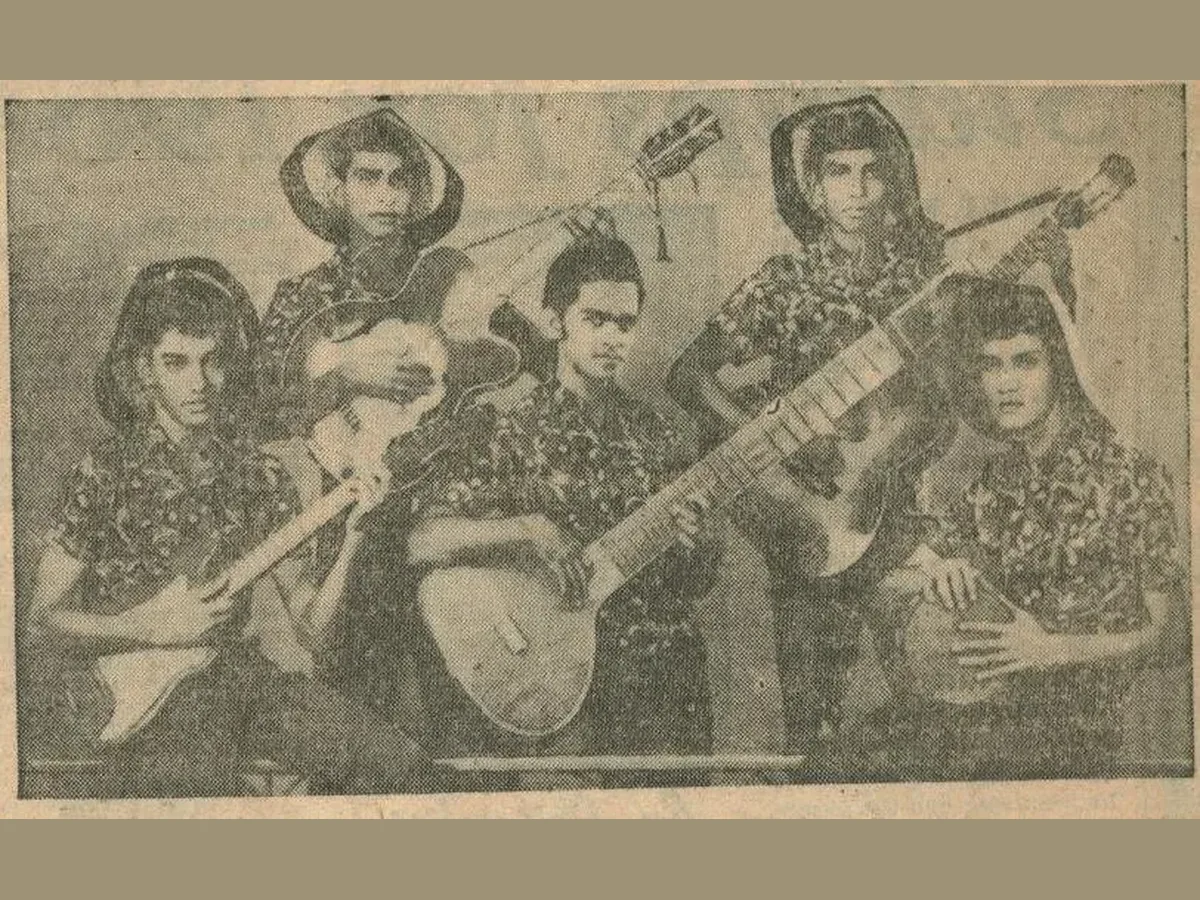
The band was named after a rock. Ratnapura, the town they came from, is the centre of Sri Lanka's gem country, and the moonstone is the stone it sends out into the world in the largest quantity. The advertising man Sri Sangabo Corea, who took charge of the group's affairs, heard them play, thought of the town's leading export, and told them they were the Moonstones — a name that worked twice over, since he also thought they were rather good.
He was right about that. In the space of about four years this band did something no amount of committee work had managed: it made Sinhala words sound natural coming out of an electric guitar amplifier. Everything the country now calls Sinhala pop — the guitar band, the light tenor, the three-minute song with a hook — starts here.
When, exactly, nobody agrees
The formation date is one of the genuinely unsettled facts of Sinhala music history, and it is worth being honest about rather than tidy. English Wikipedia says 1966, and dates the founding to the moment Clarence Wijewardena settled on his school friend Annesley Malewana as lead vocalist, after an earlier candidate failed to impress Sri Sangabo Corea. Other retellings put the band at 1964 or 1965, usually by way of the often-repeated line that Wijewardena formed it at twenty-one, and Malewana's own account has been reported as 1965. The Sunday Times, previewing Malewana's fiftieth-anniversary concert in 2016, dated his career from 1966 in Ratnapura — which is why he marked fifty years in 2016 rather than in 2014 or 2015.
The ending is fuzzy at the same edges. Wijewardena left in 1970 by most accounts and in 1969 by others, playing a Moratuwa show billed with deliberate bluntness as "Breakaways from the Moonstones". Annesley Malewana kept the name going for a while afterwards with Mike Goonesekera, and had a hit in that period with Dunhinda Manamali. Then the Moonstones stopped.
Around Wijewardena on guitar and Malewana on lead vocals, the line-up included Mangala Rodrigo on lead guitar and Sunil Malawana on bass. Chanaka Perera on bass and Wijith Peiris on drums joined in late 1967, in time for the records that made the band a household name. The singer Indrani Perera came in at the end of the decade — English Wikipedia says 1968, her own account and Sooriya's biography say 1969 — and Sooriya Records would later describe her, Wijewardena and Malewana as the original Sinhala pop trio.
The slot that was given away
Their break came through radio and through an act of ordinary generosity that changed the shape of an industry.
The radio part is a family story. The SLBC's Sinhala service is remembered as allowing Sinhala group songs something like a quarter of an hour a week, which is not a schedule so much as a shrug. The Coreas got round it sideways: Sri Sangabo Corea managed the band, and the broadcasters Vernon and Vijaya Corea used their standing in the English stream to put the Moonstones on the Saturday Star programme on the Commercial Service. A Sinhala-language band therefore reached the country first through the English service — an inversion of the natural order that says a great deal about who controlled the Sinhala one.
The recording part is the anecdote everyone repeats and most people get wrong. The session at Philips that produced the band's first hit was not booked by the Moonstones. It belonged to another bandleader, who surrendered his own slot so that these unknowns from Ratnapura could use it. That bandleader was Noel Ranasinghe of La Ceylonians. He is very frequently named in print as Neville Fernando, which is a different man: Fernando led Los Caballeros and died in 1968. The two are not the same person, and the mix-up has been published often enough that it now looks like a fact.
Mango Nanda
What came out of that borrowed session was Mango Nanda, carried in the Sinhala lyric databases as මන්ගෝ කළු නැන්දේ Mango Kalu Nande ("dark auntie of the mango tree"). The 1968 EP built around it also held රුවන් පුරය Ruwan Puraya, Sudu Menike and Muhudu Rella, and it sold in the region of five thousand copies — a figure that meant nothing in London and everything in a market where Sinhala group music was not yet a category a shop could file records under.
Later in 1968 came More Hits by The Moonstones, catalogue number CHB001: the first release of Sooriya Records, the label Gerald and Dulcie Wickremesooriya had grown out of the Children's Bookshop near the Fort clock tower in Colombo. Being CHB001 is a small immortality. Sooriya would go on to record the Golden Chimes, the Super Golden Chimes, the Three Sisters, M. S. Fernando, Desmond de Silva, Milton Mallawarachchi and the Dharmaratne Brothers, and to release the first Sinhala LP made in Sri Lanka — and it started with these five.
The songs from those years are still singable without prompting: මාමේ අපෙ කළු මාමේ Kalu Mama ("our uncle Kalu"), රෝස මලේ නටුවෙ කටු Rosa Male ("the rose has thorns on its stem"), ගොයම් කපනවා මැණිකේ Goyam Kapanawa Manike ("they are reaping the paddy, Manike"), Gon Wassa, Ramani, and දිල්හානී දුවනී Dilhani Duwani, which Malewana sang first and which became a landmark when it was recast for Indrani Perera's voice. Wijewardena took the lead himself exactly once in this era, on දිලීප පොඩි පුතූ Dileepa Podi Puthu ("little son Dileepa"), built from a poem the broadcaster Karunaratne Abeysekera had written for his own child.
What the Moonstones actually changed
It is easy to underrate the size of the shift, because the result now sounds so obvious. Before the Moonstones, a Sinhala singer who wanted to be taken seriously was expected to arrive with Hindustani training and be graded for it; the alternative was the film studio. A guitar band was for weddings, and it played in English. What the Moonstones proved, commercially and in public, was that a Sinhala song could be three minutes long, be carried by an electric guitar, be sung by a young man with no classical grade at all, and outsell everything on the shelf.
In July 2019 the surviving members came back to the BMICH for a concert called Memories of the Moonstones Live, almost half a century after the band had stopped. Annesley Malewana, Indrani Perera, Sunil Malawana and Chanaka Perera were all on stage; Vijaya Corea, of all people, compered; the Super Chimes played the music.
Three things that get repeated and are wrong
Piyal Perera was never a Moonstone. He belongs to the Gypsies, the Perera family band from Ratmalana, and is swept into this lineage only because of a shared surname and an overlapping decade. The two family trees do not touch.
"Lantra Perera" is not a person. The name appears in retellings of this lineage as a garbling of Lankika Perera, the singer who joined the Golden Chimes. (There is a real musician called Lanthra Perera — a nephew of Sunil Perera of the Gypsies, and no relation to any of this.)
Annesley Malewana was not a member of the Golden Chimes. He sang with the Moonstones, and later with the Super Golden Chimes. The detailed Golden Chimes line-ups printed in the Sri Lankan press — Clarence Wijewardena, Chanaka Perera, Dixon Gunaratne, Wijith Peiris, then Lankika Perera and Anil Bharathi — do not include him. The error seems to date from the billing of his 2016 BMICH concert, which advertised a reunion of the members of "Annesley's old bands", Golden Chimes among them. It was an accurate guest list and a misleading possessive, and it has been copied ever since.