
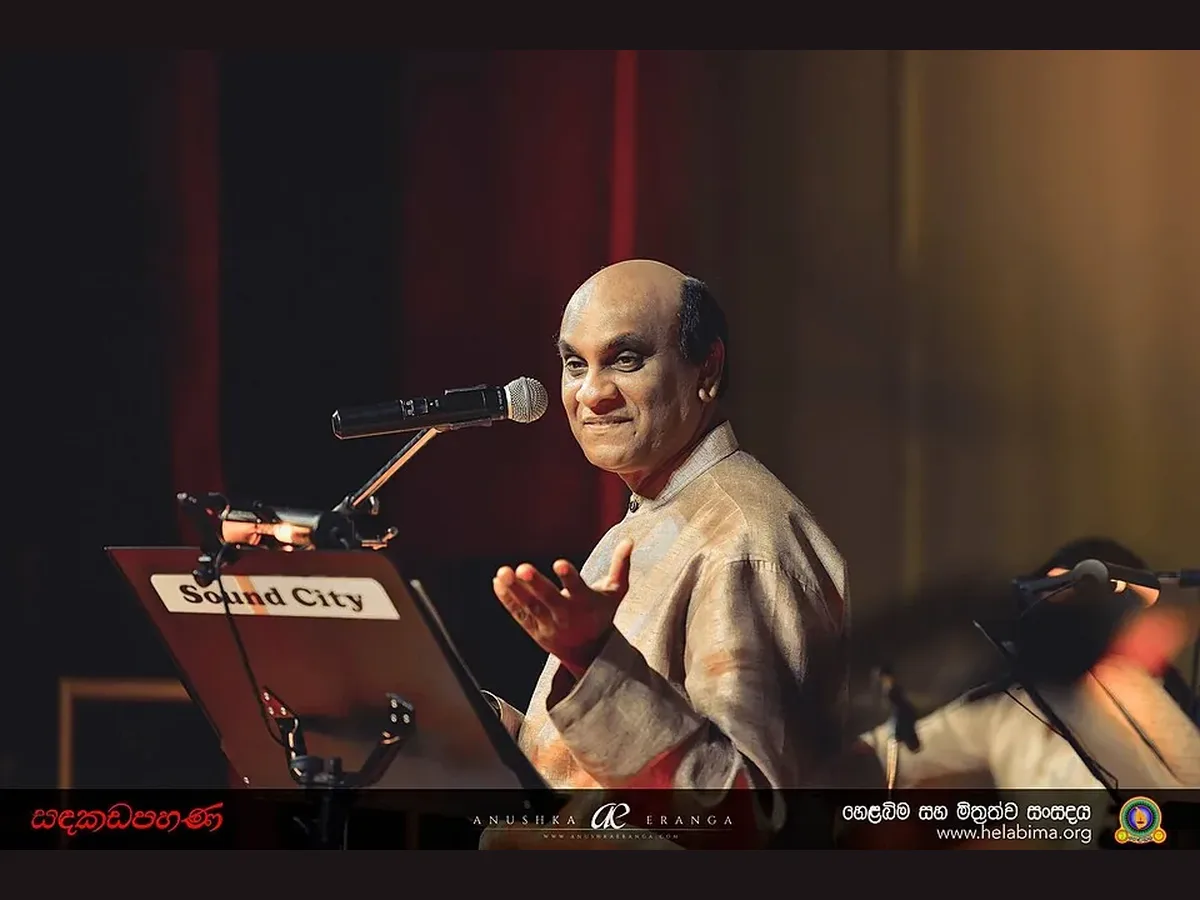
In 1969 a young man from Waragoda in Kelaniya finished school, took a job at the Government Printing Corporation, and was asked by his elder brother to sing a song. The brother was Sathischandra Edirisinghe, who was making a film called Matara Achchi. The song was සඳකඩපහණ Sandakada Pahana — named for the carved moonstone slab at the foot of a temple staircase — with a melody by Victor Rathnayake and words by Wally Nanayakkara.
It is a good song, and it could easily have been the only one. Sri Lanka is full of people who sang once for a relative's film. What Sunil Edirisinghe did instead was go to India, get a degree, and come back with a technique.
Seven children in a rubber district
Patikirige Sunil Jayapreethi Edirisinghe was born on 19 December 1949, the youngest of seven children of Patikirige Edirisinghe and Ushettige Elizabeth Perera, and grew up around Waragoda in Kelaniya when the rubber industry there was expanding. It was an artistic household by accident rather than design: the eldest brother Dharmasri worked in the fine arts, his sister Mercy taught music, and two brothers, Sathischandra and Nimal, went into film.
He was schooled at Sri Dharmaloka Vidyalaya, moved to Sapugaskanda Maha Vidyalaya, and sat his A-levels at the Delgoda Kalyana Pradeepa Pirivena — a monastic school, which is a detail worth noticing in a singer whose diction later became one of his trademarks.
Lucknow
In the early 1970s he studied under the Visharada P. V. Nandasiri at his academy of music, and then went to India. In 1975 he graduated with first-class honours from the Bhatkhande academy in Lucknow, one of the two or three institutions that shaped almost every trained Sinhala classical singer of the twentieth century. He joined the Sri Lanka Broadcasting Corporation soon afterwards.
The training shows. Edirisinghe's singing is unusually clean — deliberate consonants, a straight tone, ornament used sparingly and on purpose. In a period when Sinhala popular song was moving fast towards the cassette and the electric keyboard, he stayed on the classical side of the line and made a career there anyway.
His first cassette, Chandra Mandala, came out in 1980 — which places him precisely at the hinge of Sinhala music history. The cassette was about to replace the radio disc as the way songs reached people, and it rewarded singers who could fill a forty-minute tape with material of a consistent character. Edirisinghe could.
It also placed him in the SLBC at a moment when a state grading panel still decided who was allowed to record and at what rank. He came into that system with an Indian degree in hand, which was the surest route through it.
Rohana Weerasinghe, and the shape of the catalogue
The partnership that produced most of his best-known work is with the composer Rohana Weerasinghe. Between them, and with a rotating cast of lyricists, they built a body of song that is now a standard part of the Sinhala concert repertoire.
The most quoted of them is චන්ද්ර මණ්ඩලේ සැතපුණ පුංචි සාවියේ Chandra Mandale Sathapuna Punchi Saviye ("little hare asleep on the face of the moon"), with words by Rathna Sri Wijesinghe. There is චන්ද්ර මඬල Chandra Madala, written by Kumaradasa Saputhanthri — who supplied him with more lyrics than anyone else — and පැන මඩ කඩිති (අපේ ගුරුතුමා) Pana Mada Kadithi, Mahinda Chandrasekara's song about a teacher. From Sunil Ariyaratne came දෙවැනි බුදුන් ලෙස Dewani Budun Lesa and මල්ලියේ නරක මිතුරන් Malliye Naraka Mithuran ("little brother, bad friends"). Premakeerthi de Alwis wrote මිනිසෙකු පිට නැගි Miniseku Pita Nagi for him. Mahagama Sekera's පටු අදහස් නම් පවුරින් ලෝකය Patu Adahas Nam Pawurin Lokaya — the world walled in by narrow ideas — is in his repertoire too.
Two more should be named because of who wrote them. හඬන පණ නල Handana Pana Nala ("the weeping breath of life"), set by Lakshman Wijesekara for the film Rekha, is by K. D. K. Dharmawardena, the SLBC announcer who wrote lyrics between shifts and who also gave Amaradeva and Victor Rathnayake some of their most durable songs. And Saman Athaudahetti, a writer far better known in Sinhala than in English, wrote for him as well; Athaudahetti's lyrics were later collected under the title Malak Une Ai.
Beyond those there is a long tail — වන්නි වනපෙතේ Wanni Wanapethe, නිල් කටරොළු මල් ගොමුවේ Nil Katarolu Mal Gomuwe, සකිසඳ නුඹමය Sakisanda Numbamaya, පවුරක් සේ Pawurak Se, දුවේ නුඹ මගෙ Duwe Numba Mage — most of it recorded across the 1980s and 1990s.
Awards, and the film work
Edirisinghe's playback singing has been decorated steadily since the early 1980s. He won a Presidential award in 1983 for මායා මිරිඟුව පිරුණු ලෝ තලේ Maya Miringuwa Pirunu Lo Thale from the film Adhishtanaya. He took the Swarna Sankha award twice: in 1988 for තුරුලක හුරතල් Thurulaka Hurathal from Mangala Thagga, and in 1990 for වලාකුළක් ගෙන මුවා කරමු Walakulak Gena Muwa Karamu from Saharawe Sihinaya. He won the Sarasaviya award for playback singing in 1988 for තිදස පුරේ Thidasa Pure from the film Sandakada Pahana, and again in 2002 for පොරොන්දුව Poronduwa from the film of the same name.
There is a neatness to that 1988 award that is easy to miss: nineteen years after singing "Sandakada Pahana" for his brother, he won a Sarasaviya for a song in a film called Sandakada Pahana.
Still working
Sandakada Pahana is also the name he has given his solo concert, which he has toured for years — a June 2018 staging at the Dharmaraja College auditorium in Kandy had Susil Amarasinghe leading the orchestra and a script written by Pushkara Wanniarachchi. In 2021 he released Sunila Yamaya, a pair of LPs built from a concert performance with eighteen songs and short spoken passages between them, at a moment when almost nobody in Sri Lanka was pressing vinyl.
His daughter Sankani Edirisinghe also sings.
What is unusual about the career, looked at from a distance, is how little it changed. Singers of his generation who stayed employed generally did so by moving — into film playback, into television theme songs, into whatever the cassette market was buying. Edirisinghe moved a little, but the voice on Sunila Yamaya is recognisably the voice on Chandra Mandala four decades earlier: the same restraint, the same insistence on the words being audible. In a musical culture that argued for most of the twentieth century about how much North Indian ornament a Sinhala singer should use, he settled the question for himself in Lucknow and then never revisited it.