
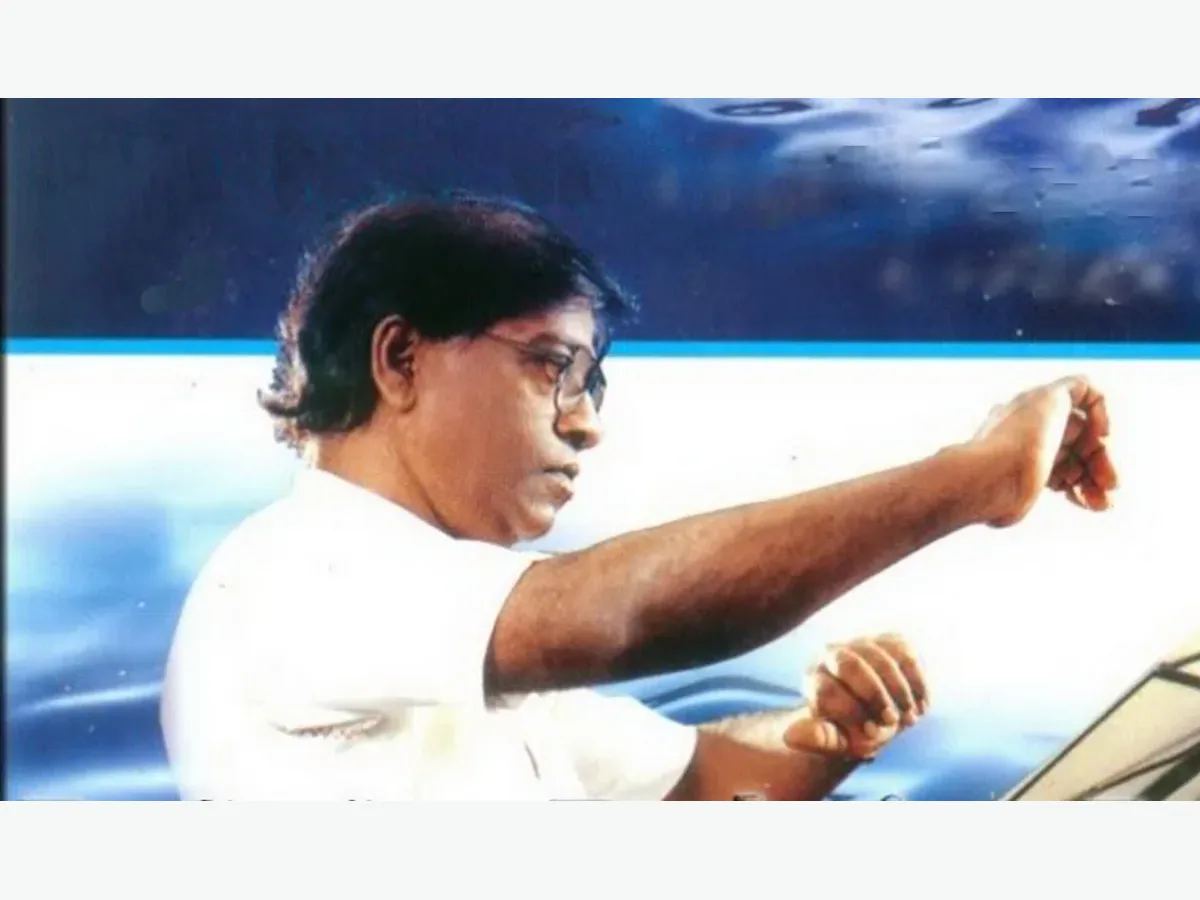
For most of the 1960s he was the man with the sitar in the back of somebody else's orchestra. R. Muttusamy's, first — the violinist who had worked on the very first Sinhala feature — and then, again and again, Premasiri Khemadasa's. A session sitarist is paid to be exactly what the composer asks for and nothing more. Sarath Dassanayake did that for about a decade, and then spent the next twenty-seven years being the composer, on a scale almost nobody in Sinhala cinema has matched.
Everything he tried before music
He was born in Katukurunda, Moratuwa — the second child of Don Dharmapala Dassanayake, a businessman, and Malalage Podi Nona Peiris, a teacher. He was a bad student who moved between a great many schools, several of them wherever his mother was posted: Anuruddha Vidyalaya in Nawalapitiya, then Ja-Ela, then Laksapathiya, then Hunumulla Central, and finally the Buddhist school at Horana that is now Don Pedrick Maha Vidyalaya, where in 1957 he passed the Senior examination and surprised everybody.
Then came a run of jobs that did not take. He trained as a garage mechanic. He worked as a radio reporter. He learned typing and log-keeping. He sat the public health inspector examination, passed the preliminary stage, and went to the Treasury near Parliament for the rest of it, and did not get the post.
What is told about the turn to music is that in October 1959 he walked into Sri Palee, the arts college at Horana, and found the place closed: the artist Edwin Samaradiwakara had died and it was the day of his cremation. Two teachers there, the music master Hewage Premadasa and the dance master Weerasena Gunatilleke, told the boy standing at the gate that where one artist had gone another should come, and let him in. Sources give the date as both 1958 and 1959, and the story reaches us through the Sinhala press rather than from a document, so it is best read as the way he liked to tell it.
He learned sitar properly — at the Government College of Music under teachers including Lionel Edirisinghe, and he led the college orchestra. In 1961 he joined R. Muttusamy's band of players. His first film credit, as sitarist, was Udarata Menike in 1963.
Out of the back row
Music did not pay, so he taught it. He was a music teacher at Bibila Central College, then at Piliyandala, then a Music Inspector working the Anuradhapura, Polonnaruwa, Vavuniya, Trincomalee and Jaffna districts. In December 1970 he married Preethi Neela Wijesundara, an esraj player he had met in the classroom at the Government College of Music. From 1977 he was Deputy Director of Aesthetic Education for the Colombo district. He was, in other words, a civil servant who happened to be scoring the national cinema in his other life.
The first score was Sithijaya in 1972, under the guidance of Wahalle Piyathilaka, followed by Vishmaya. The one that made him was සදහටම ඔබ මගේ Sadahatama Oba Mage in 1973 — a hit, and a deliberate move away from the practice, then still normal, of lifting Hindi film tunes wholesale. From there the filmography simply does not stop: Kasthuri Suwanda and Dinum Kanuwa in 1974, Awa Soya Adare and Sangeetha in 1975, Duhulu Malak and three more in 1976, and through the 1980s a rate of six, eight, ten films a year.
The songs
The scores are gone into the films, but the songs stayed on the radio.
From Dinum Kanuwa came ඉරට අකීකරු හඳට අකීකරු Irata Akeekaru Handata Akeekaru — "disobedient to the sun, disobedient to the moon". Kasthuri Suwanda gave up four at once, among them ලස්සන ලෝකෙක ඉපදිලා Lassana Lokeka Ipadila ("born into a beautiful world") and හද විමන් දොරින් Hada Viman Dorin. From Sangeetha came Lokaye Wenas Wune and Sal Sapuna.
Away from the cinema he wrote for the concert and radio repertoire too, and the list of singers tells you how wide his reach was: බොල් වී අහුරු Bol Vee Ahuru for W. D. Amaradeva; පුංචි දවස්වල නින්දට යද්දී Punchi Dawaswala Nindata Yaddi for Sujatha Aththanayaka, built on the old jayamangala singing manner over a plain rhythm; කන්දේ විහාරේ Kande Vihare for Chandralekha Perera; සැරයටියෙන් අපි යනෙන තුරා Sarayatiyen Api Yanena Thura as a Vijaya Kumaratunga and Chandralekha duet; Pem Sililare as an Amara and Dayaratne duet; හිම කඳු යහනේ Hima Kandu Yahane; සිහින අහසේ වසන්තේ Sihina Ahase Wasanthe. He set සමනල මුදුනේ සිරිපා සිඹ සිඹ Samanala Mudune Siripada Simba Simba — words written by Ranasinghe Premadasa, later President — for H. R. Jothipala.
He was also the composer who first put several major voices onto film soundtracks: T. M. Jayaratne, Neela Wickramasinghe, Gratien Ananda and Chandralekha Perera all made their playback debuts in films he scored.
Awards, and the films he paid for himself
The Sarasaviya awards for best music direction came in 1983 for Athin Athata, in 1984 for Sasara Chethana, in 1992 for Muwan Palessa and in 1993 for Chaya.
He also produced. Mihidum Sihina (1982), Madhu Sihina (1990) and Aathma (1994) were his own productions — an unusual step for a composer, and one that says something about how completely the film industry had become his working life.
The numbers, and the dates
The figure attached to his name everywhere is roughly 150 films and around 600 film songs. It comes from the National Film Corporation's artist file and is repeated by the Sinhala press; it is a round number and should be read as one, though the published filmography alone runs to well over a hundred titles, with several released after his death and one, Kota Uda Express, as late as 2017.
Two dates are less settled than they look. English Wikipedia and the biography reproduced on films.lk both give his birth as 13 August 1942, but the summary panel on that same films.lk page gives 1943. And while English-language sources date his death to 18 November 1999, the Sinhala Wikipedia article says 18 December. This entry uses 13 August 1942 and 18 November 1999, which are the better-attested forms, but the disagreements are on the record.
He died in 1999, aged fifty-seven, after a short illness. His eldest son, Ranga Dassanayake, lectures in sound at the University of the Visual and Performing Arts and works as a film music director himself. In November 2015 a tribute concert, Sarath Siritha, was staged at the Tharangani cinema in Colombo — sixteen years on, and there were still enough of his songs to fill an evening several times over.