
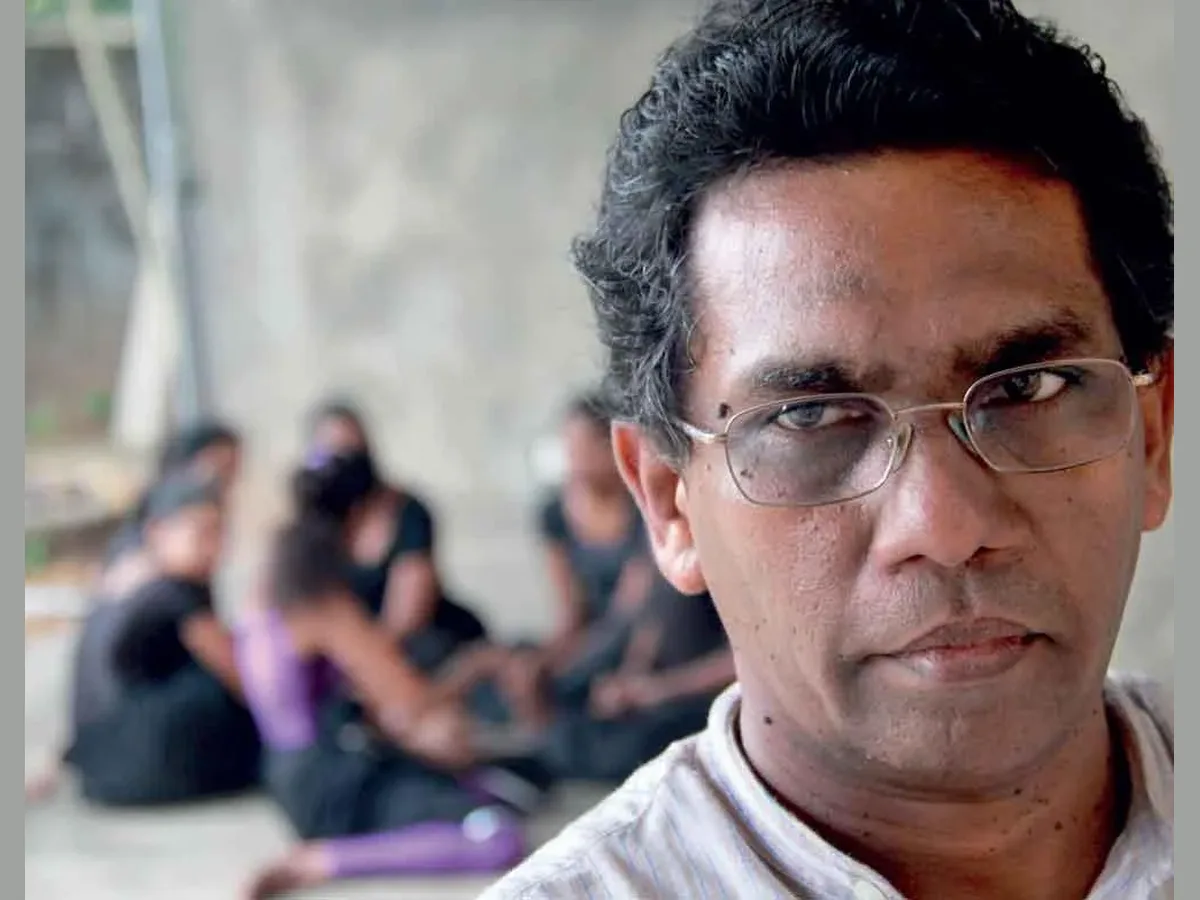
In March 2006, in a park in Adelaide, an ensemble from Sri Lanka appeared three times on the WOMADelaide programme — twice as a performance and once as a workshop, which at that festival means an hour in which the audience is handed instruments and expected to try. The drums they had brought were ගැට බෙරය geta beraya, the barrel-shaped, waist-slung, two-headed drum of the Kandyan tradition, whose two skins come from different animals so that one side booms and the other rings. The man leading them was Ravibandhu Vidyapathy.
He is, by common consent, the best-known Sri Lankan drummer alive. He is also one of the least documented in English, which is why this article is shorter than it should be.
A house full of teachers
He is the eldest son of Somabandhu Vidyapathy, the classical painter and sculptor best remembered for the wall paintings at the Bellanwila Raja Maha Vihara, and the country's pioneer of costume and set design for dance and ballet. Somabandhu had learned painting, sculpture and dance from his father, James Fernando, a traditional dancer and craftsman. Ravibandhu's mother, Malathi Somabandhu — Sinhala sources also give the name as Malani — was a Kandyan dancer and the daughter of the dance guru Algama Kiriganitha. His brother Manubandhu Vidyapathy became an art critic.
So he inherited three trades at once, and took all of them. He learned painting, sculpture, costume and stage design from his father, and he learned classical Kandyan dance from Chitrasena and Vajira, the couple who more than anyone else moved Kandyan dance from ritual courtyard to proscenium stage.
Two gurus of the drum
The drumming came from two teachers named on the Arts Council's profile of him: Piyasara Shilpadhipathi, the Kelaniya University geta bera master who took Sri Lankan drumming abroad and invented a drum of his own, and a guru given simply as Punchiguru.
That lineage matters more than it may look. Kandyan drumming was for centuries transmitted inside the Berava caste, taught from father to son and tied to ritual obligation rather than performance. Shilpadhipathi's generation moved it into a university department; Ravibandhu's carried it onto a concert stage and then onto festival stages abroad. Each move changes what the drum is for.
He did not stop at Sri Lankan drums. He studied Kathakali — the masked dance-drama of Kerala — at the Kerala Kalamandalam, and Hindustani music under Ustad David Podiappuhamy of Maihar and Shri P. V. Nandasiri. He plays pakhawaj and tabla as well as geta bera, which is an unusual span: the pakhawaj is the classical North Indian barrel drum, and having both it and the geta bera under the same pair of hands is the technical basis of most of what he has done since.
The Kala Beraya
In 1997 he introduced a new drum, the කලා බෙරය Kala Beraya. It is the fact most often cited about him, and also the one on which published detail is thinnest: the Arts Council records that he brought it into Sri Lankan music and that it contributed to what it calls the progressive drumming art of the country, without describing the instrument.
That is worth being honest about. Traditional Sri Lankan drums are defined very precisely — by region, by which hand or stick strikes them, by the animal each skin comes from. A new drum is therefore a real claim, and a reader deserves to know that the claim is on record while its specifications are not, at least not in any source reachable online. Anyone with a photograph, a measurement or a maker's account of the Kala Beraya would be adding something genuinely new.
What is clear is the direction of his work. He has spent his career setting Sri Lankan drums against other musics — jazz, Western classical, Indian classical — rather than presenting them as museum pieces, and he choreographs as well as plays, across traditional pieces, full-length narrative ballets and short abstract works.
Honours, and what is not known
In August 2019 President Maithripala Sirisena conferred national honours on seventy people at the BMICH. On the Kala Keerthi list, among the artists, was Navaratna Ravibandhu Vidyapathy. He serves as Vice Chairman of the Arts Council of Sri Lanka.
Beyond that, the English-language record is genuinely poor. There is no Wikipedia article about him in any language. His personal website no longer resolves. His birth year could not be established from any source consulted here, and this entry leaves it blank rather than guess. He is often said to have performed at the Kennedy Center in Washington; that appearance may well have happened, but no listing or report confirming it could be found, so this article does not assert it. The WOMADelaide programme for 2006 is the one international engagement that can be documented outright.
For a musician of his standing, that is a startling gap — and a fair illustration of the wider problem this site exists to address. Sri Lanka's drummers have been the least written-about of its musicians for as long as anyone has been writing about music here, and the reasons for that are older than any of the archives.