
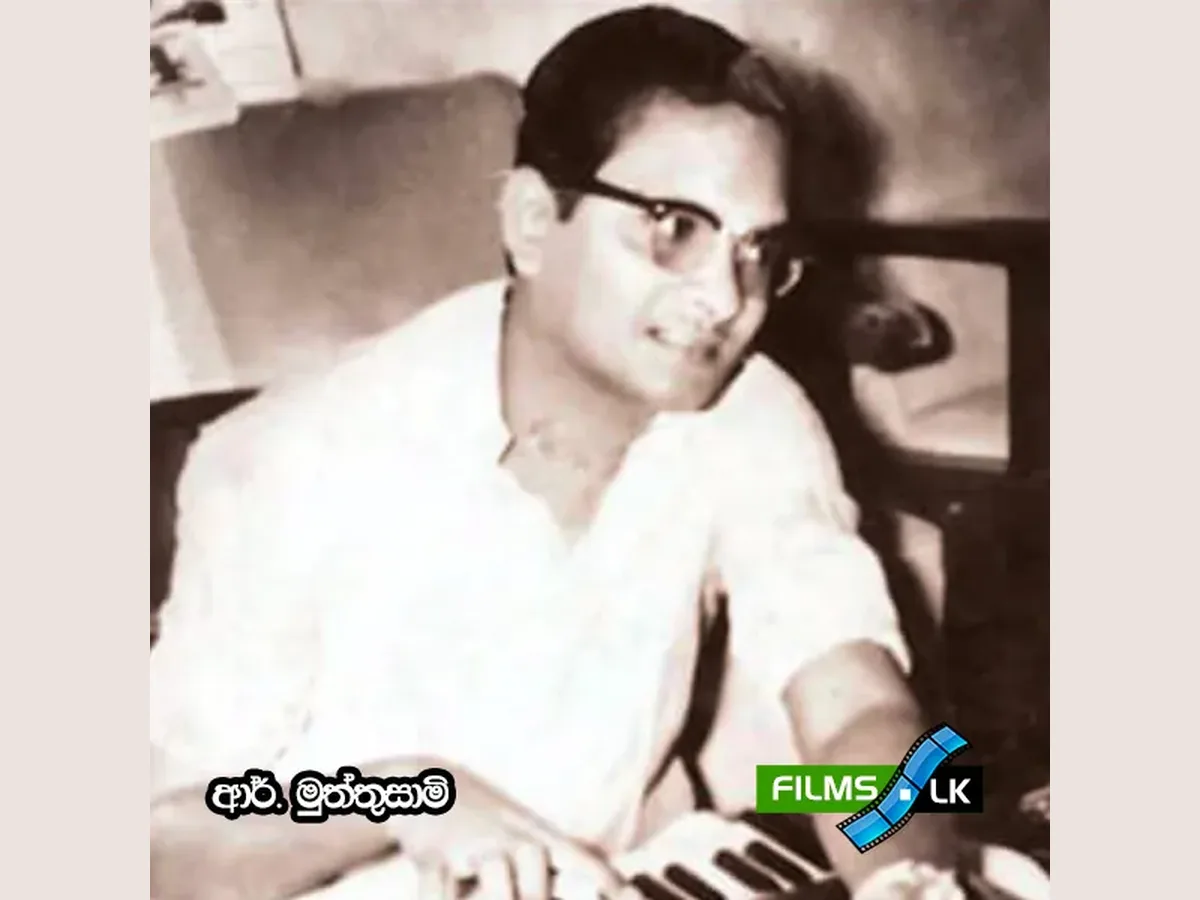
In 1946, in a recording room in South India, a twenty-year-old violinist was working through the score for a film in a language he did not speak. The film was කඩවුනු පොරොන්දුව Kadawunu Poronduwa — "The Broken Promise" — and it would open at the Kingsley Cinema in Colombo in January 1947 as the first Sinhala feature ever made. The music director, R. Narayana Iyer, noticed how good the boy on the violin was and promoted him to assistant.
Sinhala cinema's very first soundtrack, in other words, was assembled by a Tamil crew, and the young man taking Narayana Iyer's instructions was Ramaya Muttusamy of Nagercoil. He liked the look of Ceylon. He stayed for the rest of his life, and by the time he died in 1988 he had written the music for something like 225 Sinhala and Tamil films — which is to say that a very large part of what the island heard at the cinema for thirty-five years was written by an immigrant from Tamil Nadu.
A baby violin in Nagercoil
He was born on 5 January 1926 in Nagercoil, in the far south of Tamil Nadu near the Kerala border — the only son of the musician Ramaya Baghwather. (Sources disagree about the father: the Sunday Times and films.lk call him a Malayalee, other accounts simply "South Indian" or Tamil. Nagercoil sits on the language line, so both may be defensible. Note too that films.lk's page header gives the son's birth date as 26 January while its own biography text, like every other source, says 5 January.)
The father put a child-sized violin into his son's hands, and by ten the boy had mastered it. He played recitals around Madras, and it was through that circuit that he ended up in Narayana Iyer's orchestra for a Sinhala picture being shot at S. M. Nayagam's studio near Madurai.
His Wikipedia entry dates the Kadawunu Poronduwa work to 1941, which cannot be right — he would have been fifteen, and the film was shot in 1946 and released on 21 January 1947. Every other account puts him in that orchestra at the recordings for the film itself.
Radio Ceylon's Tamil Orchestra
Nayagam, the film's South Indian producer, encouraged him to come to Ceylon, and on 20 October 1952 Muttusamy joined the Tamil Orchestra of Radio Ceylon as a violinist. He arrived with a whole ensemble of South Indian players — the violinist G. Shanmugananthan, the ghatam and tambura player K. K. Atchuthan, the mridangam players T. Ratnam and K. Ganapathipillai, the veena player Colendavelu, E. Suppiahpillai on clarinet — all under the conductor D. S. Manibaagavathar.
He did not stay long the first time. In 1953 Nayagam opened the Sundara Murugan studio at Kandana (today SPM Studio) and asked Muttusamy to run its music department. He resigned from the station and went. But he came back: he rejoined in 1958, took over as leader of the Tamil Orchestra when Manibaagavathar's residency permit sent him home, and stayed through Radio Ceylon's conversion into the CBC and then the SLBC until he retired in January 1981 — around twenty-four years of state service in total.
Two of his innovations in Sinhala film music were instruments: the morsing and the ghatam, both Carnatic percussion, which he brought into film scores that had not used them. In 1966 he played the first electric Hammond organ imported into Ceylon, at the launch of the film Okkoma Hari.
Prema Tharangaya, and two singers' first day
At Kandana the producer K. Gunaratnam — a businessman who would come to dominate Sinhala film production — sought him out, having heard him as a Carnatic violinist. Muttusamy handled most of Gunaratnam's pictures for the rest of his life.
His debut as music director came in 1953 with ප්රේම තරඟය Prema Tharangaya. On that session he directed two young playback singers making their own debuts: Dharmadasa Walpola and Latha Walpola. It is not a small footnote. Between them the Walpolas would sing a substantial share of everything Sinhala cinema recorded for the next twenty years, and their first day in front of a microphone was run by Muttusamy. The South Indian Journalists' Association gave him a certificate for best music director for the film; he was twenty-seven.
The films, and one particular song
Then it simply did not stop: Puduma Leli (1953), Ahankara Sthree (1954), Mathalan (1955), Ramyalatha, Siriyalatha, Sohoyuro, Nalagana, Kurulu Bedda, Ganthera, Chandiya, on and on through the 1960s and 1970s.
The one everyone cites is Lester James Peries's සංදේශය Sandeshaya. Sunil Santha wrote the melodies; Muttusamy did the background score and the recording in India, and he handed a young unknown named H. R. Jothipala the song Puruthugeesikaraya ("the Portuguese man"). Jothipala's career began there, at a moment when Dharmadasa Walpola was the undisputed male voice of Sinhala film. The LP sold over a hundred thousand rupees' worth at Cargills, a startling figure for the period.
Among the songs he composed that are still sung: Harun Lantra's මගෙ නාමලී Mage Namali, Milton Perera's විනෝද වෙන්න Vinoda Wenna and මහ ගණ වනන්තරේ Maha Gana Wananthare, Narada Disasekara's ගමන නොනිමෙයි ලෝකයේ Gamana Nonimei Lokaye ("the journey in this world does not end") to words by Sri Chandraratne Manawasinghe, Mohideen Baig's අමතක කරලමු පැරණි කතා Amathaka Karalamu Parani Katha ("let us forget the old story"), and Dharmadasa Walpola's Honda Hondama Weya Lowa and ලංකාරෙන් Lankaren. He also sang: his duet with Sujatha Perera (later Attanayake), මධුර යාමේ Madura Yame, from the film Sithaka Mahima, is the recording of his own voice that outlived him. His son Mohanraj later re-recorded it with Nirosha Virajini.
Amaradeva on violin, Khemadasa on flute, Sarath Dassanayake on sitar and Victor Ratnayake on violin all played under his baton before they were famous — a list that says as much about the size of the Colombo studio world as it does about him.
Citizenship, awards and a last unfinished film
He was granted honorary Ceylonese citizenship by Prime Minister Sir John Kotelawala in 1956; sources differ on the month, with the Sunday Times and films.lk saying June and the NewsIn.Asia account giving 12 April. In 1974 the fourth Deepasikha awards named him the musician who had scored the most films. The OCIC honoured him for his contribution to Sinhala film music, and on 3 January 1987 he received the title Layagnana Vaaridhi.
On 7 October 1961 he married B. D. E. Neeliya Perera, from a Sinhalese family in Kandy. They had four children — Mohanraj, born in 1962 and later leader of the band Apsaras, and three daughters, Chitrangi, Prasanna Vadhani and Keerthika.
His last project was Samawa, produced by the actor and politician Vijaya Kumaratunga, and it was the first time father and son shared the music direction of a film. On 15 February 1988 Kumaratunga telephoned Muttusamy about the arrangements for Latha Walpola to record the final song on the 17th. On the morning of the 16th, Kumaratunga was shot dead on the verandah of his house.
Muttusamy died on the evening of Monday 27 June 1988, aged sixty-two. Ten years later, at the Elphinstone Theatre, his son conducted a concert of his songs.