
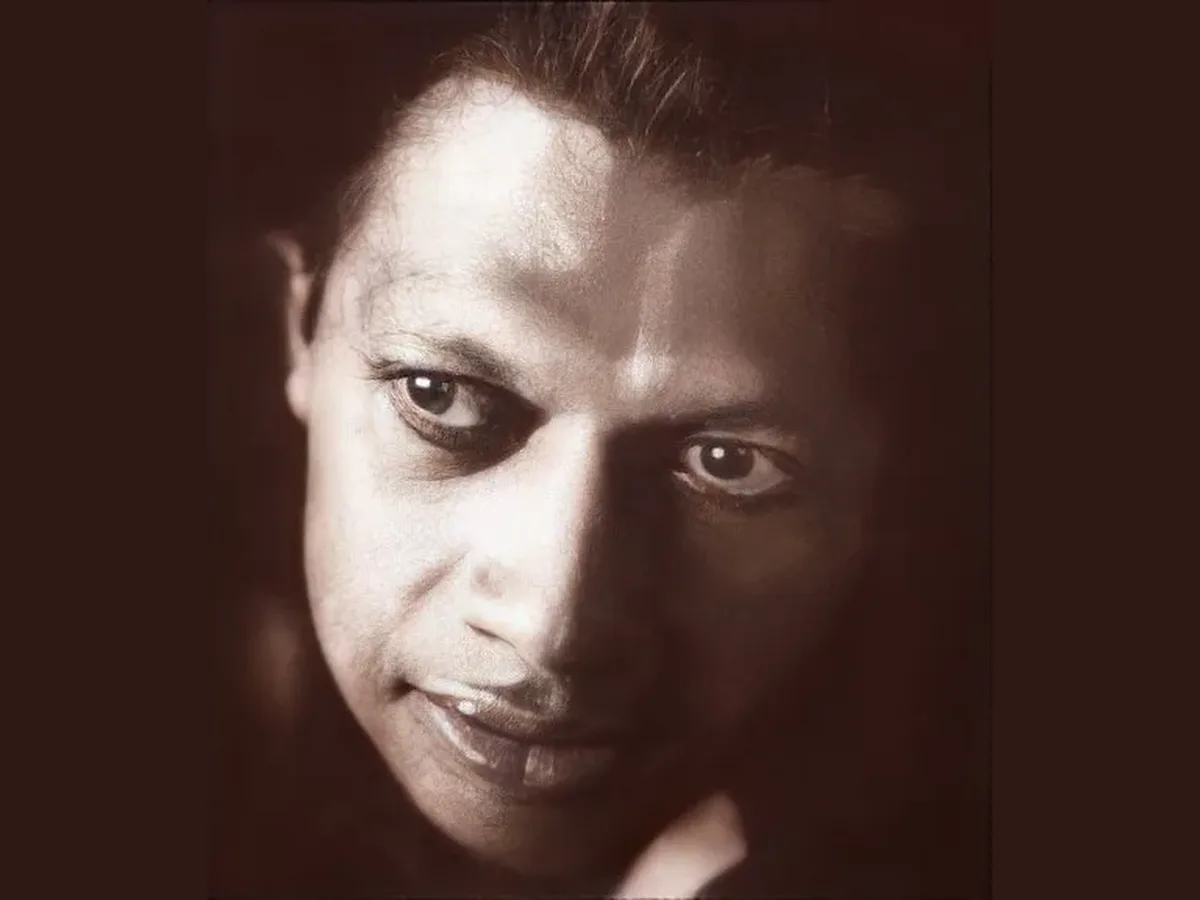
In 1961 a fourteen-year-old boy from Ananda College auditioned to sing on Radio Ceylon, and did not get in. Somebody at the station noticed something else about him: the way he spoke. He was taken on for the children's programmes instead, and over the next quarter of a century that speaking voice became one of the most familiar sounds in the country — first on radio, then on the new television service — while the singing, which he had failed at, he handed to everybody else. Premakeerthi de Alwis wrote the words to songs for more than a hundred and fifty films.
Maligakande to Ananda
Samaraweera Mudalige Don Premakeerthi de Alwis was born on 3 June 1947 in Colombo, the second child of Simon de Alwis, a railway employee from Maradana. He went first to Maligakande Maha Vidyalaya and then to Ananda College, where the editorial habit showed early: he co-edited the Buddhist student magazine Dhamma Jayanthi and compiled the school annual Anandaya in 1965. His father wanted him in the railway department. He wanted the radio.
After the failed 1961 audition, he appeared on the children's programmes Lama Pitiya and Lama Mandapaya, both associated with the great announcer Karunaratne Abeysekera. In 1966 he joined the magazine Visithura, part of the Davasa newspaper group, as a feature writer. On 17 December 1967 he began work at Radio Ceylon as a freelance announcer; he became a permanent announcer in June 1971, a Grade Two announcer in 1974, and then a programme producer.
A voice for the microphone
The programme names are still enough to date a household: Sonduru Sevana, Serisara Puvath Sangarawa, and above all Shanida Sadaya, the Saturday-night entertainment on the Sri Lanka Broadcasting Corporation. When television arrived he moved into it too, presenting Anduna, Shanidha Ayubowan and Sampath Rekha, the National Lotteries Board draw. He was posted at various times to the Rajarata, Ruhuna and Kandurata services. He wrote poetry and features for Silumina, Dinamina and Lankadeepa, and published books, among them the lyric collection Sihina Sathak.
Songs written on the nearest piece of paper
His first song, Hada Puda Asune Senehasa Bendune, was written in 1969 for Rupa Indumathi and Malkanthi Nandasiri. His first film lyric came the same year, for K. A. W. Perera's Lokuma Hinawa. After that the flow scarcely stopped. He wrote for Mohideen Baig, Milton Mallawarachchi, J. A. Milton Perera, Mervyn Perera, Malini Bulathsinhala, Freddie Silva, Priya Sooriyasena and Victor Rathnayake, among many others; the songs include Adaraneeya Neranjana, Eda Re Guwan Thotupoledi, Me Nagaraya, Oba Dedunna Akasaye, Mannaram Piti Welle and Sanda Midulata Enawa.
The veteran lyricist Rathna Sri Wijesinghe has recorded that critics called him the bard of Sinhala music for the speed with which he could produce a finished lyric, and the stories about that speed have become part of the folklore — which means they need the usual caution.
The best-known of them concerns හෙට දවසේ Heta Dawase ("tomorrow"), sung by Priya Sooriyasena. As the story is normally told, Sooriyasena arrived at de Alwis's house with a bottle of his favourite drink to ask for a song, found him rushing out, and was fobbed off with two scribbled lines telling him to come back tomorrow just as he had come today — lines that became the opening of the song. Sooriyasena himself later denied it. In a television interview he said the meeting was at the SLBC, arranged through the announcer Elmo Fernando; that de Alwis pulled a piece of paper from his pocket at the reception desk, wrote the first two lines and promised the rest tomorrow; and that Sooriyasena came back the next day from Narammala, whereupon de Alwis asked for the paper and finished the song on the spot. The charming version is not true. The true version is barely less remarkable.
Two songs he wrote for Victor Rathnayake carry better-attested stories. තනි තරුවේ Thani Tharuwe ("lone star") is said to have begun with de Alwis lying on a beach one evening with friends from the music industry, looking up, and calling out the two words as a single bright star came out. ආදරයේ උල්පත වූ අම්මා Adaraye Ulpatha Wu Amma ("mother, the wellspring of love") came from a reproach: his mother, who listened to everything he wrote, once told him he had written songs for stilt-walkers and puppets and everyone else but never one for her. He laughed it off. He wrote it about a year later, while she lay in hospital too ill to recognise him, and asked for it to be recorded quickly.
The night of 31 July 1989
At around 8.30 in the evening on 31 July 1989, armed men came to his house in Homagama. The country was in the middle of the bheeshanaya, the years of insurrection and counter-insurrection in which tens of thousands of people were killed and in which a great many artists, journalists and broadcasters died. The men are attributed in the standard accounts to the Deshapremi Janatha Viyaparaya, the armed wing of the Janatha Vimukthi Peramuna.
He tried to leave by the back door. More men were waiting in the garden. His wife pleaded with them and was told they only wanted to question him. They took him out of the house and shot him. His body was found about two hundred yards away. He was forty-two. He was cremated at the General Cemetery, Kanatte, on 7 August 1989, and a murder case arising from the killing was later tried in the Colombo High Court.
What is not established is why. No motive has ever been documented, and this article does not supply one; the various explanations that circulate — about his broadcasting, his perceived political sympathies, or a private quarrel — are speculation. Sinhala-language accounts also record that in 2009 his widow, Nirmala de Alwis, publicly disputed the attribution of the killing to the JVP altogether, saying she had evidence to the contrary. The sourcing behind that claim is thin, and it is noted here without being settled.
What remains
In July 2014 a stretch of Independence Square Mawatha, the road that runs up to the SLBC headquarters, was renamed Premakeerthi de Alwis Mawatha. It is a small memorial and an exact one: the road to the building where a boy who could not sing found out what his voice was for.
The songs are the larger memorial. They are sung constantly, mostly by people who could not name the man who wrote them — which is, in the end, what a lyricist's success looks like.