
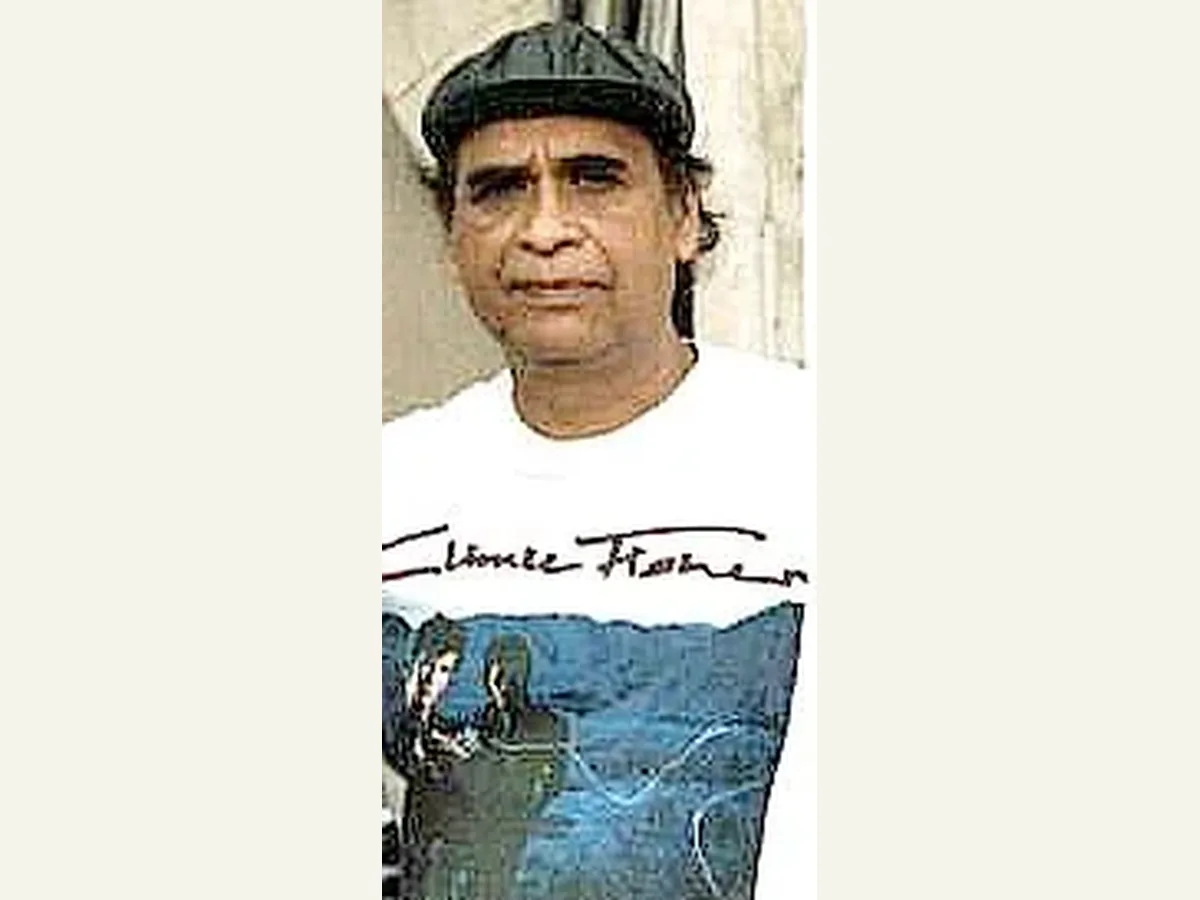
In 1968 a Sri Lankan stood in a BBC television studio in London with a singing partner named Sandra Edema and performed a song called "Feel Like a Clown" on Top of the Pops. Very few musicians from the island have ever appeared on that programme. The same year the pair sang it on Beat Club in West Germany. The B-side of the record, "Rainbow Land", was flipped to become the A-side in the United States, and decades later it turned up again as a minor collector's item among psychedelic-rock enthusiasts who had no idea the writer was from Colombo.
The writer was Nimal Mendis, and the strangest thing about him is that this is not what he is remembered for at home. In Sri Lanka he is remembered for two songs so thoroughly absorbed into Sinhala music that most people who love them have never wondered who wrote them — and both of them were written in English first.
Radio Ceylon finds him
Mendis was born on 29 March 1934 and grew up in Colombo, schooled at Royal College and S. Thomas' College, Mount Lavinia. He was playing and writing from childhood. In the late 1950s Radio Ceylon picked him up, and that mattered more than it sounds: the station's Commercial Service was then the most powerful broadcaster in South Asia, heard across India, and a song it decided to back was a song a subcontinent heard. Listeners wrote in from all over the region asking for his numbers. "Kandyan Express", "Cherry Blossom Tree", "Oh My Lover", "Butterfly in the Rain", "Champagne Blues" and "Goodnight Kisses" all date from those years. Sri Lanka had no chart to top, so claims about how high any of them went should be treated gently; what is not in doubt is that they were everywhere.
He then went to Britain, where twenty-two of his songs were published and where he stayed for much of the rest of his life. His first song recorded there was "Kiss Kiss Kiss", sung by Mary Marshall on the Columbia label. An instrumental, "Kandyan Dance", was recorded in Germany by Friedel Berlipp and his orchestra and climbed to number two on Radio Luxembourg — the English-language station that half of Europe tuned to after dark. Decca released Black Pearls & Green Diamonds, an album carrying eight Mendis songs performed by the British folk group One Two and Three. Eugene Wright, the bassist of the original Dave Brubeck Quartet, arranged and recorded five of his songs playing every part on bass himself.
Master Sir
In 1974 Mendis was music director for the film Kalu Diya Dahara ("a column of black water"), and he wrote a song for it in English, about colonial Ceylon. Its narrator is a plantation labourer addressing the man who owns his working life. The first verse turns on a raise of eight panam — enough to put a little rice in front of his child, and nowhere near enough. The second remembers the beatings, and the kneeling, and the shaking voice. Then the chorus lifts and asks whether the rope-pull between master and servant might one day stop, and the two of them become friends.
Karunaratne Abeysekera translated it into Sinhala. The Sinhala vocal on the film recording was sung by Neville Fernando of the calypso group Los Caballeros; Mendis and Sandra Edema recorded the English original. And then මාස්ටර් සර් Master Sir — often listed by its opening words, Panam Aten — was taken up by Neela Wickramasinghe, who sang it over the film's title sequence and whose version, built on the time signature and guitar figures of the English arrangement, is the one that has stayed on the radio for more than thirty years. This is worth stating plainly, because the song is grand enough and old enough that people reach for a bigger name when asked whose it is: it is Nimal Mendis's song and Neela Wickramasinghe's recording, and it belongs to neither W. D. Amaradeva nor anyone else of that generation. Bathiya and Santhush later cut an authorised cover, and it has been recorded many times since.
Banks of the River
Six years later Sumitra Peries made Ganga Addara (1980), from a novel by Letitia Botejue, with a script by Tissa Abeysekara. Mendis wrote the score, and again wrote the title song first in English, as "Banks of the River". Augustus Vinayagaratnam turned it into Sinhala, and the man who sang ගඟ අද්දර Ganga Addara was Vijaya Kumaratunga — the film's leading man, one of the most famous faces in the country, and not, until that moment, a singer. The song made him a playback vocalist. The film swept that year's Sarasaviya awards, best music direction among them.
From the same film came රන් ටිකිරි සිනා Ran Tikiri Sina ("golden little smile"), recorded in 1979 with Victor Silva and Nirasha Perera, with schoolgirls from Sangamitta Balika Vidyalaya, Borella, on the chorus; the arrangement was by Sarath Fernando. It was later covered by Neela Wickramasinghe and T. M. Jayaratne. When Sirasa TV made a Ganga Addara teledrama in 2010, Mendis produced a new version of the title song, sung by Surendra Perera. For Lester James Peries's Ahasin Polawata (1978) he wrote උපුල් නුවන් විදහා Upul Nuwan Widaha, sung by Milton Mallawarachchi.
The documentary years
Through the 1970s Mendis had been making long-form audio pieces in London — The Passion Report on the Way of the Cross, and Ferryman, which traced the history of the Sri Lankan tea-estate worker and farmer back through the colonial period. In the 1980s he and his wife Ranjani moved into documentary film, working as Mediaeye Productions with their son Paulmarie, who did the editing. Dawn of Terror, made for the Centre for Society and Religion, was an anti-war film about the ethnic conflict; Shattered Pearl, about women affected by the war, was made for Channel 4 in London. Others followed for Article 19, CAFOD and the Methodist International, filmed as far afield as Bangladesh. Three were shown at the Montecatini festival in Italy, including Stop Killing Start Singing, built around three of his songs.
He kept writing songs about what was happening around him. His stage show It's What I Am included "July '83", about the anti-Tamil riots of that year. After the 2004 tsunami he wrote and recorded a relief song in Australia, Sri Lanka and Britain; it was commended in the British Parliament in early day motion 638. In 2013 he wrote what he called the first Sinhala blues song, ගර්ල්ස් Girls, sung by Amila Sandaruwan, with a Sinhala translation by Duminda Allahendra and a video shot by film students.
What he left
Nimal Mendis died on 16 April 2015 at a private hospital in Malabe, aged eighty-one. Ranjani, to whom he had been married thirty-three years, had died in 2010.
His career reads oddly on paper — a Colombo teenager on Radio Ceylon, then Radio Luxembourg and a BBC studio, then documentary work in war zones — but the through-line is easy to hear. He wrote melodies with a light Western pop frame and put weight inside them: a plantation worker's wage, a river, a riot, a country's grief. That two of his best-known Sinhala songs began life in English is not a curiosity but the point. They crossed, and the crossing left no seam.