
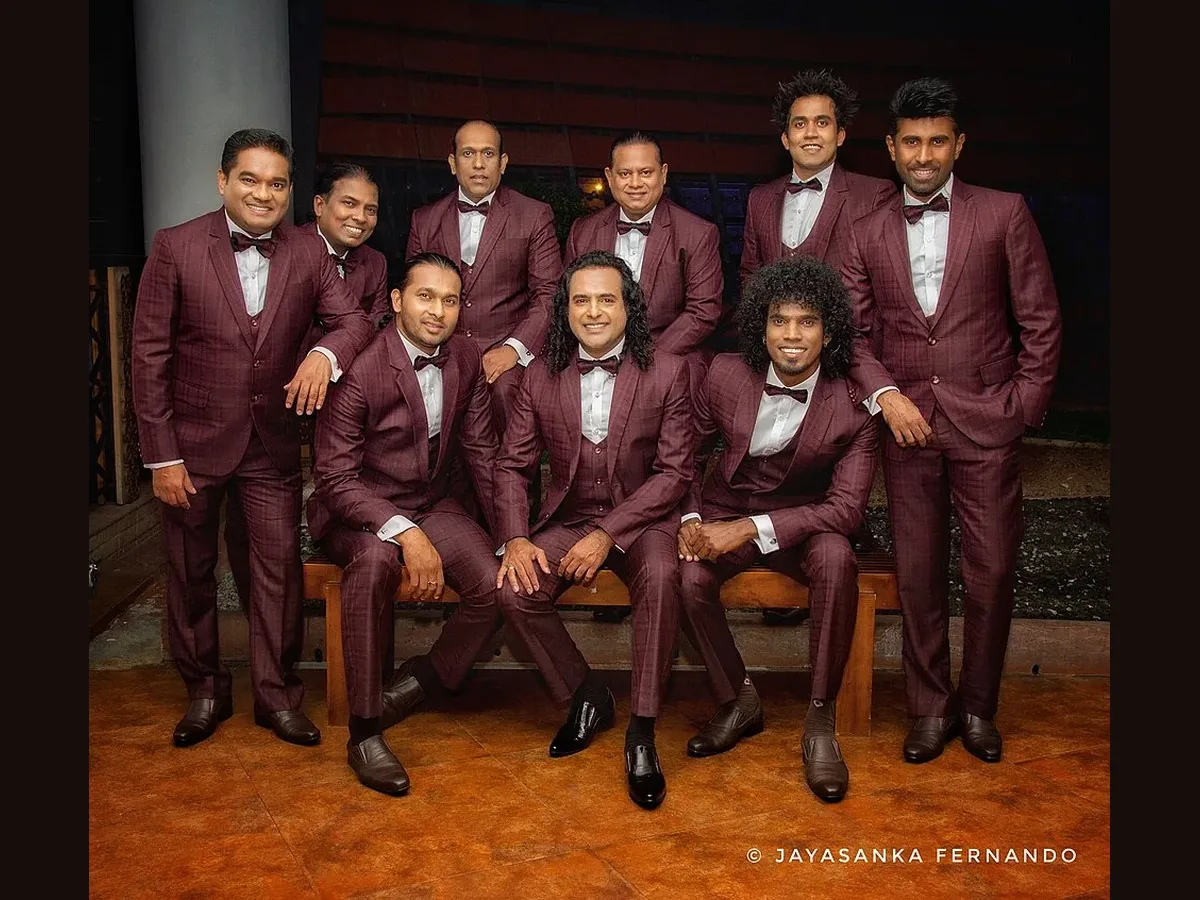
The band was formed to do a job nobody remembers now: to back the contestants at a singing competition at St Mary's College, Chilaw. The boy who put it together was the school's head prefect, and when the group needed a name it was the principal, Rev. Brother Aloysius, who supplied one. Marians, after the school. They played their first concert on 11 February 1988 at the Sudasuna auditorium.
Thirty years later the same man was still leading the same band, and had changed the way live music works in Sri Lanka in the process.
Chilaw
Mahabaduge Nalin Anjelo Perera was born on 15 October 1969 in Chilaw, the eldest of five, and was educated at St Mary's College there. He has said that it was Sunil Perera of the Gypsies who made him want to do this, and in 1985 he joined a group called the Nightingales as a vocalist. Three years later he was head prefect, and Marians existed.
For most of the first decade they were a backing band. Through the early 1990s they played outdoor shows supporting guest artistes — the standard apprenticeship of a Sri Lankan band, and one most bands never leave. They collaborated with the Gypsies and with Sunflowers, and by the middle of the decade Marians had a name of their own. From 1997 to 2008 Perera also presented Kageda Gee Nada on Sirasa TV, which put his face in front of a national audience every week, and he took a lead role in the film Eka Malaka Pethi, directed by Mohan Niyaz.
Unplugged
The thing that changed everything was a decision to take the amplifiers away.
Marians Unplugged — acoustic arrangements of Sinhala songs everyone already knew, played to a seated theatre audience rather than a dancing one — began in 2006 at the BMICH. By November 2008 they were staging the seventeenth of them, at the Maris Stella indoor stadium in Negombo, and had taken the format to the Middle East and Europe. Perera's own assessment at the time was unsentimental: the recognition the band got from two years of unplugged shows, he told the Sunday Times, was enormous compared with the popularity of the previous eighteen years.
Accounts differ slightly on how it started. The 2008 and 2018 reports place the first unplugged concert in 2006 and a dedicated Clarence Unplugged series, built on Clarence Wijewardena's songs, in 2008. A 2012 profile has Perera saying the change began with an unplugged show in memory of Wijewardena, which would put the tribute at the origin rather than two years in. Both versions agree on the repertoire and its effect.
The material was the national songbook: H. R. Jothipala's Oba Nidanna Oba Nidanna and Neela Desa Pura, calypsos like Kadukare and Sandak Negi Sandak Dile, Clarence Wijewardena and Milton Mallawarachchi, and later a Kings of the 70s series built around Jothipala and C. T. Fernando. Around them the band wrapped jazz, country, blues and classical treatments, along with English and Hindi numbers — "Hotel California", "Let It Be", "Summertime" — so that a single evening moved between idioms that Sri Lankan concert-going had kept in separate rooms.
The consequences were larger than one band. The unplugged concert, the tribute concert to a dead songwriter, and the sing-along evening at which the audience is handed the words, all became standard fixtures of the local live circuit in the years that followed. Marians did not invent nostalgia, but they built the format that packaged it.
The songs of his own
Amid all the reinterpretation, Perera has written and composed a body of original material. අංජලීකා Anjalika, his melody to a lyric by Rohana Kumara, is the one most often named. He composed සුළඟක් වෙලා Sulagak Wela to words by Nandana Wickramage, මම හීනයක් Mama Heenayak to words by Madushani Sarukkali, බඹා කෙටු හැටි Bamba Ketu Hati to words by Kelum Srimal, and ආවර්ජනා Awarjana. For සාගරේ තරම් මම ආදරේ අරන් Sagare Tharam Mama Adare Aran he wrote the words himself and Udara Samaraweera set them.
It is a modest catalogue beside the hundreds of songs by other people that the band has rebuilt, and that proportion is itself the point of Marians. Their trade is not writing the canon; it is keeping it in performance, in arrangements good enough that people pay theatre prices to hear songs they already own.
Running a band as a business
Perera has been unusually explicit about the commercial machinery underneath all this, in a scene where most musicians prefer not to discuss it.
Marians Sound Gear, the band's own professional sound-reinforcement operation, was launched in 2004, and by the mid-2010s it was hiring out to local and foreign artistes; a recording studio followed around the silver jubilee. The band works the whole ladder — indoor concerts, corporate events, five-star hotel dinner dances, the old-boys' balls of St Joseph's and Trinity, the tea trade and planters' dances — and Perera has been open about still taking weddings, which he describes as a good occasion to render a service with music.
The line-up has been stable in a way Sri Lankan bands rarely are. Where it began as seven schoolboys, the 2018 group was nine: Perera leading, Prasanna Rosa on lead guitar, Ruwan Fernando on rhythm, Chaminda Silva on bass, Dileepa Mangala on keyboards, Subash Punyasoma on drums, Jayantha Kandabadage on percussion, Shehan Jayasooriya on saxophone and Shivantha Fernando on vocals. Several of them had been there for decades.
Thirty years
In July 2018 Marians marked thirty years with two concerts at the BMICH on consecutive nights, billed as Thaala. They had done the same thing at twenty-five, in 2012, and again at the Nelum Pokuna in 2016 for the Kings of the 70s show. Few Sri Lankan bands survive their founders' twenties, let alone reach a stage where anniversary concerts are an institution.
Perera's stated ambition, in the 2018 interview, was the global market. Whether or not that arrives, the domestic achievement is already fixed: a school band from Chilaw that outlasted almost everything around it, and taught the country a new way to sit and listen to its own old songs.