
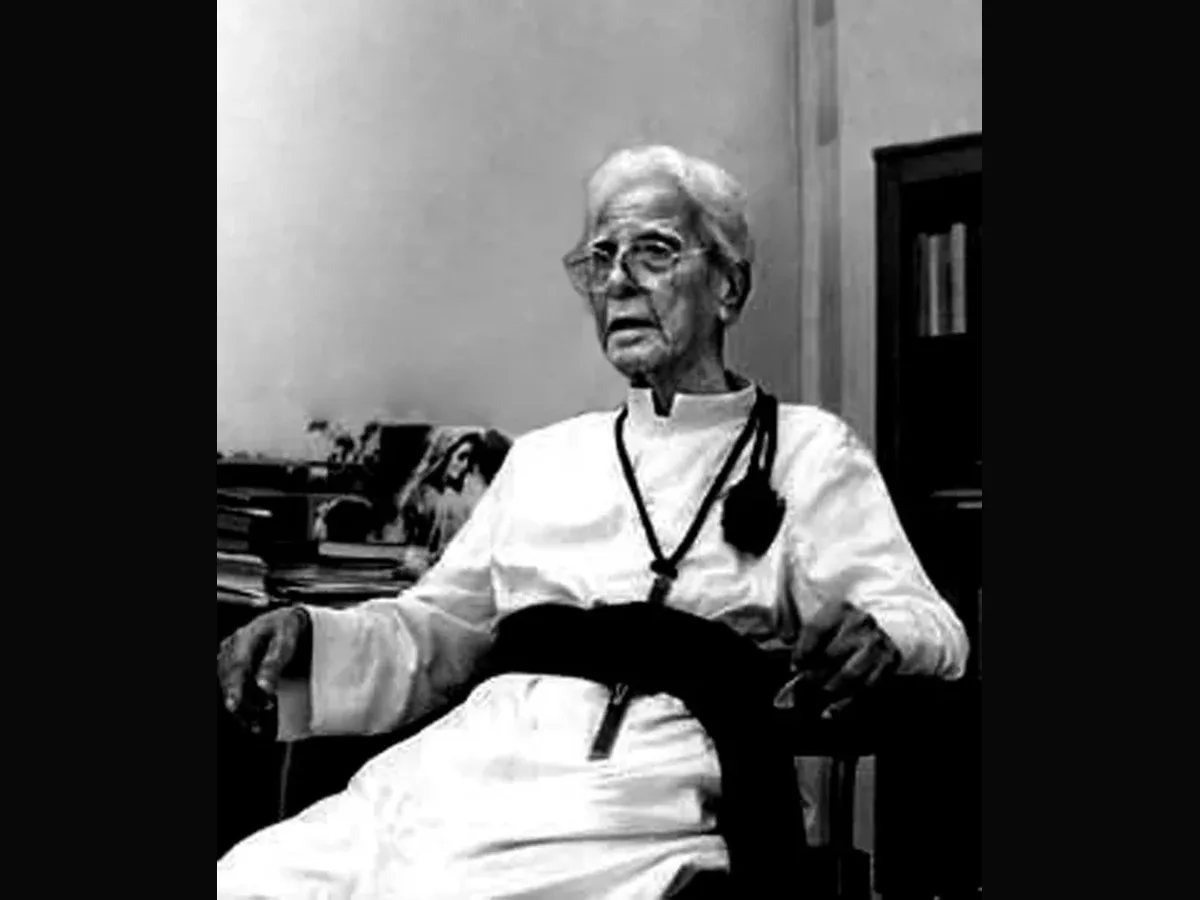
A young Catholic priest, officiating at the wedding Mass of one of his own relatives, decorated the sanctuary with lotus flowers. In the Ceylon of the 1930s this was close to scandal: the lotus belonged to the temple, the church belonged to the West, and the line between them was not something a curate was expected to smudge. He was hauled into controversy over it.
Sixty years later the country would call him පන්සලේ පියතුමා Pansale Piyathuma — the priest of the temple — and a Buddhist prelate would write a book about him, the first of its kind anywhere. In between, Marcelline Jayakody wrote somewhere between eight hundred and a thousand songs, and a great many of them are sung by people who have never been inside a church.
Dankotuwa to the seminary
He was born on 3 June 1902 at Dankotuwa, on the north-western coastal belt, into the family of a farmer who was also a herbal physician. He was schooled at Madampe and then at St Joseph's College in Colombo, where at one point he had to drop out for a year because his family could not find the fees — an experience he never forgot, and which later made him a public defender of Ceylon's free education scheme even though his own Church had fought it.
He had decided at about ten years old to become a priest. He entered the seminary in 1920 and was ordained into the Oblates of Mary Immaculate in December 1927 by Archbishop Anthony Coudert — accounts give the date as either the 20th or the 21st. At St Joseph's he had already grown troubled by what he saw as a rift between a Western-facing Christianity and the Sinhala Buddhist culture around it, and closing that gap became, in the words of his Magsaysay citation, his personal quest.
He was a working musician as well as a priest: competent on violin, piano and organ, and, after studying at Rabindranath Tagore's Visva-Bharati at Santiniketan, on sitar and tabla too. Sources place that Indian training at different points in his life; one well-known account has him leaving for Santiniketan around 1950 without the permission of his Church superiors, and being posted to Jaffna on his return as a rebuke.
Duwa, and the hymns that sounded Sinhala
In 1933 he began writing a newspaper column and composed his first hymn, Sapiri Sama ("full of grace"). Six years later he was made parish priest of Duwa, the island village off Negombo that stages Sri Lanka's Passion Play.
The Duwa play had until then been performed with puppets. Jayakody rewrote the script and composed new hymns to sit alongside the traditional pasan — the sung Passion laments of the Catholic coast — and then did the thing that changed it: he replaced the puppets with living actors, eventually more than 250 of them, all drawn from the one small island. Accounts differ on the source text; some say he worked from the centuries-old Dukprapthi Prasangaya of Fr Jacome Gonsalvez, others that he adapted Dorothy L. Sayers's radio cycle The Man Born to Be King. What is not in dispute is the result: for a while the Duwa Passion was reckoned the greatest Passion show in Asia.
Around independence he began writing hymns with a deliberately village idiom — Ronata Vadina Bingu Obay ("you are the bee that comes to the pollen"), Nelum Pipeela Pethi Visireela ("the lotus has bloomed, its petals scattered"), Suvanda Jale Pipi Kumudiniye ("O lily blooming in scented water"). The imagery is Sinhala poetry's; the theology is Catholic; and the tunes are close enough to the ground that non-Catholics sing them without noticing they have crossed a border. Most of the hymns heard in Sri Lankan churches today are his.
In 1949, when the first anniversary of independence needed a choir to sing Namo Namo Matha and its composer Ananda Samarakoon was abroad, it was Jayakody who was asked to train the singers. He drilled the students of Musaeus College — a Buddhist girls' school — and the performance is remembered as having helped push the song towards becoming the national anthem.
Rekava
In 1956 Lester James Peries made Rekava, the first Sinhala film shot entirely in Ceylon and still the only Sri Lankan film nominated for the Palme d'Or. He wanted songs that were not imitations of Hindi film numbers, and he went to two men who had spent their careers refusing exactly that: Jayakody wrote the words, Sunil Santha wrote the music.
They are still sung. ඕලු නෙළුම් නෙරිය රඟාලා Olu Nelum Neriya Rangala — water lilies and lotuses swaying like the fold of a woman's cloth — was sung by Sisira Senaratne and remains the film's signature. සුදු සඳ එළියේ Sudu Sanda Eliye ("in the white moonlight") was sung by Indrani Wijebandara, and වෙසක් කැකුළු Wesak Kakulu ("Vesak buds") by Indrani Senaratne. Sources disagree on how many songs he wrote for the film — five is the usual count, while his Magsaysay citation says six and dates the writing to 1957 rather than 1956.
Rekava flopped at the box office. It did something else instead. When the Sunday Observer ran a poll that year to find the leading personality of the film world, Jayakody led it from the start. He publicly protested that he had only written the words and that the music was Sunil Santha's; the readers voted for him anyway, over Rukmani Devi, B. A. W. Jayamanne, Sirisena Wimalaweera and Mohideen Baig. Presenting the award, the Minister of Education W. Dahanayake said that if he could write a single song like that, he would count it a greater achievement than being a minister.
The rebel
Jayakody was a professional journalist as much as a lyricist, and it repeatedly got him into trouble. Appointed editor of the Catholic weekly Gnanartha Pradeepaya in late 1949, he expanded it, gave its masthead a Sinhala design that the paper still uses, and then refused an instruction to reproduce the English Catholic Messenger in Sinhala — that, he said, would be translation, not journalism. He left.
In 1976, with the Colombo archbishopric vacant and factions lobbying Rome, he wrote in his Messenger column that the best qualification for a bishop was to be found in the Gospel. The column was discontinued. He moved his poems to the magazine Kaviya instead, writing there in warm appreciation of Sinhala Buddhist culture; the collection became Muthu ("Pearls"), which won the state literary prize for poetry — 1979 by most accounts, 1980 by his Magsaysay citation — making him the first Catholic priest to take a state award.
He was a member of the Hela Havula, the Sinhala-language purist movement, and for decades president of the Sinhala Poets' Association. In 1958 he set up a faculty of Eastern art at St Peter's College, and he ran a school, Kala Lanka, that trained children from poor families in the performing arts at his own expense.
Pansale Piyathuma
In 1982 the state gave him the title Kalasuri and the Church gave him the Kithu Nandana Pranamaya. In 1983 he went to Manila to receive the Ramon Magsaysay Award for Journalism, Literature and Creative Communication Arts — the citation credits him with lyrics and music for "some 1,000 songs" that "helped bridge the religious and ethnic divide in Sri Lankan society". Output totals for this generation are notoriously elastic, and other accounts put the figure nearer 800; the safe statement is several hundred at minimum, across hymns, carols, lullabies and film songs.
The prize money he split three ways: one share to the arts centre for underprivileged children, one to the Sinhala Poets' Association, and the rest to scholarships for poor students. He kept living simply.
Ven. Dr Ittapane Dhammalankara Thera later wrote his life as මල් පැලේ උපන් පන්සලේ පියතුමා Malpale Upan Pansale Piyathuma — "the priest of the temple, born in the flower hut" — which is recorded as the first book anywhere by a Buddhist prelate about a Catholic priest. He died on 15 January 1998, at ninety-five.