
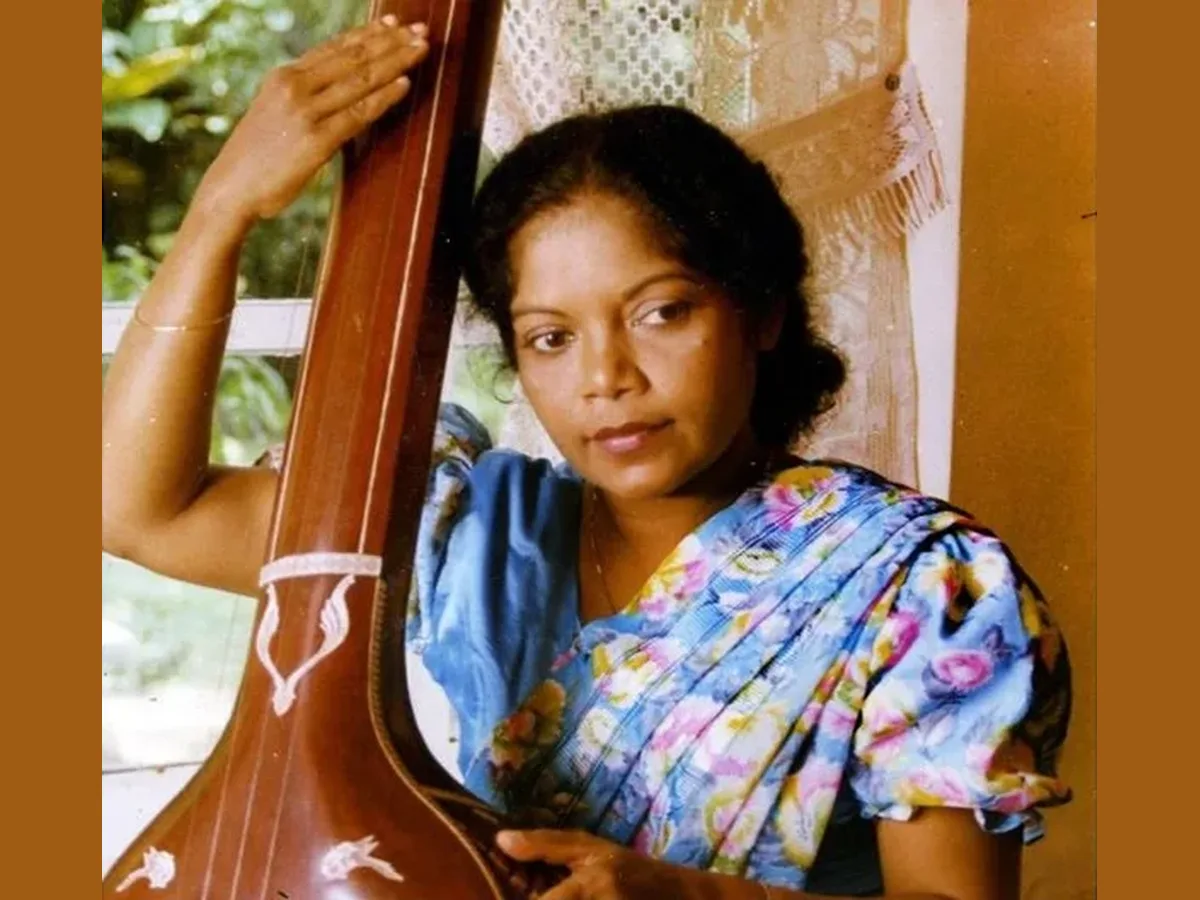
There is a grave at the Borella cemetery with a photograph set into it and a stone veena carved on top. It belongs to a singer who died three thousand miles away, in a consul's house in Los Angeles, while getting ready for a concert. She was fifty-one, and the Sri Lankan press spent the following fortnight speculating about how it had happened, mostly wrongly.
B. S. Malani
Malani Bulathsinhala was born on 12 December 1949 in Boralesgamuwa, the eldest of the three children of Wilson and P. K. Bulathsinhala. Her brother was named Sireshan; her younger sister, Sandhya, also became a singer. She went to the Beacon School for Girls in Papiliyana, and her first music teacher was Kamalini Perera.
She was on the radio at ten. The Sri Lanka Broadcasting Corporation's children's programme Lama Pitiya introduced her as B. S. Malani, and her first broadcast song was Yala Yala Yala Yamu Saththu Balanna — "let's go, let's go and see the animals" — sung with Graeme Leonardos. There is a particular kind of Sri Lankan musical career that starts in a studio at Torrington Square before the singer is old enough for a job, and hers is a textbook instance: by the time she was an adult she had a decade of broadcast experience behind her.
Lucknow, and back to a classroom
What she did next is the part that separates her from most of her radio contemporaries. She finished at the State College of Fine Arts and then went to India, to the Bhatkhande Music Institute in Lucknow, to specialise. Bhatkhande is a Hindustani conservatory, not a pop school, and the training shows in the recordings: a controlled, centred tone that stays exactly where she puts it, which is why the same voice could carry a devotional piece and an R&B-inflected light song without sounding like two different people.
Then she came home and became a school music teacher. She later served as an Assistant Director of Education. This was never a full-time performing life; it was a working teacher who happened to be one of the best-known voices on the radio.
The songs
She recorded across the whole spread of Sinhala light music. There are the devotional and reflective songs — තුන් රුවණේ සරණයි Thun Ruwane Saranai, හිමි සණරාමර Himi Sanaramara, පිපෙනා මලකට Pipena Malakata. There is සඳ මඬලේ සිට Sanda Madale Sita, which she sang on the radio programme Prabodha Gee, with words by Saman Chandranath Weerasinghe and music by Shelton Premaratne. There is the great slow duet with Gunadasa Kapuge, දම් පාටින් ලා සඳ බැස යනවා Dam Patin La Sanda Basa Yanawa, and another Kapuge setting, මං හින්දා ඔබෙ Man Hinda Obe, to words by Sunil Ariyaratne.
She sang for most of the composers who mattered in her generation: Rohana Weerasinghe wrote සීත අරණේ Seetha Arane and කිරිල්ලියක් විය තටු Kirilliyak Viya Thatu for her; Lucien Bulathsinhala gave her අහසින් තරුවක් කඩා හැලෙනවා Ahasin Tharuwak Kada Halenawa. And a long list of them came from her own husband.
The household
On 30 December 1978 she married the composer H. M. Jayawardena. It is one of the most productive musical marriages in the Sinhala repertoire and one of the least discussed: ප්රේමයේ විල් තෙරේ Premaye Wil There to Kularatne Ariyawansa's words, ඔබට මා ආදරය කල බව Obata Ma Adaraya Kala Bawa to Sunil Ariyaratne's, මා එක්කලා අමනාප වී Ma Ekkala Amanapa Wee to Premakeerthi de Alwis's, all set by Jayawardena and sung by Bulathsinhala.
Their son, born in 1981, is the singer and composer Kasun Kalhara. Their daughter Nirmani Chaya died of dengue fever in 1991, at three years old. The lineage — one of the clearest in Sinhala music, from a Bhatkhande-trained radio singer and a film composer to one of the defining voices of the 2000s — is routinely left out of profiles of all three of them, on what seems to be the assumption that a family connection either explains everything about an artist or should not be mentioned at all.
Los Angeles
In March 2001 she flew to the United States alone, for a run of concerts in cities with large Sri Lankan communities. Her last performance was in Staten Island. She then travelled to Los Angeles, where she stayed at the home of the Sri Lankan consul Tissa Wijeratne, and on 29 March, while getting ready for the concert there, she was found dead in the bathroom.
Sri Lankan newspapers immediately began printing theories, the most persistent being electrocution. The Los Angeles County Coroner's office contradicted them within days. Coroner Barbara Nelson told reporters the body had no external injuries indicating a fall, an assault, or an electric shock, and that it "looks like she died of natural causes"; she added, of the electrocution reports, "I do not know where they got this. They never contacted us." Tissue and blood samples went to the pathologist Dr. Louis Pena for analysis, and the final verdict was deferred. The explanation that has since been generally accepted — reported later by the forensic pathologist Ravindra Fernando in the Sunday Times — is anaphylaxis, a violent allergic reaction to a hair dye she had not used before.
A pansakula almsgiving in her memory was arranged in Los Angeles by the staff of the Consul General's office and presided over by Ven. Walpola Piyananda Thero. Her body was flown home on the night of 1 April, taken on 2 April to the family house in Mattegoda, and placed at the Lionel Wendt on 4 April so that the public could pay their respects. She was buried at the Borella General Cemetery that afternoon.
Afterwards
Her sister Sandhya has kept the repertoire alive, staging a commemorative concert, Sandamadala, at Ananda College's Kularatne Hall in March 2016. Her son has recorded her songs and talked about her in interviews; when a newspaper once asked Malani Bulathsinhala for the most memorable day of her life, she chose not one of her own recordings but the evening Premasiri Khemadasa walked up to her son after his first concert and hugged him.
What is easy to lose, forty years on, is how unusual the combination was. Sri Lanka had radio child stars, and it had classically trained singers, and it had women who sang light music on television. Malani Bulathsinhala was all three at once, with a day job in the education department, and she died with a great deal of it still ahead of her.