
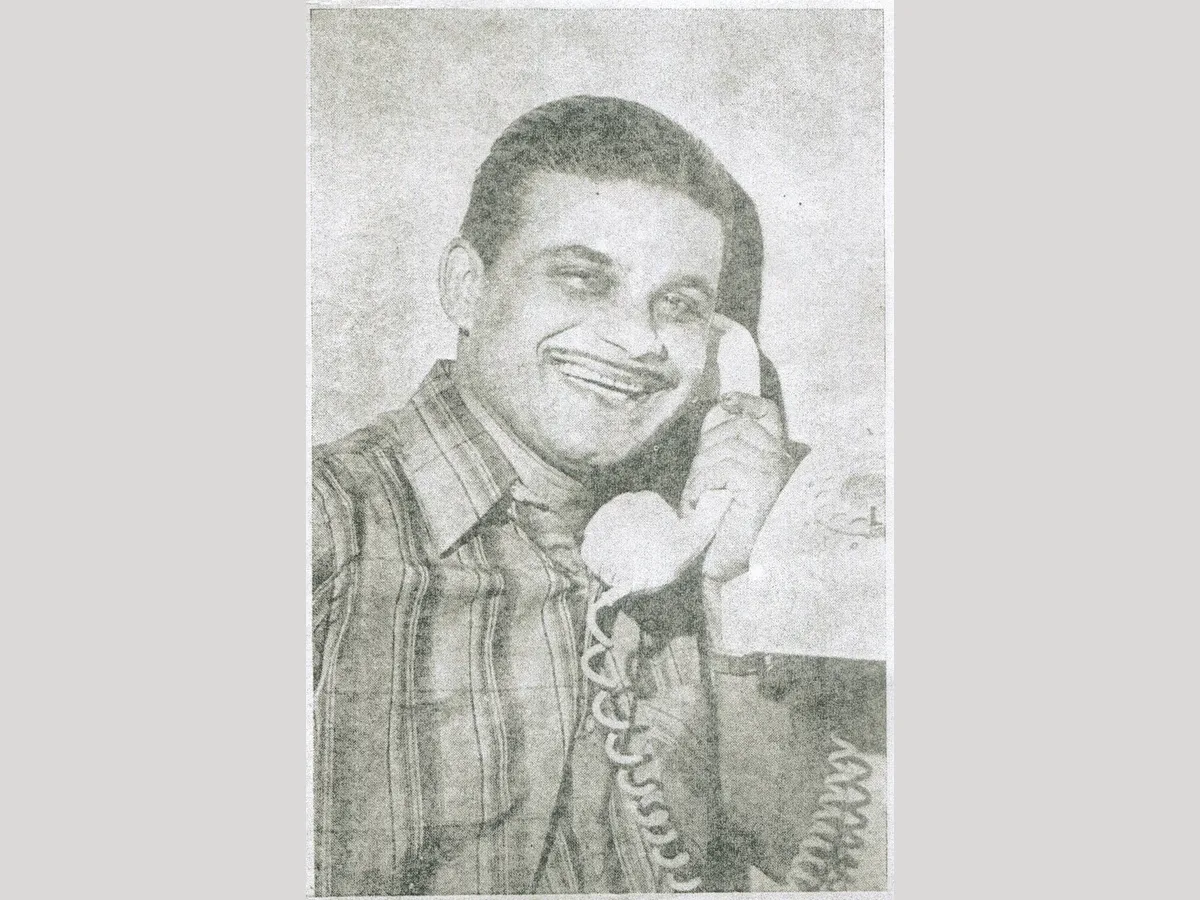
Ceylon were playing a visiting Test side, the Sinhala service of Radio Ceylon had decided to carry the match, and Karunaratne Abeysekera was faced with a problem no announcer before him had faced: there were no Sinhala words for what was happening on the field. There was no word for a cover drive, a leg bye, a googly, a follow-on. So he made them. He sat down and built a cricket vocabulary out of Sinhala, and the words he invented are the words Sinhala commentators still use today, half a century later, most of them with no idea whose they were.
That was the shape of his working life. He arrived somewhere first, made the language for it, and then everyone else used the language.
Ratmale, and a boy on the radio
He was born on 3 June 1930. English Wikipedia's summary box says Colombo; the article's own text, the Sinhala Wikipedia entry, and the Daily News tribute by Ivan Corea all place his birth at Ratmale, near Matara in the deep south, and that is the version the family and his school have always given. He was educated at Nalanda College in Colombo, in a year group that also produced the writer Gunadasa Amarasekara, the cricketer Stanley Jayasinghe, the eye surgeon Hudson Silva and the dramatist Henry Jayasena. His Sinhala master there was U. A. S. Perera — better known to the whole island as Siri Aiya.
Siri Aiya presented Radio Ceylon's children's programme Lama Pitiya ("children's field"), and it was onto that programme, at about fifteen, that Karunaratne Abeysekera walked with his poems. He was a hit immediately. In 1950, aged twenty, he joined the panel of announcers at Radio Ceylon — a teenage broadcaster grown up into a professional one, which was then close to unheard of. In 1958 the Corporation sent him to London for specialist training with the BBC.
The voice
For the next two and a half decades he was simply what Sinhala radio sounded like. Colleagues remembered the appearance as much as the sound: hair combed back and glossy with Brylcreem, a thin moustache, sharp cheekbones, an immaculate bush shirt. He was an announcer, a compere of hundreds of public events, a dialogue writer, a poet and a writer of children's stories, several of which were published as books. He worked in close partnership with the English-service broadcaster Vernon Corea, one of the most productive pairings Sri Lankan radio has had. He was known across the country as Karu Aiya — big brother Karu.
His own children's programme, Lama Mandapaya ("children's pavilion"), did for others what Lama Pitiya had done for him. In 1956 a thirteen-year-old who had just won a gold medal at a verse-singing competition in Borella sang Budu Sadu on it; her name was Nanda Malini. Premakeerthi de Alwis, later the most-recorded lyricist of his generation, appeared on it after failing a Radio Ceylon audition. Ajantha Ranasinghe began by writing Buddhist songs for it as a schoolboy. A generation of Sinhala music has Lama Mandapaya somewhere in its first paragraph.
The SLBC eventually named Studio 5 after him.
Two thousand lyrics, and one number that can be checked
Almost every account of him repeats that he wrote over two thousand songs, a national record for a Sri Lankan lyricist. The figure comes from press tributes rather than from any register, and English Wikipedia has carried a "citation needed" tag against it for years, so it is best treated as an order of magnitude rather than a count.
One figure, though, can be pinned down, and it says more than the round number does. At a 2006 press conference for a concert of his songs, Latha Walpola — who sang more Sinhala film songs in the 1950s and 60s than anyone — said she had recorded about 550 film songs, and that more than half of them were written by Karu Aiya. One singer, one genre, one decade or two: nearly three hundred lyrics.
The songs themselves range absurdly widely. There is the tenderness of කිමද සුමිහිරියේ Kimada Sumihiriye for C. T. Fernando, who also set it; the Christmas carol බෙත්ලෙහෙම් පුරේ Bethlehem Pure and the Buddhist devotional බුදු සාමිනේ Budu Samine sitting in the same catalogue without embarrassment; the hill-country charm of උඩරට මැණිකේ Udarata Manike, set by the Hawaiian guitarist Patrick Denipitiya; the wry city songs he wrote for Nimal Mendis, මේ අවන්හලේ Me Awan Hale ("in this tavern") and මාස්ටර් සර් Master Sir; the working-man's complaint මං රික්ෂෝ කාරයා Man Riksho Karaya ("I am a rickshaw man"); and the patriotic නිදහස් කාහල නාදය Nidahas Kahala Nadaya ("the trumpet-call of freedom").
Two of them show how far his words travelled from him. Mangala Mohotha, the wedding song he wrote, was taken abroad by Mignonne Fernando and the Jetliners and became one of the most requested songs at Sri Lankan weddings anywhere in the world. And දිලීප පොඩි පුතූ Dileepa Podi Puthu ("little son Dileepa") began as a poem for his own child, was set by Clarence Wijewardena, and became the only Moonstones-era recording on which Wijewardena himself sang lead.
He won the Sarasaviya Award for his lyrics twice.
Virudu at the big match
He belonged to the Aganuwara Tharuna Kavi Samajaya, the young poets' society of the capital, and the poet in him never quite left the microphone. His brother remembered him singing virudu — the old Sinhala form of extempore praise-verse, chanted rather than sung — to add colour to the annual Ananda–Nalanda cricket match, in a style nobody else could copy. It is a small detail and a revealing one. The cricket vocabulary, the announcing register, the children's programme, the film lyrics and the virudu at a schoolboy match are all the same act: taking a classical Sinhala literary training and pointing it at whatever was happening that afternoon.
Nalanda's principal put it in institutional language at a memorial concert: Abeysekera "invented a new linguistic vocabulary not only for the art of announcing and songs of literature but for wider use." Listeners put it more simply. They said nobody else spoke Sinhala on air like that.
After
Karunaratne Abeysekera died on 20 April 1983, aged fifty-two. Colombo named a road after him. Nalanda's old boys have staged commemorative concerts — one in 2006, Sandawata Ran Taru, put twenty-five of his lyrics in front of thirty singers, among them Nanda Malini, Latha Walpola, Victor Rathnayake, Sanath Nandasiri, Sujatha Attanayake and Sisira Senaratne, with stand-ins singing the parts of those already dead.
His brother Daya Abeysekera, a journalist and actor, said the plainest thing anyone has said about him: his world was Nalanda College and the Broadcasting Corporation, and nothing else. It was enough. Every time a Sinhala commentator says the word for "cover drive", he is quoting a man who died in 1983.