
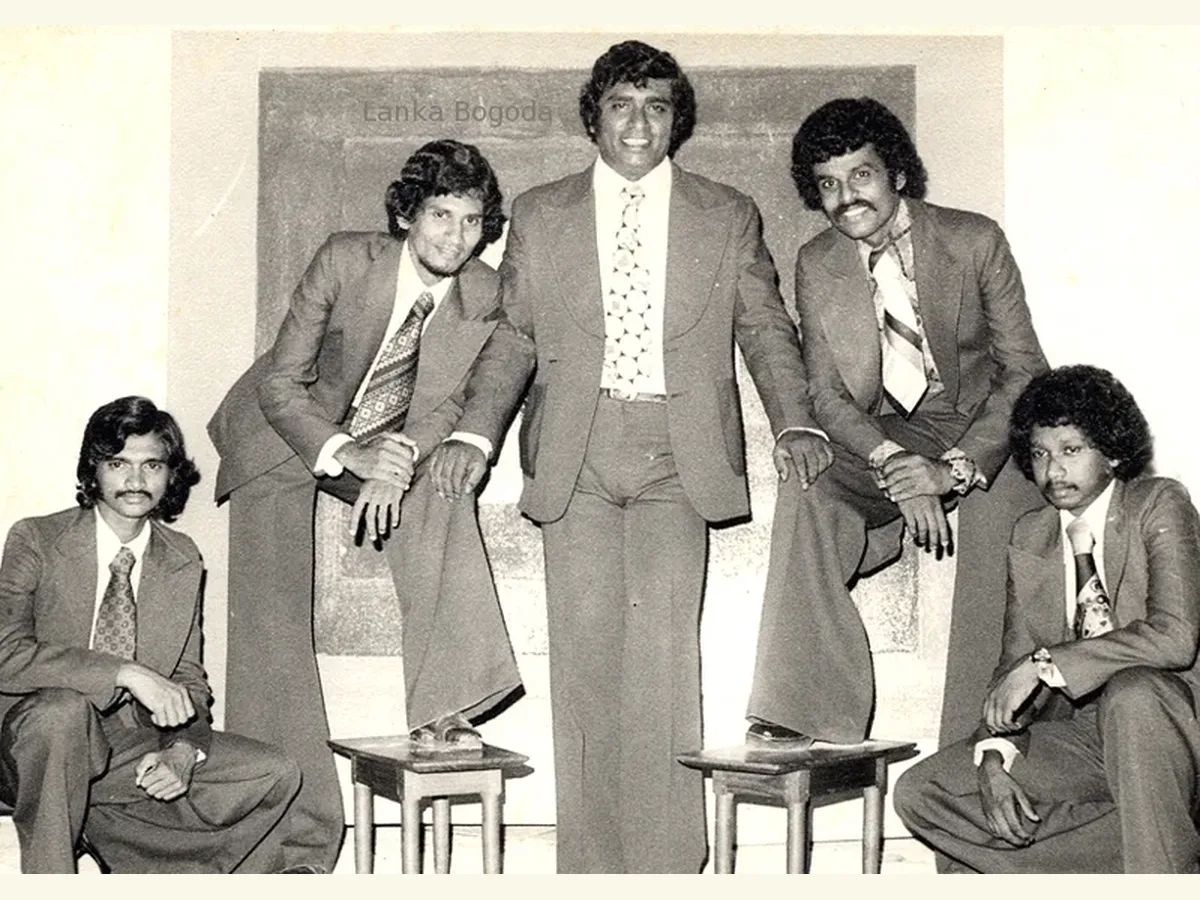
In 1970 a group of musicians took the stage in Moratuwa under a billing that was less a band name than a public notice: Breakaways from the Moonstones. The most popular Sinhala guitar band in the country had just come apart, and three of its members — the guitarist and songwriter Clarence Wijewardena, the bassist Chanaka Perera and the drummer Wijith Peiris — wanted the audience to know exactly who they were before a note was played. The audience approved. Gerald Wickremesooriya of Sooriya Records gave the new group a proper name, and the Golden Chimes existed.
What happened next is one of the most reliably garbled stories in Sinhala popular music, so it is worth being slow and exact about it. There are two bands here, not one. They overlap, they share a founder, and only one of them still exists.
Breakaways from the Moonstones
Chanaka Perera had started out in 1965 with a Colombo dance band called the Beacons — Laksiri Wijepala on guitar, Perera on bass, Sunimal Peiris on Hawaiian guitar, Nihal Corea on drums, Donald Perera on mandolin — playing the same dance circuit as the Jetliners, the Spitfires and the Harold Seneviratne Combo. He and the drummer Wijith Peiris joined the Moonstones in late 1967, in time for the run of records that made Wijewardena and the singer Annesley Malewana household names.
The Moonstones broke up in 1969, and the Moratuwa show followed in 1970. Anton Goonatilleke, another old Beacon, filled in on lead guitar that night; when a permanent player was needed, Wijewardena brought in Dixon Gunaratne, whom he had heard playing at a wedding. The line-up that Sooriya named the Golden Chimes was Wijewardena on rhythm guitar and vocals as leader, Chanaka Perera on bass and vocals, Gunaratne on lead and Wijith Peiris on drums.
Then came the voice the band is remembered for. Lankika Perera joined, and the debut EP on the Sooriya label carried කිමද නාවේ Kimada Nawe ("why did you not come?") along with Mage Pelpathe, Sihin Sinawai (සිහින් සිනාවයි, "a faint smile") and Samanalayo ("butterflies"). The singer Anil Bharathi joined soon after, and with him came Iru Dina, Maa Adarei Nangi, Sandai Tharui, Malai Welai, Sudu Menike, Bethlehem Pure, Kiri Muhuda and Muhudu Rella. A second EP on Philips held Malai Velai, Sihil Nuwan, Surangana Vesvala and Mage Viyowen; a third carried Iru Dina, Sandai Tharui, Muhudu Rella and තක්කිට තරිකිට Thakkita Tharikita.
Sources genuinely disagree about when the band began. The Sunday Times, in two separate features, treats the Moratuwa show and the naming as 1970 — the band's thirtieth anniversary fell in 2000 and its forty-fifth in 2015, which only works from a 1970 start. English Wikipedia, following a Sinhala newspaper account, dates the founding to January 1971 and names Wijewardena, Chanaka Perera and Lankika Perera as the founders. The two versions are reconcilable if the band formed in 1970 and Lankika joined in 1971, which is what the Sunday Times says happened; but the 1971 date is printed often enough that it cannot simply be waved away.
The band that never stopped
In 1972 — some accounts say 1973 — Wijewardena and Dixon Gunaratne left. This is the moment most retellings get wrong, because they treat the departure as the end of the Golden Chimes. It was not. Chanaka Perera took over as leader and has run the band ever since. Rukshan Perera came in on lead guitar and vocals and Lakpriya de Silva on guitar and vocals, and the group put out three more EPs carrying Molaketi Puthuni, Vishvasai, Mula Amathaka Aya, Dalada Perahera, Puthu Nidiyay and Sihininga Watakuru.
By 2000 the Golden Chimes had been going for thirty years and were working the resort hotels of the southern coast — the Riverina, the Neptune, Saman Villas — with a repertoire that had drifted a long way towards Western pop. Lankika Perera was still the female vocalist. In 2015 the band, by then billed as Lankika & the Golden Chimes, marked its forty-fifth year and Chanaka Perera's fiftieth in music with a sing-along concert at which every ticket holder was handed a booklet of some forty-five Golden Chimes lyrics. It is still a working band.
Super Golden Chimes
Only after leaving the Golden Chimes did Wijewardena form the group most listeners now think of first. The Super Golden Chimes came together in 1972 or 1973 — accounts differ — with Gunaratne alongside him, and this time Annesley Malewana came back. The old Moonstones partnership was restored, and the results dominated the decade: උඩ රට නිළිය Udarata Niliya ("the upcountry actress"), Wana Bambaro ("wild bees"), Sihina Pathum Wimane, Sathuta Sanasuma, Gamen Liyumak ("a letter from the village"). The band held the number one slot on the hit parades of both the Sinhala and the English services of Radio Ceylon and its successor the SLBC, an unusual double for a Sinhala-language act, and it played everything from dinner dances to the opening ceremonies of state corporations.
Sri Lankan accounts credit Wijewardena with topping the readers' polls run by the magazine Pop and Teen Fanfare in the mid-1970s, and his song Kataragama with winning that poll's best-song award for 1974. Those polls are poorly documented today and the figures should be treated as reported rather than established. What is certain is that the Super Golden Chimes were the reference point: the band that made "the Sinhala band" a format the whole country recognised.
The partnership lasted until Malewana stepped back in 1977 and married in 1978, at which point Wijewardena went solo. Malewana returned to performing in 1988 and in the 2000s formed Annesley & the Super Chimes, a separate and later group again.
Getting the order right
The lineage runs Moonstones → Golden Chimes → Super Golden Chimes. Two errors recur.
The first is skipping the middle band entirely, jumping from the Moonstones straight to the Super Golden Chimes as though the name had simply grown a prefix. The second, and more stubborn, is placing Annesley Malewana in the Golden Chimes. He was not in it. The detailed line-ups printed by the Sunday Times — Wijewardena, Chanaka Perera, Dixon Gunaratne, Wijith Peiris, then Lankika Perera and Anil Bharathi — do not include him, and neither does any Sinhala account of the band's founding. He sang with the Moonstones before it and with the Super Golden Chimes after it.
The confusion has an identifiable source. When Malewana staged his fiftieth-anniversary concert at the BMICH on 6 August 2016, it was promoted as a reunion of "the original members of Annesley's old bands — Moonstones, Golden Chimes and Super Golden Chimes", and the stage held Indrani Perera from the first, Lankika and Chanaka Perera from the second, and Dixon Gunaratne, Rukshan Perera, Paul Pereira and Sunil Malawana from the third. It was an accurate guest list and a misleading possessive, and the phrasing has been copied ever since.
Sooriya's house bands
Both groups belong to the story of Sooriya Records, the label Gerald and Dulcie Wickremesooriya grew out of the Children's Bookshop near the Fort clock tower in Colombo. Talent was found at weekly auditions at Gerald's house at 5 Sea Avenue, and the Golden Chimes and Super Golden Chimes sat on a roster alongside the Three Sisters, M. S. Fernando, La Bambas, Desmond de Silva, Milton Mallawarachchi, the Dharmaratne Brothers and the saxophonist Stanley Peiris. Indrani Perera, who had sung Dilhani with the Moonstones, recorded with the Golden Chimes in 1973 — මතකය ඇසුරින් Mathakaya Asurin and හා හා හෝරේ Ha Ha Hore, issued on the Lotus label.
Between them the two bands account for a large slice of what a Sri Lankan means by "the old songs". That the two are constantly merged into one is a small injustice to the musicians of the first, who are still on stage.