
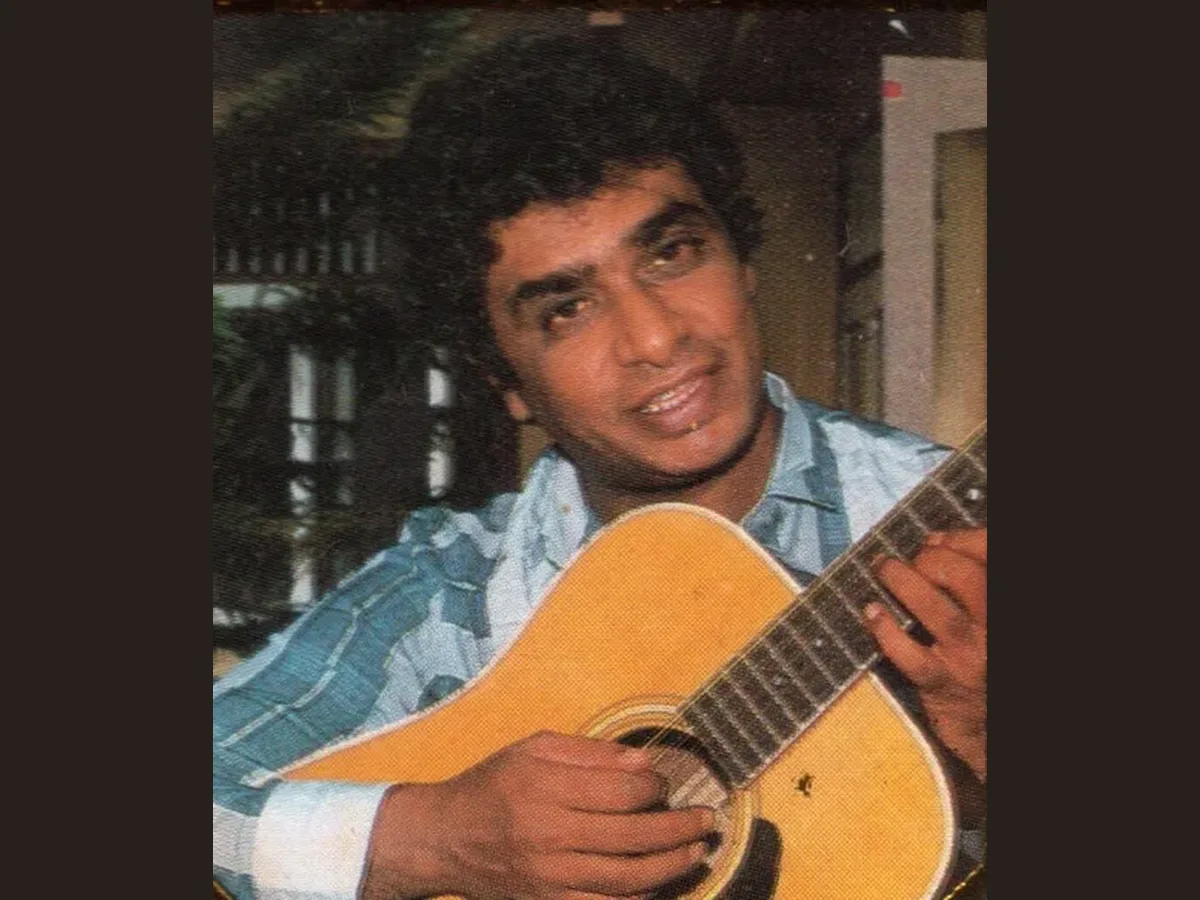
Their first record was an EP with four songs on it, pressed on the Philips label in 1968, and it sold about five thousand copies. Anywhere else that would be a modest number. In Ceylon, where Sinhala group music barely existed as a commercial category and the state broadcaster gave it a sliver of airtime, five thousand copies was a signal. The band was called the Moonstones. The songs were Mango Nanda, Ruwan Puraya, Seetha Ude and Menike. And the young man who had written the tunes and played the guitar on them had, not long before, been on his way to becoming a tea planter.
The estate boy who chose the guitar
Clarence Wijewardena was born on 3 August 1943 at Brampton Estate in Haputale, up in the tea country, where his father worked as an estate medical practitioner. The family later moved to Batugedara, near Ratnapura. He went to school at Weeraparakrama College in Yatawatta and at Highland College in Hatton — an upcountry education that pointed him straight at the plantations, and for a while he did begin a career as a planter before abandoning it for music.
He taught himself the guitar. That detail matters, because almost everything he later did with the instrument was worked out by ear rather than inherited from a teacher. His idea, when he began, was small: a three-piece band. What he ended up building was an entire commercial ecosystem for a kind of Sinhala song that had not previously had one.
Mango Nanda and the Moonstones
Accounts differ on exactly when the Moonstones came together. The most common telling has Wijewardena forming the band at the age of twenty-one, which would put it around 1964 or 1965; other accounts place it as late as 1966, the year their recordings began going out on Radio Ceylon's Saturday Star programme. Annesley Malewana sang lead. The advertising man Sri Sangabo Corea managed them, and the broadcasters Vernon Corea and Vijaya Corea gave them the radio exposure that a Sinhala group could not otherwise get — a family intervention that changed what was possible for the whole genre.
After Mango Nanda came More Hits by the Moonstones in November 1968, this time on the new Sooriya label, carrying Kalu Mama, Rosa Male, Ramani and Goyam Kapanawa (ගොයම් කපනවා — "reaping the paddy"). In 1969 the singer Indrani Perera joined and took the lead on Dilhani. Wijewardena sang lead himself only once in the Moonstones era, on දිලීප පොඩි පුතූ Dileepa Podi Puthu ("little son Dileepa"), adapted from a poem the broadcaster Karunaratne Abeysekera had written for his own child.
He left the band in 1970 — some accounts say 1969 — and played a show in Moratuwa billed, pointedly, as "Breakaways from the Moonstones". Mike Goonesekera took over the group he had left behind.
Golden Chimes, and then Super Golden Chimes
What happened next is often compressed into a single step, and it should not be. In January 1971, Wijewardena formed a new band called the Golden Chimes, with the ex-Moonstones bassist Chanaka Perera and the singer Lankika Perera. Their first release carried කිමද නාවේ Kimada Nawe ("why did you not come?"), Mage Pelpathe, සිහින් සිනාවයි Sihin Sinawai ("a faint smile") and Samanalayo. The vocalist Anil Bharathi joined soon after, and Wijewardena wrote Ada Wei Iru Dina, Bethlehempure and Tikirimalee for him. At a wedding, he heard a lead guitarist called Dixon Gunaratne and recruited him.
Only in 1972 did Wijewardena and Gunaratne leave to form the Super Golden Chimes, with Annesley Malewana rejoining them in 1973. The Golden Chimes did not dissolve into the new band; it is a separate group that has continued to exist. Any account that jumps from the Moonstones straight to the Super Golden Chimes has skipped a band.
The Super Golden Chimes were, for most of the 1970s, the biggest group in the country, topping charts on both the Sinhala and English services of the broadcaster. Wijewardena went solo after about three years, when Malewana announced he was getting married.
A collector of firsts
Much of what Wijewardena is credited with is technical, and unusually well documented for Sinhala pop of the period. He put a sitar into Moonstones arrangements. He was the first in the country to run a guitar through a wah-wah pedal on a recording, for the song Pemkathawa. His Sigiriya is described as the first song in Sri Lanka built on a bossa nova beat, a rhythm he then reused on මාලිනියේ Maliniye, Mage Palpathe, Muhudu Rella and Piyaneni. He used twin lead guitars in counterpoint, a blocked guitar tone on Kusumalatha, single-guitar harmony on Dileepa Podi Puthu and arpeggios on සිහින ලොවක් Sihina Lowak ("a world of dreams") and මලට බඹරෙකු සේ Malata Bambareku Se ("like a bee to a flower").
He joined Sing Lanka Ltd. as general manager; its studio was the first multi-track recording facility in Sri Lanka. He also gave an artist's evidence to the framing of the Code of Intellectual Property Act No. 52 of 1979 — a piece of unglamorous work whose absence would later be felt by his own family.
Films, teledramas, jingles and after
He entered cinema with H. D. Premaratne's Sikuruliya in 1975, whose soundtrack the Golden Chimes supplied and in which the band appears on screen; Wasanthaye Mal Kekulay, sung by Indrani Perera, came from it. He scored Premaratne's Apeksha in 1978. On television he wrote all six songs for the serial Susima, including දෑස පියාගත් කල Desa Piyagath Kala, and for Nidikumba Mal he composed Sasara Gewa Yana for W. D. Amaradeva to sing — a striking pairing of the pop pioneer with the towering figure of the classical tradition.
And he wrote jingles: Elasto, Bata, Astra, Arpico, Singer, Atlas, Edna. A generation that could not name a single song of his could hum three of his advertisements. When Sri Lanka gained Test status in 1982 he produced an album, Test Cricket Souvenir, and the song Thana Nilla Dige became a fixture of big-match season. In 1985 he put together a band called Madhara, with Rookantha Gunathilake and Mariazelle Goonetilleke among its members.
Clarence Wijewardena died on 13 December 1996, aged fifty-three. Sources give differing accounts of the illness that killed him, and this article does not choose between them. His widow, Sheela, spent years in unsuccessful litigation trying to establish rights over his catalogue — an irony, given his own contribution to the copyright law of 1979.
His songs did not fade. They are still on radio, still covered, still learned by teenagers on cheap guitars; and in June 2025 a biographical film, Rhythm of the Guitar: Clarence, was released across the island. Songs sometimes attributed to him in casual retellings — Gopalu Handa and Kandulella among them — have no source behind the attribution, and are best left out of the list. He wrote enough.