
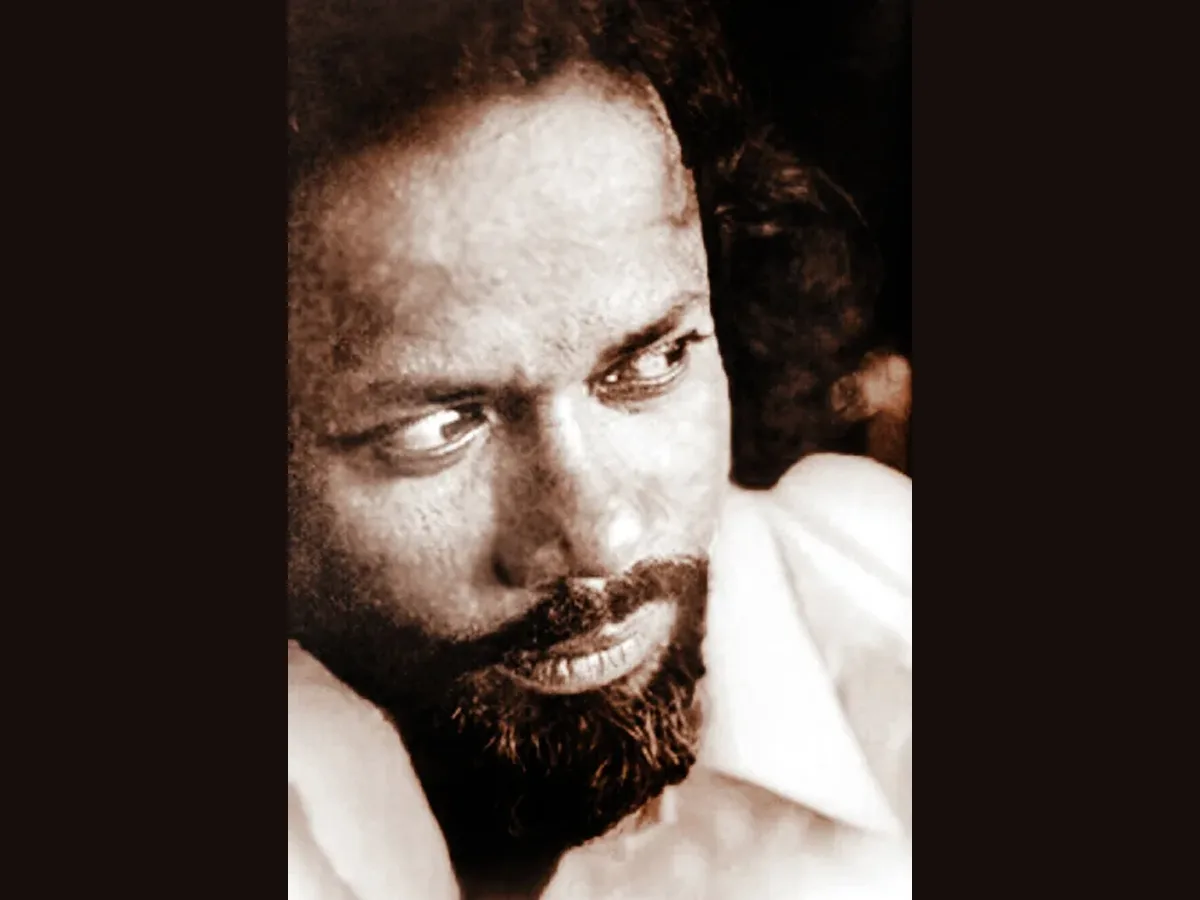
Before he wrote a single hit, people knew the voice. It came out of the loudspeaker at the start of a Radio Ceylon programme, low and unhurried, and it belonged to a schoolboy from Kurunegala who had talked his way into the studios while he was still at Ananda College. He announced under the name Ananda K. Wijethunga then. By the time he was writing the songs that made him famous, he had swapped the first name for his second and become Bandara K. Wijethunga — and the voice had become a career, a livelihood, and eventually the thing the state took away from him.
Pallegama to Ananda College
Senarath Bandara Ananda Kulathilaka Wijethunga was born on 28 January 1939 at Pallegama, Weliganwatta, in the Weuda Korale of Kurunegala District. His father, Wijetunga Mudiyanselage Punchi Banda Wijayatunga, was a schoolteacher; his mother, Herath Mudiyanselage Bandara Menike Herath, kept the house. His only sister, Chinta Padmini, became a teacher too.
His first schooling was at St. Bede's College, Badulla. In 1953 he moved to Ananda College in Colombo to study in the English medium, and landed in one of those school years that Sri Lanka would keep hearing about for the next half-century: his classmates included the linguist J. B. Disanayake, the film-maker D. B. Nihalsinghe, the academic Sunanda Mahendra, Asoka Ponnamperuma and the broadcaster Wijeratne Warakagoda.
He was already writing and drawing. He took first place in the inter-school art exhibition in 1957, and in 1958 edited both the Sinhala magazine Sinhala Lamaya and the English-language Enchanted. He also won the Sivaguranathan award for best autonomous design — a reminder that for years he was as much a designer and layout man as a lyricist.
The radio and the day job
Radio came first as a sideline and then as an identity. He began at Radio Ceylon as a relief announcer, filling in shifts, and made himself useful in print at the same time: he edited the souvenir brochures for films including Ran Muthu Duwa, Getawarayo, Saravita and Narilatha, and it was on those that the name Bandara K. Wijethunga first stuck. With Tissa Liyanasuriya and the director K. A. W. Perera he presented the radio magazine programme Radio Sangarava.
His salaried life ran alongside all of it. His first job was as a data officer in the Exchange Control Department of the Bank of Ceylon; later he was appointed publicity officer of the State Film Corporation, where the promotion of every Hindi film the corporation imported passed through his hands. He designed cover titles and film catalogues for Amaranath Jayathilake's Chithrapata Adyanaya and Ajantha Ranasinghe's Thivanka Rekha, wrote the poetry collection Neth Dahasa, worked as a dubbing artist on many film characters, and acted in Sweep Ticket (1965) and Titus Thotawatte's Handaya (1979).
Mahada Namathi Wana Bambara
The song that carried his name furthest was මහද නමැති වන බඹරා Mahada Namathi Wana Bambara ("the wild bee that is my heart"), sung by H. R. Jothipala. Around it sits a cluster of radio songs from the same years: රුවන් තොරන් තන Ruwan Thoran Thana and මුළු ලෝකේ පුර Mulu Loke Pura, both recorded by Christopher Paul, and Ayubowan Ayubowan by G. S. B. Rani.
He wrote for the serious end of the repertoire as well as the popular one. ඇයගේ ඇකයෙහි Ayage Akayehi was recorded by W. D. Amaradeva and by Victor Rathnayake; සඟවා ගනු මැන Sangawa Ganu Mana went to Victor Rathnayake. Sinhala song catalogues also list සමන් මල් පියල්ලේ Saman Mal Piyalle, ඔබයි මමයි මැවූ සිහින Obai Mamai Mewu Sihina, ඔබ වෙනුවෙන් මා Oba Venuwen Ma and මගේ සෙනෙහස Mage Senehasa under his name. Sanath Nandasiri, Milton Mallawarachchi, Neela Wickramasinghe and Sunil Edirisinghe all sang his words.
The petition
In October 1980 the former prime minister Sirimavo Bandaranaike was stripped of her civic rights. Artists circulated a petition against it, and Wijethunga signed.
What followed is the hinge of his life. Radio stopped broadcasting the songs of the signatories and stopped reading out their names, and Wijethunga lost both his radio work and his publicity work for the National Film Corporation. It was not a formal blacklist published anywhere; it was a set of individual doors closing, which is how this kind of thing has usually worked in Sri Lankan broadcasting. Some years later, according to the Sinhala press, he was brought back under the guidance of Nihal Silva.
The years in between damaged him. The Sinhala daily Dinamina, in a memorial piece, states plainly that after losing his radio job he began to drink. It is the only detail of his private life that his obituarists dwell on, and they dwell on it because they saw it as the cost of the signature.
Awards, and a name still winning prizes after death
His film lyrics kept working. He wrote for Podi Malli, Sri Madara, Sudda, Asha Dasin, Biththi Hathara and Madhusamaya, among some thirty films between 1966 and 1993, and took the Best Lyricist award at the Presidential Film Festival for Ridee Nimnaya — English Wikipedia dates the award to 1984, while the films.lk cinema database records it at the 5th Presidential Awards ceremony held in 1983 for the 1982 film. Accounts also differ on which song from Madhusamaya (1991) took the Best Lyricist prize at the 20th Sarasaviya Awards in 1992: Wikipedia names "Sagara Weralaka Piya Satahan", while films.lk credits මාද ඔබම විය Mada Obama Viya. The same film won him a Best Lyricist award at the 4th Swarna Sanka ceremony in 1992 as well.
He did not see either of those. Bandara K. Wijethunga was admitted to hospital at midday on 3 January 1990 and died around five that evening, after a short illness, at the age of fifty. He was cremated at Borella Cemetery on 6 January. In 2001 his collected lyric writing, Sulanga Wage Awidin, won a State Literary Award — a prize handed to a body of work eleven years after the man who made it had gone.