
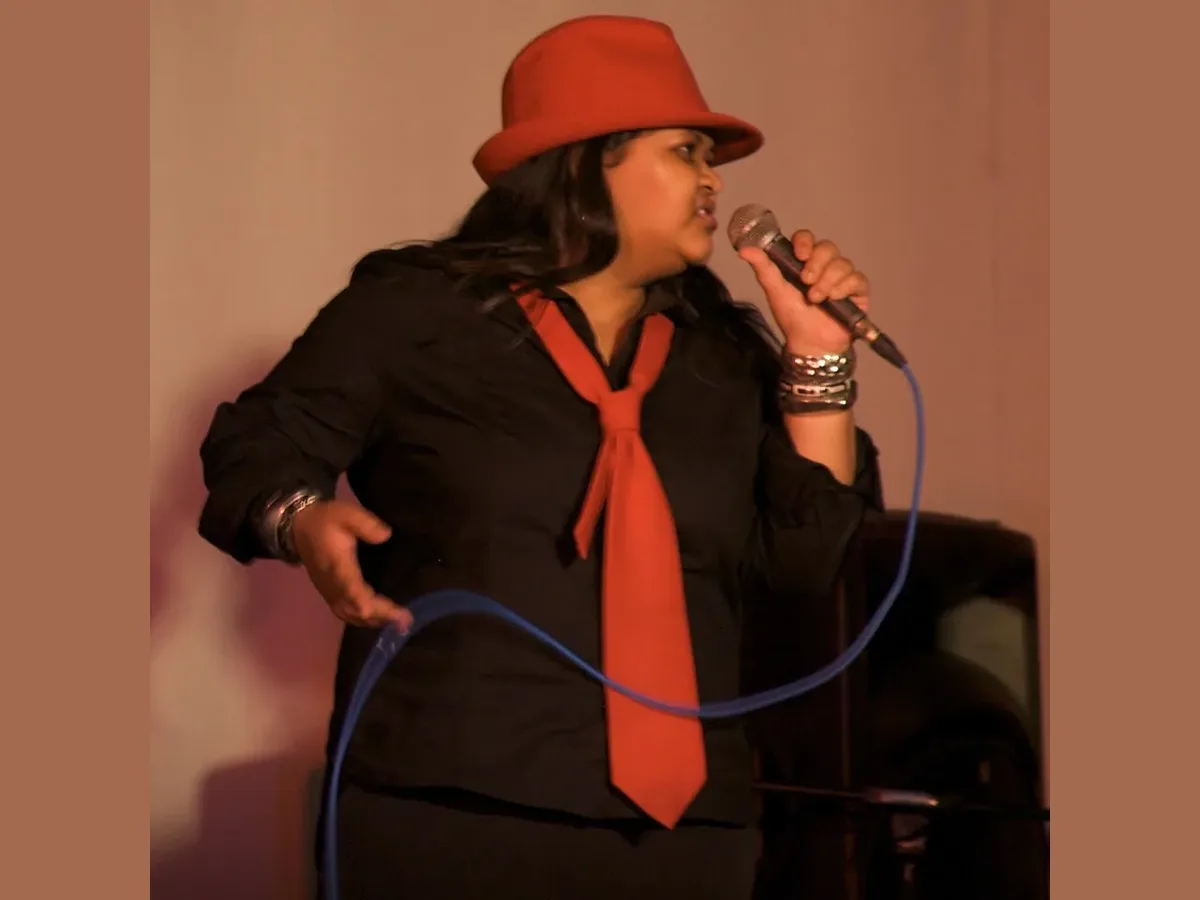
By the middle of the 2000s Sri Lankan hip hop had a shape and the shape was male. The producers were men, the rappers were men, the acts young people copied were men. The one voice inside that scene that was not was Ashanthi De Alwis — and she had arrived not as a novelty act but as the rapper in the country's biggest pop group.
"When you look at youth hip hop music in Sri Lanka," she said in 2006, "it is evident that the majority of the music young people have to look up to is male. I feel that in this day and age, a girl needs to feel confidence and power in whatever she wants to do. She needs to feel that there are no boundaries."
The rapper in the boys' band
Her first prominence came through Bathiya and Santhush, whose records used a female rapper the way an American R&B track of the period used a guest verse — except that she was a fixture rather than a guest. That role is audible across the BnS catalogue and in the songs she still performs: රෑ තිස්සේ ඇවිල්ලා Ra Thisse Awilla, හන්තානේ Hanthane, පපරේ Papare, නෑනෝ Nano, රින්ග් රින්ග් Ring Ring.
The first album with her name on the sleeve was a duo record, Oba Magemai, made with Ranidu Lankage. Accounts of it differ in a way worth noting: English Wikipedia dates it to 2002 and describes it as released through M Entertainments, while its own discography and a 2006 Sunday Times interview with Ashanthi both put it at 2003 and name Sony as the label. What is not in dispute is that a Sri Lankan hip-hop duo in their early twenties had an international record contract.
She has also said, publicly and repeatedly, where the music came from at home: her mother, Antoinette de Alwis, was herself a singer in Sri Lanka's Western-music scene.
Sandawathuren
Sandawathuren, released in November 2006 with a launch on the 23rd, is the record the claim rests on: the first hip-hop solo album by a Sri Lankan woman.
It ran to fourteen tracks, twelve in Sinhala and two in English, and the description she gave of it at the time was "a soundtrack to life" — a deliberate mix of hip hop, R&B, pop, ballads, crunk, bhangra and, for local flavour, baila. She was its executive producer alongside Bathiya Jayakody, with Sri Shyamalangan Ranganathan co-producing; it was mixed and mastered at Saregama. The lyrics, which she conceptualised, were written by established Sinhala lyricists — Nilar N. Cassim, Wasantha Dukgannarala and Hemasiri Halpita — while melodies came from Bathiya, Sri Shyamalangan, Sarangan, Nawarathna Gamage, Eranga Jayawansa and Rajeev. That is an unusual credit list for a hip-hop record anywhere: a rapper in her twenties commissioning lyrics from the same writers who supply the art-song platform.
The album was not programmed end to end. "The day we were recording 'Aale'," she recalled, "the studio was completely free and I got to really play around with the harmonies." "Oba Ven Vi" was the slow one and the hardest to sing; "Get It Crunked", made with the young rapper Redrum, was pure rap. Live players ran through the record too — flute, violin, saxophone, ethnic drums, and cellos and violins from members of the Sri Lanka Youth Orchestra.
Two labels, and after
Sandawathuren came out under M Entertainment and Universal, making her, on the Sunday Times's account, the youngest female artist in the country to have been signed by two international labels. In 2008 Dialog took her on as a brand ambassador for its prepaid brand. In 2013 she won Best Hip Hop Video at the Derana Music Video Awards for අලවන්තියක් Alawanthiyak.
The English-language album Rock the World followed in 2013, aimed frankly at an international market and led by the single "Let's Give Peace a Chance", which was also cut in Sinhala with additional vocals by the Indian playback singer Benny Dayal. Daas Panawa came in 2014.
Music with a cause
The turn that changed the shape of her career began with curation rather than recording. Programming the music for the British Council's WOW — Women of the World — festival put her in a weekly room with women running social projects. "We used to meet once a week for about six months, and it was like a power women committee. I started getting passionate about things that affected women after meeting them."
When the festival ended and a Voices and Choices grant came up, she chose depression and suicide prevention, and made "Hitha Danne Mithuranne". The follow-up, "Rajiniye", took on harassment; the specific settings — public transport and the workplace — were arrived at by consulting people who work on gender-based violence, and the first video was made after consultation with psychologists.
The obstacle, she says, was not the audience. It was the industry: "With Hitha Danne Mithuranne, people were confused as to how to promote a song of this nature. We don't address our issues. We would rather come home and watch a comedy and laugh than watch something like this and face the thought that this might be us." Her verdict on the work is unambiguous — "Rajiniye, I feel, is one of the best songs I've produced personally" — and so is her intention to keep doing it: "I will always do it regardless of the commercial music I may make. It gives you, as an artiste, more substance."
The chair on the other side
Since 2020 she has been on the judging side of the business: a coach on the first season of The Voice Teens Sri Lanka on Sirasa TV, and in 2023 a judge on the eleventh season of Derana Dream Star. For a generation of Sinhala-speaking teenagers, the first woman they see occupying that chair as a hip-hop artist is the same woman who had to argue, twenty years earlier, that there was any room in the form for a girl at all.