
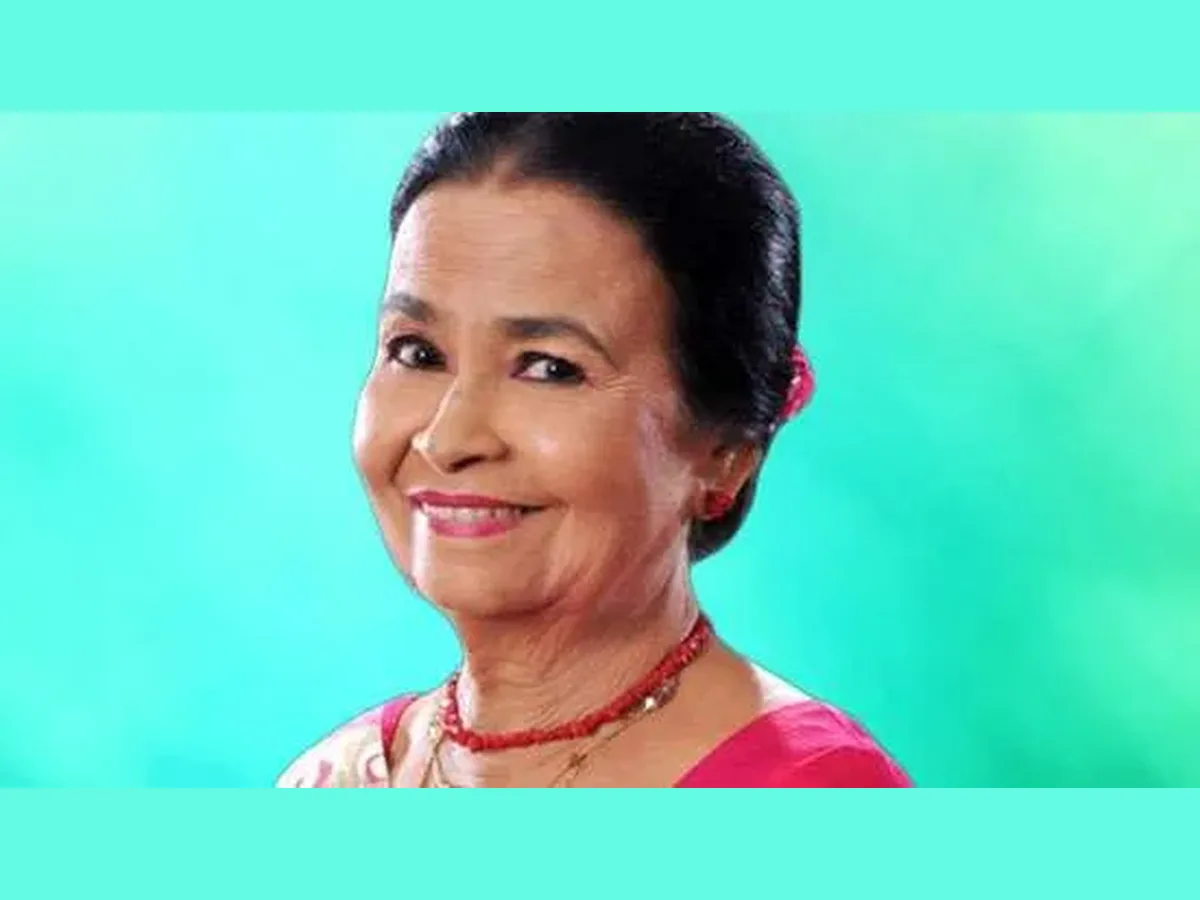
Sri Lankan film songs of the 1950s were mostly sung by Indian playback singers. The films were Sinhala; the voices were not. What changed that was a small group of Sinhala women who could do the job — hold a tune under a microphone, in character, to a scene they had not acted in — and by the reckoning of the musicologist Sunil Ariyaratne there were three of them at the front: Latha Walpola, Sujatha Attanayake, and a Catholic girl from Matara born Angelin Rachel de Lanerolle.
She is remembered as Angeline Gunathilake, and as the Silver Bell of Sinhala cinema; the Sinhala press called her the geetha kokilawiya, the song-nightingale. For roughly forty years, whenever a Sinhala actress opened her mouth to sing, there was a good chance it was Angeline's voice coming out.
A second place at eight
She was born on 23 December 1939 in the Matara district, into a large family — Wikipedia and the Sinhala press make her the seventh of ten children, while the BBC Sinhala service's account of her life calls her the youngest daughter of seven; the accounts differ. Her father worked for the Ceylon Government Railway, and a transfer moved the family to Colombo when she was eight. She went to St. Mary's Convent in Matara and then to St. Thomas' College, Kotte.
At eight she entered a Radio Ceylon amateur programme and came second. That was enough to get her noticed, and it led to the thing that shaped her: she was taken as a pupil of Sunil Santha, the most rigorous and most difficult figure in Sinhala music, who was then at the height of his campaign for a Sinhala song built on Sinhala speech rather than on North Indian raga. Her famously exact pronunciation — Ariyaratne singled it out — comes from there. At thirteen she was selected for Karunaratne Abeysekera's children's programme Lamapitiya. She studied dance as well, under Panibharatha.
Sohoyuro, 1958
While she was on Lamapitiya she entered a singing competition called Tharu Thenuma, run by Sri Murugan New Art Films, and won it. The prize was a playback assignment. Her first film was සොහොයුරෝ Sohoyuro ("brothers"), released in 1958, and in the same year she recorded her first film duet, with Sydney Artigala. Her first solo record is given as Adara Ambare.
From there the work simply did not stop. She recorded for P. L. A. Somapala under the His Master's Voice label; she sang Buddhist songs with Mohideen Baig and Chitral Somapala for the 2500th Buddha Jayanthi commemoration; she sang Christmas records with C. T. Fernando under the influence of Father Marcelline Jayakody; she cut baila duets with Wally Bastiansz; she sang virindu for the 1958 film Deyyange Rate. A Catholic woman from Matara singing Buddha Jayanthi hymns and Christmas carols in the same career is not a contradiction anyone in the industry seems to have remarked on at the time, which is itself worth noticing.
Her filmography runs from 1958 to a credit in 2017 — well over two hundred films — and the list of actresses she sang for reads like a history of Sinhala cinema: Leena de Silva, Florida Jayalath, Sandya Kumari, Jeevarani Kurukulasuriya, Malani Fonseka, Geetha Kumarasinghe, Swarna Mallawarachchi, Anoja Weerasinghe, Sabeetha Perera, Dilhani Ekanayake. Her duets with H. R. Jothipala are the ones people still hum.
How many songs?
The figure attached to her in almost every obituary is "over 5,000 playback songs" across nearly six decades. It should be treated as an attribution rather than a count: nobody has published a discography, output totals in this subject are notoriously inflated, and Ada Derana's own death notice took a very different line, naming "more than 30 iconic songs" and listing three — මියුරු පෙම් මදිරාවේ Miyuru Pem Madirawe ("in the sweet wine of love"), සරා සඳේ Sara Sande ("autumn moon") and පාට පොදක් තිලකලා Pata Podak Thilakala, the last of these to a lyric by Ajantha Ranasinghe. Others still sung include Raththaran Pem Purane, Kuweniye Ma and Chandra Mandale. Somewhere between thirty landmark records and five thousand sessions is the honest answer, and the gap between those two numbers is the measure of how badly this part of Sinhala music has been catalogued.
She held an A grade from the Sri Lanka Broadcasting Corporation, which in that system was the formal statement that she was among the best in the country.
The originals, and the argument about them
Much of the film music she sang was copied — Sinhala words fitted to Hindi and Tamil melodies, which is how the industry worked and what its critics never forgave it. Sunil Ariyaratne's assessment, given to the BBC on the day she died, makes the more careful point: alongside all those copies she sang original Sinhala compositions superbly, and it was the composers Premasiri Khemadasa and Sarath Dassanayake who recognised it and gave her that material. "They are the ones who had Angeline Gunathilake sing original songs and gave her a place to stand," he said.
He also placed her precisely. "If we consider her a lighthouse of an era, I think that would be correct. That era can be described, entirely, as the era of Latha Walpola, Sujatha Attanayake and Angeline Gunathilake." And on what she actually did at the microphone: "She pronounced words absolutely correctly. She sang from the correct registers. She never sang a false note in any song." Singing in character for a film, he added, is harder than singing for radio or a cassette, and she did it right.
Late years
She performed Angeline Rocks with The Boys at the BMICH on 9 August 2009, singing duets with a much younger generation — Shihan Mihiranga, Nalin Perera, Amal Perera, Dushyanth Weeraman — and gave another live concert at the same hall on 23 August 2014.
Latha Walpola, her exact contemporary and sometime rival, spoke to the BBC after her death with unusual candour. "Angeline and I went into film playback singing at the same time. She was a very skilful singer. Honestly, for a while there were small hurts between us. But later I went to see her." She said Angeline embraced her when she visited her in hospital, and that afterwards she went often. "She kept saying, let the two of us get better and do a concert together." They never did it. Walpola also said what a good many people in the industry believed: "In many instances I doubt whether she was given her due."
There is a detail in the Sinhala reports that is hard to shake. She married Leslie Gunathilake on 29 March 1966. She died at the National Hospital in Colombo on 29 March 2019, aged seventy-nine — fifty-three years to the day. She was buried at the General Cemetery, Borella, on 2 April.
Ariyaratne, asked whether her death was the end of an era, said it was, and the beginning of another: there are excellent young singers who came up in the light of that generation. "It might take five of them to fill this gap," he said, "but we should be glad that there are five."