
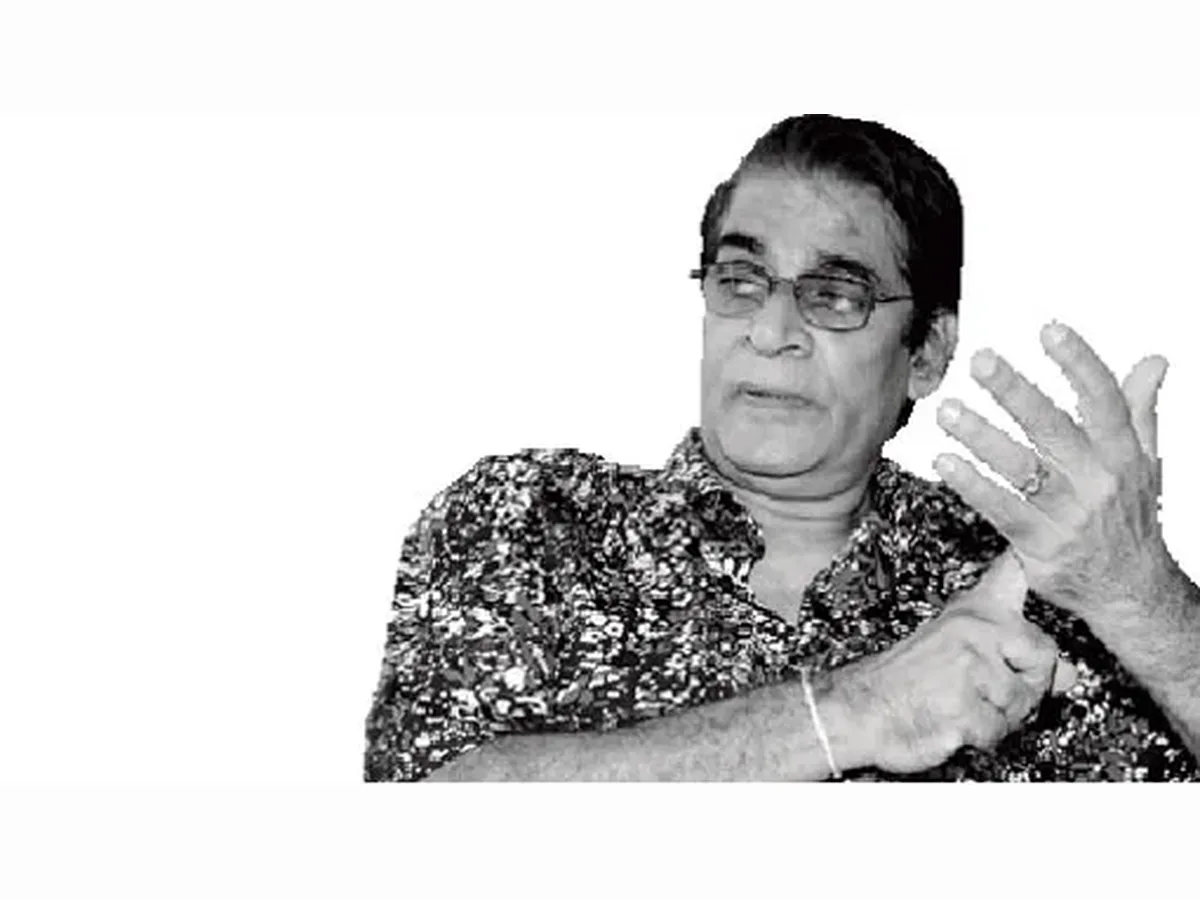
He was still in school when his verses first went out over Radio Ceylon. The programme was Lama Mandapaya, the children's hour presided over by the announcer Karunaratne Abeysekera, and the boy from Thalammahara was sending in Buddhist songs. It is an unglamorous way to begin — devotional verse for a children's slot — but it set the pattern for everything that followed. Ajantha Ranasinghe wrote to order, to a deadline, for whoever needed words; he did it for more than forty years; and he did it while holding down a full-time newspaper job that eventually made him an editor at Lake House.
By the end he had written more than four hundred songs and lyrics for close to sixty films, and had taken the President's Award for Best Lyricist three times.
Thalammahara to Nugegoda
Senanayake Mudianselage Ranasinghe Arachchilage Ajantha Sarath Kumara Ranasinghe was born on 30 May 1940 in Thalammahara, a village in the Kurunegala district, the second of five children. His father was a doctor; his mother was both a teacher and the village postmaster, which in a Ceylonese village of the 1940s made her one of the two or three people through whom the outside world arrived. (The infobox on his Wikipedia entry carries a stray 1941 in its death-date calculation; the body of that entry, the Sinhala Wikipedia article and the Sarasaviya obituary all give 30 May 1940.)
He was schooled first at Pannala Government School and then, after the family moved to Colombo, at St. John's College, Nugegoda, which he left after his Ordinary Levels. His uncle Asoka Pieris was a well-known dramatist, and it was through him that the boy got near a microphone at all. Alongside Lama Mandapaya he took part in Radio Magazine, a programme run by the film director K. A. W. Perera — a connection that would matter later.
Twenty-five years at Lake House
The writing career began in print, not in music. Poems and short stories for the children's pages of Silumina and Peramuna led to poetry in Silumina, Vanitha Viththi and Lankadeepa, and in 1964 to his first book, the poetry collection Thiwanka Rekha. He was taken on as a staff reporter at Dinamina and worked his way steadily up the masthead: sub editor, local news editor, provincial news editor, additional chief sub, chief sub, features editor of Janatha, and finally editor-in-chief of Nawayugaya. Twenty-five years as an editor at Lake House, in an era when Lake House was the country's newspaper industry.
He also passed the Radio Ceylon grading panel as a B-grade singer, a detail that says something about how he heard the lines he wrote. And he later served as a consultant to the Sri Lanka Broadcasting Corporation, closing the circle with the station that had first put a schoolboy's Buddhist verses on air.
The songs
His film work is generally dated from Wasana in 1976, and once it started it did not stop: six films in 1976 alone, seven in 1979, eleven in 1983. But the songs that outlasted the films were the ones he wrote for the concert and radio repertoire, and the list of collaborators is a roll-call of the period.
For Amaradeva, with music by Premasiri Khemadasa, he wrote හන්තානේ කඳු මුදුන Hanthane Kandu Muduna ("the crest of the Hantana hills"), පාලොස්වක සඳ Paloswaka Sanda ("the fifteenth-night moon") and Wikasitha Pem; for the same singer, with Stanley Peiris, තරු අරුන්දතී Tharu Arundathi, named for the small companion star of the Great Bear that Sinhala wedding custom asks the couple to look for. ගමේ කෝපි කඩේ Game Kopi Kade ("the village coffee shop") is his, with Khemadasa's music. So is පාළු සුසානේ Palu Susane ("the desolate graveyard"), sung by H. R. Jothipala — proof, if it were needed, that the same pen served the art-song platform and the commercial film studio without changing register.
With Clarence Wijewardena he wrote දෙගොඩ තලා Degoda Thala, Piyum Neela Wila and Kunda Saman for T. M. Jayaratne, and Pem Rajadahane. With Victor Rathnayake came Asha Nirasha Mawu; with Sanath Nandasiri, ආදර සැමරුම් Adara Samarum; with Dayarathna Ranatunga, කිරි කවඩි සිනා Kiri Kawadi Sina and සැලලිහිණියෝ Salalihiniyo ("the mynah birds"), the latter sung by the classical vocalist Amara Ranatunga. Milton Mallawarachchi sang his Dawasak Thiyewi and වීදි කොනේ Veedi Kone ("at the corner of the street"). Angeline Gunathilake, the great playback voice of the film era, sang පාට පොදක් තිලකලා Pata Podak Thilakala. As late as the 1990s Nirosha Virajini was recording his රෑ දොලොස් පැයේ Ra Dolos Paye.
On the counts: the figure repeated in every obituary is "more than 400 songs" and "nearly 60 films", and the National Film Corporation credits him with over 300 film lyrics from 1976. The Sinhala Wikipedia article says four thousand, which is plainly a slipped decimal. Take the four hundred, and treat even that as an estimate.
Doctorate, awards, and the end
He collected Sarasaviya, OCIC, State Literary, Raigam, Sumathi and Kumaratunga Munidasa awards, and the President's Award for Best Song Writer of the Year three times. In 1995 the International Open University in New Delhi gave him a doctorate, and he was Dr. Ajantha Ranasinghe thereafter. In 2014 the Editors' Guild of Sri Lanka gave him a Lifetime Achievement Award for journalism — the other half of his working life, which the song credits tend to swallow.
His songs were gathered and re-recorded twice for the collectors' market: Kalpana Vijithaya in 2002, the year a festival of his songs called Ajantha Geethavalokana was staged at the Sri Lanka Foundation Institute, and Ran Kenden in 2013. He published novels and collections alongside the poetry — Landuni Mata Varam Natha (1975), Vinkal Bass (1978), Kristhuni Karunakara Manawa (1995), Thunpath Rata, Sihina Kumara Saha Othamo (2009).
He was married to Sarojini Weeratunga, daughter of the singer Kokiladevi Weeratunga, and they had two children. On 24 February 2016 he was injured in an accident, and he died three days later at the Colombo National Hospital, on 27 February, aged seventy-five. He was cremated at Borella on 29 February.
The lyricist as newspaperman
There is a particular kind of Sinhala lyricist who came out of the newsroom rather than the university — Premakeerthi de Alwis is the other obvious case — and Ajantha Ranasinghe is the type at its clearest. He wrote quickly, to length, on subject, for money, and without visible strain between the devotional verse of his boyhood, the concert songs he gave Amaradeva, and the several hundred film lyrics that paid. The professional habits of a chief sub-editor turn out to be very good habits for a lyricist: know what the piece is for, get it in on time, and let it stand on its own.